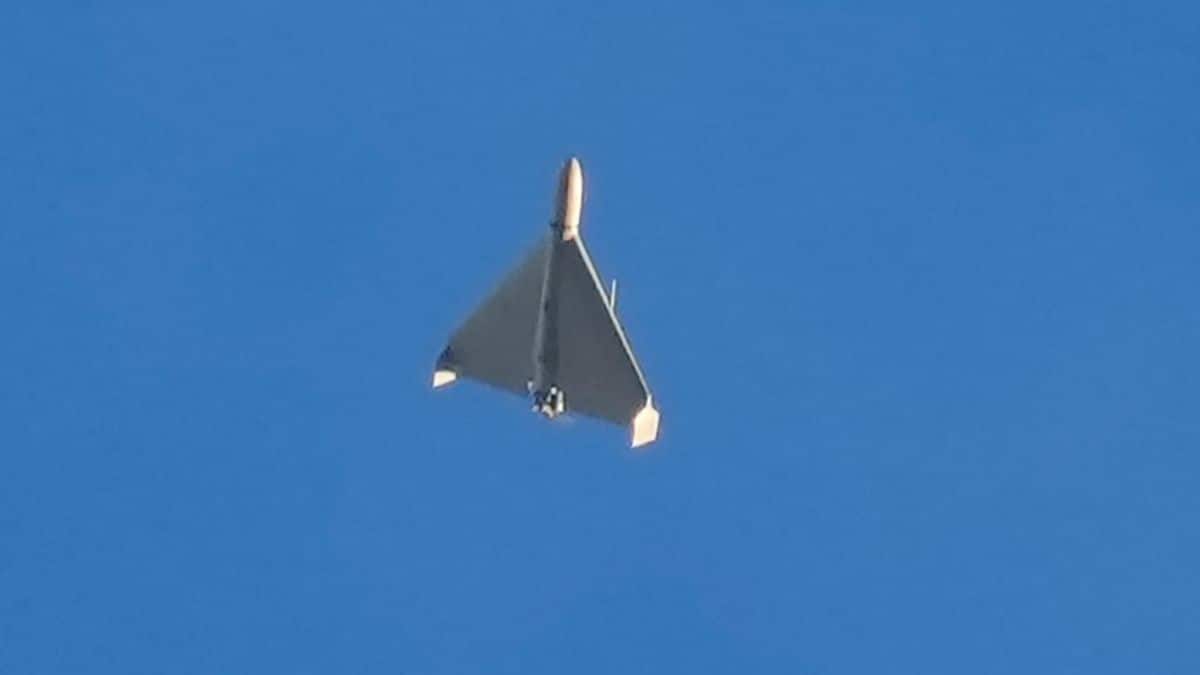
The buzzing sound over the Persian Gulf last week didn’t come from an Iranian factory. It came from Arizona. For years, the U.S. military scoffed at the "lawnmower with wings" approach to aerial warfare. They preferred $2 million Tomahawk missiles and $30 million MQ-9 Reapers. Then the Shahed-136 happened. Iran’s cheap, loud, and incredibly effective suicide drone changed the math of war in Ukraine and the Middle East, forcing the Pentagon into a humiliating realization: you can’t win a war of attrition if your bullets cost more than the enemy's targets.
So, the U.S. did what any pragmatic superpower does when it's being outspent by a smaller rival. It stopped trying to over-engineer a solution and started copying the homework of its adversary.
The birth of the American Shahed
It's called LUCAS. That stands for Low-Cost Uncrewed Combat Attack System. Don’t let the military acronym fool you; it’s a blatant, unapologetic reverse-engineered clone of the Iranian Shahed-136. Developed by an Arizona startup called SpektreWorks in partnership with the Pentagon, LUCAS made its combat debut on February 28, 2026, during Operation Epic Fury.
For the first time, U.S. forces struck Iranian targets using drones that looked, flew, and sounded almost exactly like the ones Tehran has been exporting to Russia. The ironies are thick here. We spent decades perfecting stealth and hypersonic tech, only to find out that a fiberglass triangle with a piston engine is the most "disruptive" thing on the 2026 battlefield.
Breaking the cost curve
War is ultimately a giant ledger of debits and credits. Before LUCAS, the U.S. was losing the math war. When Iran or its proxies launch a $35,000 Shahed, the U.S. typically responds by firing a PAC-3 Patriot interceptor. Those interceptors cost about $4 million a pop. You don't need a math degree to see that’s a losing strategy. You can be the richest country on earth and still run out of interceptors before the enemy runs out of cheap drones.
LUCAS changes that. By producing these "expendable" drones for roughly $35,000, the Pentagon is finally fighting on the same economic plane as its rivals.
How the two drones stack up
While they look like twins, the internal guts of the LUCAS drone reflect American industrial strengths.
- The Airframe: Both use a delta-wing design about 11 feet long. It's aerodynamically stable and incredibly easy to manufacture in non-aerospace factories.
- The Engine: They both use noisy internal combustion engines. They aren't fast—topping out around 115 mph—but they have a range of over 1,000 miles.
- The Intelligence: This is where the U.S. version pulls ahead. The Iranian Shahed is essentially a "dumb" cruise missile that follows GPS coordinates. If you jam the GPS, the drone gets lost. LUCAS uses vision-based object recognition. It can "see" a radar dish or a missile launcher and home in on it even if the GPS signal is totally blacked out.
- The Network: LUCAS is built on an open architecture that allows drones to talk to each other. Instead of just a wave of individual robots, you get a coordinated swarm that can adapt if one gets shot down.
Why reverse engineering was the right move
Some critics argue the U.S. should’ve built something more "advanced." They're wrong. In the current conflict, "advanced" is the enemy of "enough." The Shahed-136 design is already a proven winner. It’s hard to detect on radar because it flies so low and slow that many automated systems filter it out as if it were a large bird or a Cessna.
By skipping the five-year development cycle and just copying a design that works, the Pentagon moved at "Silicon Valley speed." Task Force Scorpion Strike, the unit now operating these drones, went from a concept to combat-ready in record time. It’s a shift from the "exquisite" hardware of the Cold War to the "attritable" hardware of 2026.
The production race is the new arms race
The real test isn't who has the better drone, but who can build them faster. The Trump administration has poured $1.1 billion into this "drone dominance" initiative. The goal is staggering: the Pentagon wants to be able to field hundreds of thousands of these one-way attack drones by 2027.
We’re seeing a total shift in how we think about "air power." It’s no longer just about having the best pilots or the stealthiest jets. It’s about having a bigger industrial printer than the other guy. Iran has a massive head start in mass-production, and Russia’s Alabuga facility is reportedly churning out thousands of Shahed variants (the Geran-2) every month.
The U.S. is playing catch-up, but it’s doing so by leveraging private startups like SpektreWorks and Anduril rather than relying solely on traditional defense giants who are used to decade-long timelines and billion-dollar overruns.
Tactical shifts on the ground
In the recent strikes in the Middle East, the U.S. used LUCAS drones to "soften" defenses before sending in more expensive assets. If a swarm of 50 cheap drones can force an enemy to empty their missile magazines, the following wave of F-35s has a much easier time.
It also provides a level of plausible deniability—or at least psychological symmetry. When an Iranian commander sees a Shahed-shaped silhouette screaming toward his command post, the message is clear: "Whatever you can do, we can do for $35,000 too."
What happens next
If you're following this space, stop looking for the next billion-dollar jet. Start looking at the companies that can build 10,000 units of "good enough" tech every month. The era of the "exquisite" weapon is ending, replaced by the era of mass-produced, disposable robots.
Your next move is to watch the "Replicator" program updates from the Department of Defense. That's where the real budget is shifting. If you're an investor or a tech enthusiast, the money isn't in the wings; it's in the autonomous software and the supply chain. The U.S. has finally realized that in a 21st-century war, being "too proud to copy" is just a fancy way of saying you’re willing to lose.