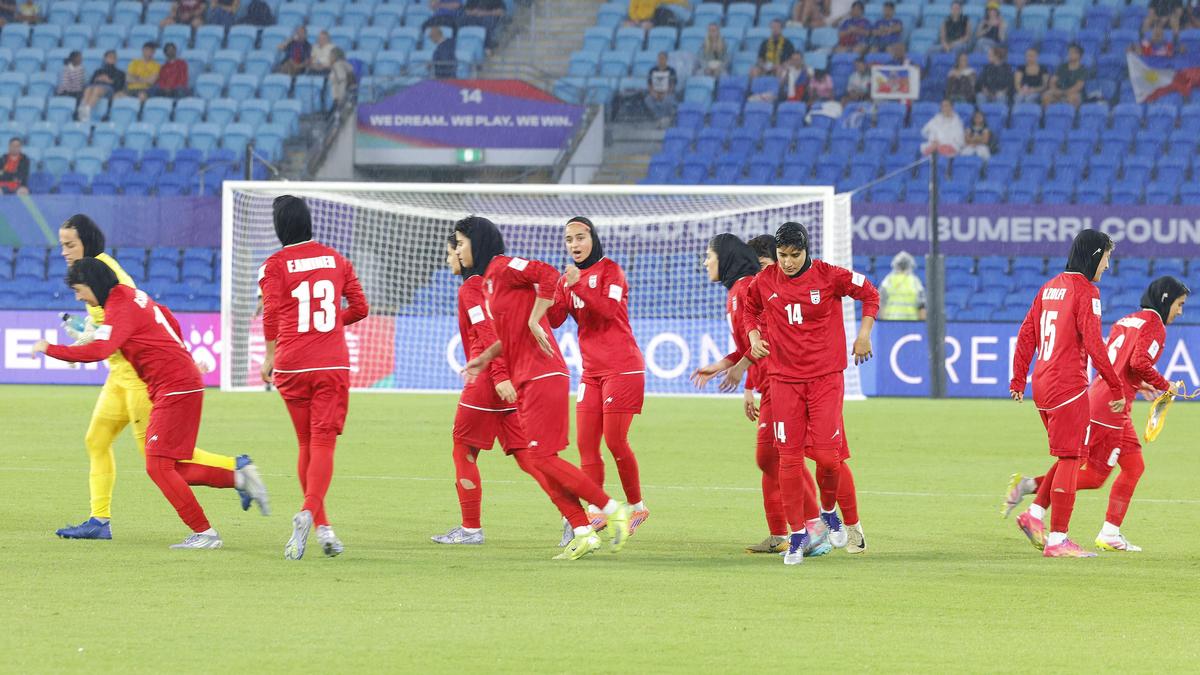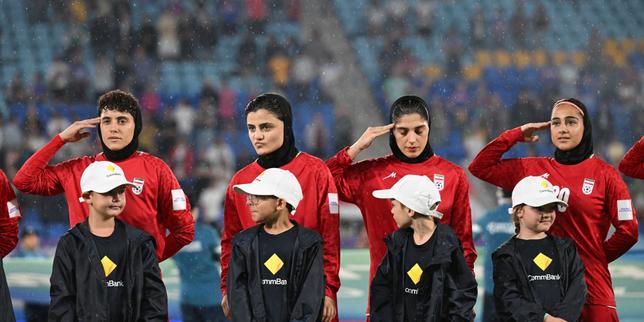
The grass under the floodlights of a Tehran stadium isn't just turf. To the women standing on it, the green expanse feels more like a tightrope. Every pass, every sliding tackle, and every goal celebrated is a quiet act of defiance that the rest of the world often mistakes for mere sport. When we talk about Iranian women’s football, we aren't just discussing offside traps or 4-4-2 formations. We are discussing the geography of fear and the persistent, nagging question of survival.
Consider a young woman—let’s call her Niloufar—tightening the laces of her cleats in a locker room where the air is thick with the scent of deep heat rub and unspoken anxiety. She isn't just worried about a torn ACL. She is wondering if a viral video of her celebrating without her headscarf properly adjusted will mean the end of her career, or worse, a visit from the authorities. This isn't a hypothetical anxiety; it is the atmospheric pressure of being an athlete in the Islamic Republic.
The Invisible Boundary Line
For decades, the story of women’s football in Iran was one of locked gates. The ban on women entering stadiums to watch men play was the most visible symptom of a much deeper malady. But the danger for the players themselves is more metabolic, woven into the very fabric of their daily existence. They play in a state of permanent contradiction. The government wants the prestige of international competition, yet it fears the liberation that sport inherently fosters.
In 2022, the death of Mahsa Amini changed the chemistry of the air. The "Woman, Life, Freedom" movement didn't just stay on the streets; it drifted into the stadiums. Suddenly, a jersey wasn't just a uniform. It was a political statement. For the national team players, the pitch became a minefield. If they showed solidarity with protesters, they faced bans. If they remained silent, they faced the wrath of a heartbroken public. They were squeezed between a state that demanded performance and a people that demanded a soul.
The danger isn't always a sudden arrest. It is the slow strangulation of opportunity. It is the "disciplinary committees" that summon players for their social media posts. It is the sudden cancellation of training camps because the "moral climate" isn't deemed appropriate. When the FIFA officials fly in for their scheduled inspections, the grass is cut and the smiles are practiced. Once the private jets leave the tarmac, the shadows return.
The Cost of the Game
We often look at sports as an escape from reality. In Iran, sports are where reality is most violently enforced. The "Blue Girl," Sahar Khodayari, set herself on fire in 2019 because she faced jail time for trying to enter a stadium. She wasn't even a player; she was a fan. If that is the price for watching, imagine the weight on the shoulders of those who dare to represent the nation on the field.
The danger is also financial and structural. Unlike the men’s teams, which enjoy significant state investment and corporate sponsorship, the women’s league survives on scraps. This isn't just about "pay equity" in the Western sense. It is about a lack of basic protections. When a female player is injured, she often has no insurance, no recourse, and no path back. If she speaks out about the lack of facilities, she is labeled a troublemaker. In a system where "troublemaker" can lead to a prison cell, silence becomes a survival strategy.
Consider the case of Zohreh Koudaei, the goalkeeper who was subjected to a humiliating gender verification demand by an opposing federation—a move many saw as a way to undermine the Iranian team’s success. While the world debated the ethics of the request, the Iranian authorities used her as a nationalist symbol. They protected her only as long as she served their narrative. The moment an athlete ceases to be a useful tool for the state's image, the protection vanishes like morning mist in the Alborz mountains.
A League of Their Own Making
Despite the looming threats, the quality of play continues to rise. This is the great irony. The more the state tries to domesticate these women, the more feral and determined their play becomes. They are technically gifted, tactically sharp, and physically resilient. They train in heat that would wilt most professional athletes, often in clothing that is restrictive and overheating, all to satisfy a dress code that has nothing to do with the mechanics of a bicycle kick.
The danger also extends to the coaches and the families. To support a daughter in her quest to be a professional footballer in Iran is to invite scrutiny upon the entire household. It is a collective gamble. Every away game is a lesson in logistics and a test of nerves. Will the passports be confiscated at the airport? Will a government minder report a private conversation overheard in the hotel lobby?
The international community, led by FIFA, has a history of performing a delicate dance of "meaningful dialogue" while the status quo remains largely untouched. There are occasional concessions—a few thousand women allowed into a specific section of a stadium for a high-profile match—but these are often choreographed performances for the cameras. The fundamental danger—the legal and social vulnerability of the women who play—remains.
The Weight of the Jersey
What does it feel like to score a goal for a country that is currently arresting people who look just like you? That is the emotional core of the Iranian footballer's journey. It is a bifurcated existence. On one hand, there is the pure, primal joy of the sport—the ball hitting the back of the net, the camaraderie of the huddle, the exhaustion of a ninety-minute shift. On the other, there is the crushing realization that you are a representative of a system that views your very presence on the field as a concession at best and a sin at worst.
The stakes are invisible until they aren't. They are the phone calls that go unanswered. They are the sudden "retirements" of stars in their prime. They are the players who seek asylum the moment their team lands in Europe or Australia, choosing the lonely life of a refugee over the gilded cage of the national squad.
Every time an Iranian woman steps onto that pitch, she is reclaiming her body. In a society that seeks to veil, hide, and domesticate the female form, the athlete does the opposite. She runs. She screams. She falls and gets back up. She is visible. She is powerful. And in a land where power is tightly hoarded, that visibility is the greatest danger of all.
The lights of the stadium eventually dim. The fans go home. The bus carries the players back through the winding streets of Tehran. Niloufar looks out the window, her medals tucked away in her bag, her headscarf pulled forward. The game is over, but the real match—the one for her right to exist as she chooses—never truly reaches the final whistle. It is a game played in the dark, where the rules keep changing, and the only certainty is the next breath, the next step, and the next time she dares to lace up her boots.
One day, the grass will just be grass. One day, the game will just be a game. Until then, every minute on the clock is a victory snatched from the jaws of a world that would rather she didn't play at all.
Would you like me to analyze the specific international policy changes that could actually impact the safety of these athletes?