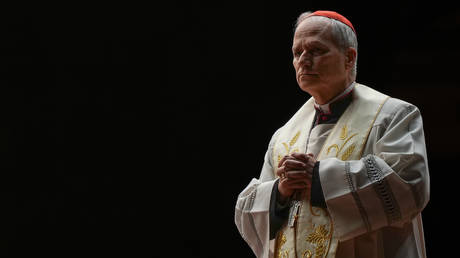
Europe is currently spending more on weapons than it has since the Cold War ended. If you ask the leaders in Brussels or Berlin, they'll tell you it’s a necessary shield against a chaotic world. But if you ask Pope Leo XIV, he’ll tell you it’s a scam.
Addressing a crowd of students at Sapienza University in Rome today, the Pope didn't hold back. He flatly rejected the idea that buying more tanks and missiles equals "defense." Instead, he called the current surge in military budgets a "betrayal" of diplomacy that enriches elites while leaving the rest of us less secure.
The 864 billion dollar question
Last year, military spending across Europe hit $864 billion. That isn't just a slight uptick; it’s a massive pivot in how the continent operates. Much of this has been fueled by the ongoing Russia-Ukraine conflict and a heavy dose of pressure from U.S. President Donald Trump, who’s been leaning on NATO members to hit a staggering 5% GDP spending target.
Pope Leo's point is that we're mislabeling the invoice. When a country pours billions into "Exquisite Class" weaponry—as Trump recently called it—that money has to come from somewhere. Usually, it’s stripped away from education, healthcare, and the very social structures that prevent radicalization and conflict in the first place.
He’s basically saying that we’ve stopped trying to talk and started trying to out-spend the "enemy." But in a world where everyone is armed to the teeth, nobody actually feels safer. The Pope argued that true peace is "unarmed and disarming." It’s built on trust, not on having a bigger pile of missiles than the guy next door.
AI and the dehumanization of war
It wasn't just about the money, though. Leo also took a swing at the tech sector. He’s deeply worried about how artificial intelligence is being baked into modern warfare. We’ve seen it in Ukraine, Gaza, and Iran—drones and algorithms making life-and-death decisions at a speed humans can’t track.
He called this shift a "destructive betrayal" of humanism. Why? Because when you let a machine decide who lives or dies, you remove moral responsibility from the equation. It makes war feel like a video game for the people in charge, which only makes it easier to start one. He warned the students not to get sucked into these "ideologies and national borders" that treat people like data points.
The friction with Washington
It’s no secret that the Vatican and the White House aren't exactly on the same page right now. Since his election in May 2025, Pope Leo—the first U.S.-born pontiff—has become an increasingly loud critic of American foreign policy. His recent meeting with U.S. Secretary of State Marco Rubio reportedly did little to bridge the gap.
While the U.S. pushes for a "fortress Europe" to offset its own declining domestic spending, Leo sees a continent losing its soul. He’s pushing for a "disarmament of the heart," which sounds like typical church-speak until you look at the numbers. When $2.89 trillion is being spent globally on the tools of death, maybe "unarmed peace" isn't as crazy as the politicians claim.
What happens when the money runs out
Europe is at a crossroads. Projects like "ReArm Europe" and "Readiness 2030" are funneling hundreds of billions into industrial production. But as McKinsey's recent analysis points out, even with all this cash, equipment stocks are still lower than they were in 2021. We’re spending more and getting less, all while eroding the diplomatic channels that kept the peace for decades.
If you're following this, don't just look at the headlines about "defense." Look at where the money is moving. Are we investing in a future where we can talk through our problems, or are we just funding the next round of "annihilation"?
If you want to understand the human cost, stop looking at the stock prices of defense contractors and start looking at the budgets for local schools and hospitals. That's where the real "betrayal" is happening.
Start by looking up your own country's defense-to-social-spending ratio. It's often a wake-up call that proves the Pope's point better than any sermon could.
Pope Leo's warning on Europe's defense budget
This video provides a direct look at the Vatican's recent statements and the specific geopolitical tensions fueling the Pope's criticism of European rearmament.