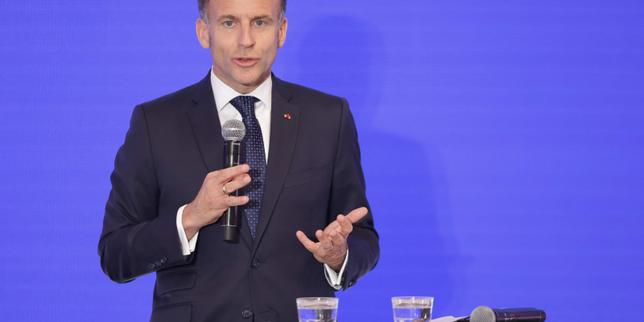
The coffee in the glass cups at the Elysée Palace doesn’t shake, but the hands holding them might.
Emmanuel Macron sits across from the titans of industry, the men and women who move the gears of the European economy. They aren't looking for a sermon on democracy or a lecture on the Enlightenment. They are looking for a compass. Outside the gilded walls of the French presidency, a cold wind is blowing across the Atlantic, carrying with it the erratic, thunderous echoes of a Mar-a-Lago campaign trail.
The tension in the room is quiet. It is the tension of a ship captain watching a barometer drop while the navigator argues that the stars have moved. For years, the global economy relied on a specific kind of boredom. You knew what the rules were. You knew that if you shipped a crate of car parts from Munich to Michigan, the math you did on Tuesday would still be true on Friday.
Then came the volatility.
The Architect and the Chaos
Macron has stepped into the role of the master mason, trying to convince a jittery continent that while the American sky is turning purple and unpredictable, the European ground is solid. His pitch is simple, though the execution is anything but: Europe is the last bastion of the predictable.
Contrast is his greatest tool. On one side of the ocean, you have the "Trump Effect"—a whirlwind of 3:00 AM policy shifts via social media, threats of universal tariffs that hit allies and enemies with the same blunt force, and a transactional approach to geopolitics that treats decades-old treaties like expiring gym memberships. On the other side, Macron offers the grinding, slow, but ultimately certain machinery of Brussels.
It is a strange sales pitch. Usually, "predictable" is a polite word for "boring." In the world of high-stakes investment, boring is the new gold.
Consider a hypothetical CEO named Elena. She runs a mid-sized chemicals firm in Lyon. She needs to decide whether to sink fifty million euros into a new carbon-neutral plant. If she builds it, she needs to know that the regulatory framework won't vanish because a different leader took office and decided climate change was a "hoax" over breakfast. She needs to know that her export costs won't jump by 20% because of a sudden trade war triggered by a perceived slight at a summit.
For Elena, Macron isn't just a politician. He is a hedge against chaos.
The Price of a Pulse
The French President’s recent rhetoric isn't just about diplomacy; it is a brutal realization of European vulnerability. For decades, Europe tucked itself under the security blanket of the United States. It was a comfortable arrangement. We provided the culture and the luxury goods; they provided the tanks and the ultimate say in global trade.
That blanket has been yanked away.
Donald Trump’s return to the conversation has forced a sudden, painful maturation. Macron is telling the continent that they can no longer afford to be a passenger in someone else’s car—especially when the driver keeps eyeing the exit ramp. He is advocating for "strategic autonomy," a phrase that sounds like academic jargon until you realize it actually means "survival."
But building a fortress of predictability is expensive. It requires a level of unity that Europe often struggles to find. When the 27 member states argue over fishing rights or budget deficits, they look less like a stable superpower and more like a squabbling family. Macron’s challenge is to convince these 27 distinct voices to sing in a choir, primarily because the alternative is being drowned out by the American soloist.
The Invisible Stakes
Why does this matter to someone who doesn't run a chemical plant or sit in a palace?
Because predictability is the invisible oxygen of the middle class. When markets freak out because a superpower threatens to abandon NATO or slap a 60% tariff on goods, the ripple doesn't just stay on Wall Street. It shows up in the interest rate on your mortgage. It shows up in the price of the laptop you need for school. It shows up in the "hiring freeze" memo at your office.
Chaos is a tax on the poor and the middle class. The ultra-wealthy can pivot. They can move capital to Singapore or buy gold. The rest of us rely on the world being roughly the same today as it was yesterday.
Macron’s gamble is that by doubling down on European integration, he can create a "safe harbor" for global capital. He wants the world to see Europe as the steady hand. If Washington is going to be the girlfriend who might leave you in the middle of the night without a note, Europe wants to be the partner who shows up every day at 6:00 PM with the groceries.
It isn't sexy. It isn't revolutionary. It is just there.
The Irony of the Strongman
There is a deep irony in this struggle. Macron is often criticized for being "Jupiterian"—aloof, commanding, and perhaps a bit too fond of his own voice. In many ways, he uses the tools of a strong leader to promote the virtues of a stable system. He is trying to use his own political capital to build a structure that doesn't depend on any single individual.
Trump, conversely, is the system-breaker. His power comes from the fact that he is the system. If he likes you, the rules bend. If he doesn't, they break.
This is the fundamental choice facing the global economy in the next twenty-four months. Do we want to live in a world governed by laws, or a world governed by moods?
The French President is betting everything on the former. He is betting that even the most aggressive investors will eventually tire of the adrenaline of the Trump years and seek the quiet, methodical progress of the European Union. He is betting that "boring" will eventually win.
The Cracks in the Foundation
However, Macron’s vision of a stable Europe faces a terrifying internal threat. You cannot preach predictability to the world if your own house is on fire. Across the continent, from the streets of Paris to the voting booths in Germany and the Netherlands, a different kind of energy is rising. It is an energy that looks a lot like the one that fueled Trump’s rise in 2016.
Populism is the enemy of the predictable. It thrives on the disruption of "business as usual."
When Macron speaks of European sovereignty, he is often met with the skeptical glares of people who feel the "system" has worked for everyone except them. For a factory worker in northern France who has seen his town hollowed out by globalization, the "predictability" Macron offers feels like a predictable decline.
To win this argument, Macron has to prove that stability isn't just a benefit for the Elenas of the world and their chemical plants. He has to prove that a predictable Europe can also be a protective one.
A World Without a Map
Imagine standing on a coastline. To the west, a massive, powerful ship is tossing and turning in a violent storm. The crew is fighting, the captain is shouting contradictory orders, and the ship is veering wildly off course. To the east, there is a smaller, slower vessel. It isn't moving fast. It looks a bit weathered. But it is holding a steady line.
Which one do you want to be on?
The tragedy of the current moment is that the powerful ship is the one that has led the world for eighty years. We are used to its speed. We are used to its strength. Many people find the chaos on its deck exhilarating, a necessary purging of the old ways.
But the ocean doesn't care about exhilaration. The ocean only cares about buoyancy and direction.
Macron’s speech was not just a political maneuver. It was a plea for sanity in an age of performance art. He is trying to remind us that while the "unpredictable" makes for great television and viral clips, it makes for a miserable way to run a civilization.
As the meeting in the Elysée draws to a close, the coffee is long gone. The CEOs leave the room and step out into the Parisian air. They look at their phones, checking the latest headlines from across the sea, looking for a sign of which way the wind will blow tomorrow.
They are looking for a certainty that no longer exists in the place it was born.
The President stays behind, staring at the map of a continent that must now choose between the comfort of its old alliances and the cold, hard necessity of standing on its own two feet. The storm is coming, and no amount of elegant French prose can stop it. All that remains is to see if the foundation he has spent years reinforcing is deep enough to hold when the waves finally break.
The lights in the palace stay on late into the night, a small, steady glow against an increasingly dark horizon.