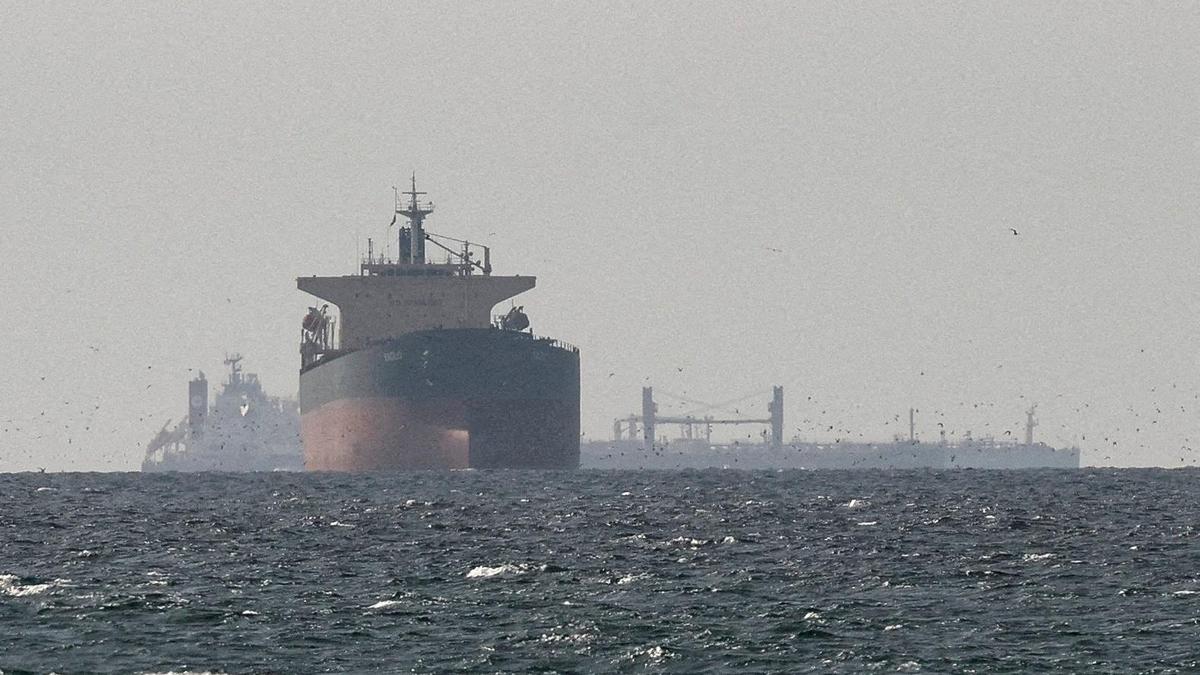
The salt air in the Strait of Hormuz doesn’t just smell like the sea. It smells like exhaust, oxidation, and the invisible weight of twenty million barrels of oil moving past your face every single day. If you stand on the deck of a ship in these waters, you are standing in the most sensitive choke point on the planet. One wrong move here doesn't just sink a vessel; it resets the price of milk in a grocery store five thousand miles away.
Below the shimmering turquoise surface, the danger is silent. It is patient. It is a sphere of rusted iron and high explosives, bobbing at the end of a tether or buried in the silt. These are naval mines. They are the "weapons of the poor," cost-effective ways for a smaller power to hold the entire global economy hostage.
The Steel Sentinel
Think of a young sailor, perhaps twenty-one years old, staring at a sonar screen inside the dark, air-conditioned gut of a U.S. Navy mine countermeasure ship. Let’s call him Miller. Miller isn't looking for an enemy fleet. He isn't looking for a supersonic missile. He is looking for a shadow on the seabed that looks slightly too symmetrical to be a rock.
The Strait is narrow. At its tightest point, the shipping lanes are only two miles wide. If a single tanker hits a mine and spills its cargo, the lane closes. The world’s pulse slows. To prevent this, the U.S. military recently sent a flotilla through these waters, not to start a fight, but to sweep for the ghosts of one.
This isn't just about "mine clearance operations," as the dry press releases put it. It is about maintaining the fiction of safety that allows modern life to function. We assume that when we flip a switch, the lights come on. We assume that the gasoline will be at the pump. We rarely think about Miller and his sonar screen, squinting at the mud of the Persian Gulf to ensure a three-hundred-dollar mine doesn't destroy a three-hundred-million-dollar cargo.
The Calculus of Chaos
Naval mines are terrifying because of their simplicity. A "contact mine" waits for the physical touch of a hull. An "influence mine" is more sophisticated, listening for the specific acoustic signature of a propeller or sensing the magnetic distortion caused by thousands of tons of steel passing overhead.
Imagine a massive, empty warehouse. Now imagine someone has hidden a single, pressure-sensitive firecracker somewhere on the floor. You have to find it, but the lights are out, and you're wearing a blindfold. That is the reality of mine hunting in the Strait. The water is murky, filled with silt and debris.
The U.S. Navy uses a combination of high-tech tools to solve this. They deploy the Mk 18 Mod 2 Kingfish, an underwater drone that looks like a yellow torpedo. It swims a pre-programmed grid, using side-scan sonar to map the floor with photographic detail.
But technology has limits. Sometimes, the computer sees a shape and can't tell if it’s an Iranian-made SADAF-02 mine or an old washing machine dumped overboard. That is when the tension spikes. That is when the human element takes over.
The Loneliest Job in the Navy
When the drone finds a "contact of interest," the ship stops. The crew goes quiet. The Navy divers or the operators of the SeaFox—a small, one-way "kamikaze" drone—prepare to investigate.
If you are a diver in these waters, you are working in a world of muted greens and browns. The temperature is often well over 90 degrees Fahrenheit, even deep down. You can hear your own heartbeat in your ears. You are moving toward something designed specifically to kill you and everything around you.
The math of the Strait is brutal. It is a game of asymmetric warfare. It costs a few thousand dollars to build and plant a mine. It costs millions of dollars—and weeks of agonizingly slow work—to find and neutralize it. The goal of the mine-layer isn't necessarily to sink a ship; it is to create doubt. If a shipping company thinks there is a 1% chance of their tanker exploding, their insurance premiums skyrocket. Suddenly, it isn't profitable to move oil. The supply chain snaps.
This is why the recent transit of U.S. warships wasn't just a routine drill. It was a physical demonstration of resolve. By sailing through the most contested waters on earth with mine-hunting gear active, the Navy is telling the world: We see the threat, and we are removing it.
Beyond the Horizon
The stakes are higher than they appear on a map. We live in an era of "Gray Zone" conflict. This isn't a declared war with clear front lines. It is a constant, simmering tension where nations poke and prod at each other’s vulnerabilities.
The Strait of Hormuz is the ultimate vulnerability.
Consider the "Tanker War" of the 1980s. During the Iran-Iraq conflict, hundreds of merchant ships were attacked. The U.S. had to initiate Operation Earnest Will, escorting tankers to ensure the world’s energy supply didn't evaporate. Today, the weapons are smarter, but the geography remains the same. The water is still shallow. The passage is still narrow. The shadows on the sonar are still there.
But there is a psychological layer to this operation that the news reports usually miss. For the sailors on those ships, the mission is an exercise in extreme patience. You spend fourteen hours a day looking at static on a screen. You wait for a beep that you hope never comes. You are the thin line between a normal Tuesday and a global economic depression.
There is a specific kind of courage in that. It isn't the courage of a Hollywood dogfight; it’s the courage of a gardener weeding a minefield. It is repetitive. It is exhausting. It is vital.
The Weight of the Invisible
As the warships emerge from the Strait and move into the open Arabian Sea, the tension on board doesn't disappear; it just changes shape. The crew knows that the mines they found—or didn't find—are only part of the story. The real struggle is the enduring competition for control over the world's most important throat.
We often talk about "freedom of navigation" as an abstract legal concept. It feels like something for lawyers and diplomats to argue about in wood-paneled rooms in The Hague. But out here, in the heat and the salt, freedom of navigation is a physical thing. It is the ability of a ship to move from point A to point B without being blown apart by a hidden relic of 20th-century technology.
The next time you see a headline about "routine operations" in the Middle East, look closer. Think about the sonar pings echoing off the seabed. Think about the divers checking their oxygen levels as they descend into the murk. Think about the massive tankers trailing behind the grey hulls of the Navy, trusting that the path ahead has been cleared of ghosts.
The Strait remains. The pressure remains. And somewhere under the waves, the next shadow is waiting to be found.