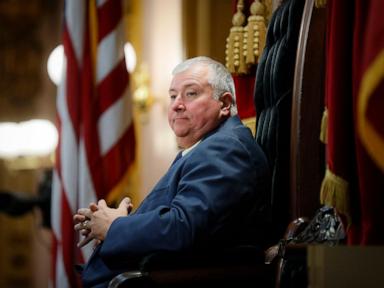
The marble floors of the Ohio Statehouse have a way of swallowing sound, but they couldn't dampen the reverberations of a $60 million secret. For years, the air in Columbus wasn't just thick with the humidity of the Midwest; it was heavy with the weight of a deal that traded the public’s trust for a corporate lifeline.
When the U.S. Supreme Court quietly declined to hear the appeals of former Ohio House Speaker Larry Householder and lobbyist Matt Borges this week, the gavel didn't just fall on two men. It fell on an era of brazen political theater funded by dark money. The highest court in the land looked at the stacks of evidence, the convictions of a racketeering conspiracy, and the twenty-year sentence handed to a once-untouchable kingmaker, and decided there was nothing left to say. The law had spoken.
The House That Greed Built
To understand how a Speaker of the House ends up in a federal prison cell, you have to look past the spreadsheets and the legal filings. You have to look at the light bill on a kitchen table in Akron or Dayton.
Imagine a grandmother living on a fixed income. Every month, she sets aside a specific amount for her utilities, unaware that the very numbers on that bill are being manipulated by men in tailored suits miles away. This isn't a hypothetical victim; she is the aggregate of every Ohioan who was forced to subsidize a failing nuclear power plant through House Bill 6. This legislation was the "solution" to a problem the public didn't create, yet they were the ones handed the invoice.
The $60 million didn't arrive in a briefcase. It flowed through a 501(c)(4) nonprofit called Generation Now. In the world of high-stakes lobbying, these organizations are often referred to as "dark money" groups because they don't have to disclose their donors. It is a legal shadow, a place where a utility giant like FirstEnergy can park millions of dollars to ensure that the "right" people get elected and the "right" laws get passed.
Householder wasn't just a politician; he was a conductor. He used that $60 million to bankroll the campaigns of a slate of candidates who would eventually vote him into the Speaker’s chair. Once he held the gavel, the debt was called in. House Bill 6 was the payment. It was a billion-dollar bailout for two nuclear plants, paid for by the people of Ohio, choreographed by a man who had sold the speaker’s podium before he even stepped behind it.
The Anatomy of a Betrayal
Corruption is rarely a sudden explosion. It is a slow rot. It starts with a lunch, a favor, a "consulting fee" that feels just gray enough to be ignored. For Matt Borges, the former chairman of the Ohio Republican Party, the path to a five-year prison sentence was paved with a $15,000 bribe.
The goal was simple: stop a ballot initiative that would have allowed Ohio voters to overturn the bailout. When the people tried to take their power back, the machine moved to crush them. There were private investigators, aggressive "blockers" sent to intimidate signature collectors, and a massive disinformation campaign.
Borges wasn't the architect, but he was a vital gear in the mechanism. His conviction, and the Supreme Court’s refusal to revisit it, serves as a stark reminder that in the eyes of the federal government, being a "middleman" for a bribe carries the same stench as taking the money yourself.
The complexity of the scheme was its primary defense. Lawyers argued that this was simply "politics as usual." They claimed that the money was for advocacy, that the speech was protected, and that the quid pro quo was a figment of the prosecution's imagination. But the jury saw through the smoke. They saw a conspiracy to commit racketeering—a charge usually reserved for the mob, now applied to the leaders of a state government.
The Invisible Stakes
Why does a Supreme Court denial in a bribery case matter to someone who doesn't live in Ohio? Because the "Ohio Model" is a blueprint that exists in every state capital.
The stakes aren't just about $60 million or a specific power plant. The stakes are the integrity of the democratic process. When a corporation can buy a legislature, the vote of a citizen becomes a decorative gesture rather than a tool of change.
Consider the sheer scale of the deception. The $60 million spent to secure the bailout was a calculated investment. Spend sixty to get a billion. In the boardroom, that’s just good business. In a democracy, it’s a hostage situation. The Supreme Court's refusal to hear the appeal confirms that while political spending has wide protections, it does not provide a cloak for criminal bribery.
The legal battle revolved around the definition of "official acts" and where the line is drawn between aggressive lobbying and criminal racketeering. Householder’s defense team leaned heavily on the idea that he was doing what any politician does: helping those who helped him. But the federal courts found that the "help" provided by FirstEnergy wasn't a campaign contribution; it was a purchase order for a Speaker of the House.
The Echo in the Halls
Walking through the Statehouse today, there is a palpable sense of a ghost being exorcised. But the damage of the Householder era isn't easily repaired. Trust, once broken, requires a generation to rebuild.
The Supreme Court’s decision is the final period at the end of a very long, very dark chapter. It signals to every lobbyist and every lawmaker that there are limits. There is a point where the "game" ends and the handcuffs come out.
Larry Householder is currently serving his 20-year sentence in an out-of-state federal prison. He went from being one of the most powerful men in the history of Ohio politics to an inmate identified by a number. His fall was as spectacular as his rise, a Greek tragedy played out in the heart of the Rust Belt.
But the story doesn't end with a prison sentence. It ends with the realization that the system only worked because it was forced to. It took whistleblowers, relentless investigative journalism, and a federal task force to peel back the layers of Generation Now.
The true cost of the $60 million scheme isn't found in the court records. It’s found in the cynicism of the voter who stays home because they believe the game is rigged. It’s found in the legislative sessions where bills are passed not because they are good for the public, but because the checks have already cleared.
The Supreme Court didn't just deny an appeal; they validated the reality that no amount of dark money can indefinitely hide the truth. The sun is finally setting on the Householder era, casting long, stark shadows over the marble floors he once commanded.
Somewhere in Ohio, a porch light flickers on. The person inside pays their utility bill, unaware that the highest court in the country just finished a fight they didn't even know was being waged on their behalf. The silence in the Statehouse is finally earned.


