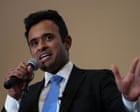
The air inside the diner in Zanesville smells of over-steeped coffee and the faint, metallic tang of an impending Ohio spring. It is a specific kind of quiet—the kind that exists before a storm or a shift in the tectonic plates of American power. On the counter lies a discarded newspaper with a headline about Vivek Ramaswamy. The name itself feels like a disruption to the steady, rhythmic hum of the Rust Belt.
For decades, Ohio politics functioned like a well-worn tractor. It was reliable, predictable, and distinctly unflashy. You had the establishment, the handshake deals, and the slow, incremental march of policy. But today, as voters head to the polls to decide if a thirty-something biotech entrepreneur should lead the Buckeye State, that old tractor is being overhauled for a jet engine.
The stakes aren't just about a seat in Columbus. They are about the soul of a movement that has spent the last decade trying to decide if it wants to be a governing body or a revolutionary front.
The Ghost of the Establishment
Consider a man like "Arthur." He’s a hypothetical composite of the thousands of precinct captains who have kept the Republican machinery running since the days of Jim Rhodes. Arthur remembers when being a conservative in Ohio meant fiscal restraint, a quiet faith, and a deep respect for the institutions of the state. To him, the primary is a test of heritage.
He looks at Ramaswamy and sees a blur of motion. He sees a man who speaks at 180 words per minute, a man who built a fortune in the cutthroat world of pharmaceutical speculation, and a man who treats the political stage like a TED Talk on steroids. Arthur is used to candidates who talk about corn subsidies and highway expansions. Vivek talks about "anti-woke" capitalism and the dismantling of the administrative state.
The disconnect is visceral. It’s the difference between a handwritten letter and an encrypted text message.
Yet, as the polls open, Arthur finds his own grandchildren wearing hats with the Ramaswamy name. They aren't interested in the slow build. They are hungry for the disruption. They see a state that has seen its manufacturing heart carved out and its youth fleeing to the coasts, and they want someone who promises to burn the old map and draw a new one.
The Geometry of the Ballot
The numbers tell a story that the stump speeches often hide. To win the Republican nomination for governor in a state as diverse as Ohio, a candidate has to solve a complex geographic puzzle. You have the suburban rings of Cincinnati and Columbus—places where "decorum" still carries weight. Then you have the Appalachian foothills, where the economic scars of the last thirty years are still raw and red.
Ramaswamy’s gamble is that the old divides no longer matter. He is betting that the "forgotten man" in Steubenville has more in common with the tech-skeptic in Dublin than anyone realizes. His platform isn't built on traditional GOP planks; it's built on a singular, aggressive identity.
In the weeks leading up to today, the campaign trail wasn't just a series of speeches. It was an exercise in high-velocity branding. While his opponents relied on traditional television buys—the kind of ads featuring soft-focus shots of families on porches—Ramaswamy lived on social media and podcasts. He bypassed the gatekeepers. He spoke directly into the earbuds of voters while they worked their shifts or drove their trucks.
This isn't just a campaign. It’s a stress test for the very idea of a "political party." If a man with no prior elected experience can seize the governorship of one of the most pivotal states in the Union, the old guard hasn't just lost a race; they’ve lost their relevance.
The Invisible Weight of the Vote
There is a peculiar tension in the act of voting in a primary. In a general election, you are fighting the "other side." In a primary, you are fighting your neighbor. You are arguing over the dinner table about what it means to be "right."
Walk into any polling station in Dayton or Akron today and you will see it. It’s in the way people avoid eye contact as they take their ballots. There is a sense that this choice is a fork in the road that can't be un-walked.
If Ramaswamy locks in this nomination, he becomes the face of the "New Right" in a way that transcends Ohio. He becomes the proof of concept. The "America First" movement has long looked for a successor to its founding father, someone who can codify the grievances of the working class into a coherent, intellectual framework.
But there is a risk. Ohio has always been a state of balance. It is the "Mother of Presidents" because it usually reflects the middle of the country, not the edges. By moving so far into the territory of ideological warfare, the party risks alienating the very moderates who have kept Ohio a reliable shade of red-leaning purple for years.
The Silence of the Tally
As the sun begins to set over the flat, expansive fields of the western counties, the noise of the campaign fades into the mechanical click of the tabulators.
Think about the physical reality of the state. The rusted skeletons of steel mills in the Mahoning Valley stand in silent contrast to the gleaming glass towers of the Nationwide building in Columbus. This is the duality Ramaswamy has to bridge. He has to convince the worker who lost his pension that a multi-millionaire with a Harvard degree understands his pain, and he has to convince the CEO that his brand of disruption won't shatter the stability required for business.
It is a tightrope walk performed in a hurricane.
The "cold facts" of the exit polls will eventually provide a percentage, a winner, and a loser. But those numbers won't capture the anxiety of the woman in Toledo who wondered if her vote for a firebrand would actually bring her grocery bill down. They won't capture the quiet defiance of the veteran in Chillicothe who voted for the "safe" candidate because he’s tired of the shouting.
Politics is often described as a game of chess, but in Ohio today, it feels more like a game of poker played with someone else’s life savings.
The Resonance of the Result
The outcome of this race ripples outward. If the firebrand wins, the national landscape shifts. Every ambitious young Republican in the country will look at the Ohio model and realize that the path to power no longer requires "paying your dues" in the state legislature or the city council. It requires a camera, a message that cuts like a knife, and the audacity to tell the establishment that their time is up.
If he loses, the narrative changes to one of a "limit." It suggests that even in a party transformed by populism, there is still a threshold for experience and a desire for the familiar.
But regardless of the name that appears at the top of the ticker tonight, something in Ohio has already broken. The expectation of what a governor is has been fundamentally altered. The conversation has moved from "how do we manage the state?" to "who do we want to be?"
The red carnation—Ohio’s state flower—was chosen to honor William McKinley, a man of steady, somber leadership. Today, as the ballots are counted, the carnation feels like a relic of a gentler, slower era.
The firebrand is at the gates. The voters have spoken. And the silence that follows will be the loudest thing in the room.
The sun dips below the horizon, casting long, distorted shadows across the parking lots of elementary schools and community centers. The doors are locked. The boxes are sealed. Across eighty-eight counties, a million different versions of the future are being funneled into a single, undeniable reality. Ohio is no longer just a bellwether; it is a mirror. And for the first time in a long time, the reflection looking back is one the state barely recognizes.