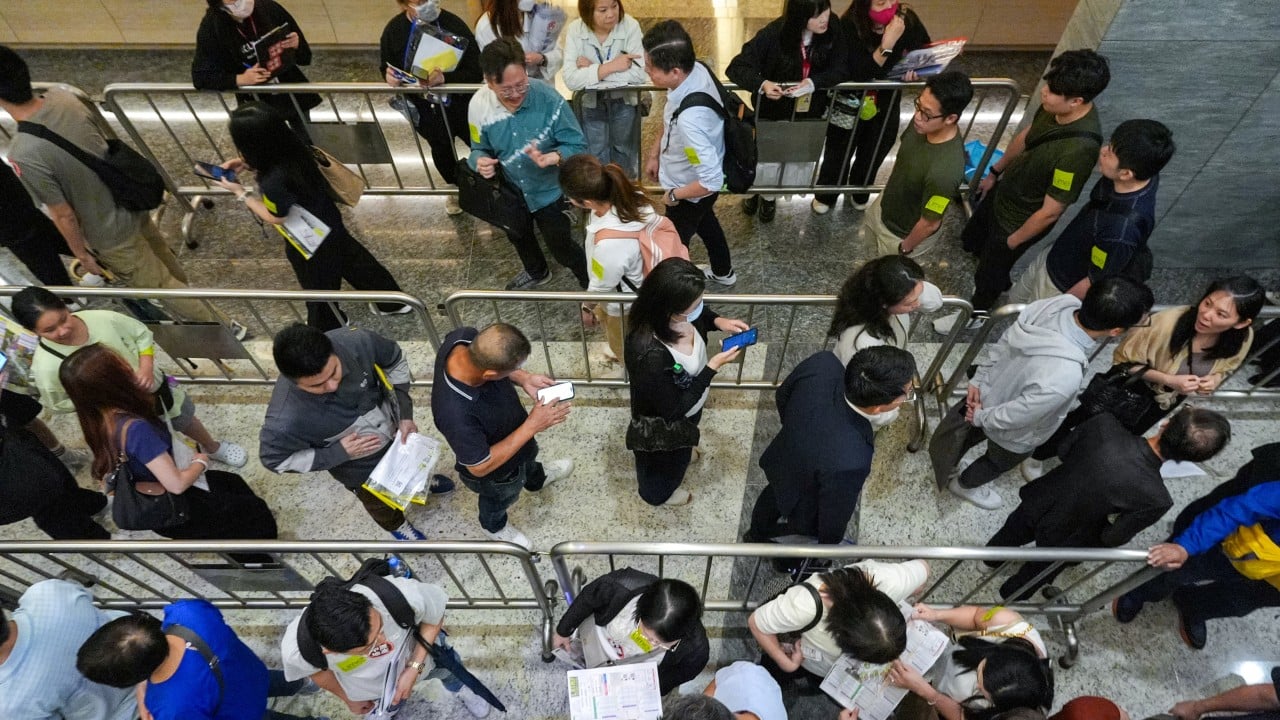
The air in the sales office at Kai Tak smells like expensive cologne and desperation. It is a thick, artificial scent, pumped through vents to mask the sweat of hundreds of people huddled over floor plans. Outside, the Victoria Harbour breeze carries the salt of a thousand years of trade, but inside, the only thing that matters is the scratch of a pen on a contract.
Mr. Lam stands at the back of the room. His thumb habitually rubs the calloused skin of his palm, a relic of forty years spent in a textile factory before he transitioned into the quiet life of a retiree. He is not here for himself. He is here for his daughter, Chloe, who is thirty-two and still sleeps in a room no larger than a walk-in closet in their family flat in Kwun Tong.
To the outside world, the news is a headline about "upward momentum" and "eager buyers." To the people in this room, it is a high-stakes game of musical chairs where the music has just started playing again after a long, eerie silence.
The Fever Returns
For years, the Hong Kong property market felt like a ghost ship. High interest rates and a cooling economy turned the once-frenzied showrooms into mausoleums. But recently, the government made a move that changed the chemistry of the city. They scrapped the cooling measures—the "spicy" taxes that had been designed to keep speculators at bay. Suddenly, the gates are open.
Consider the numbers, but look at them through Mr. Lam’s eyes. One weekend, nearly 200 units at a new development are snapped up in a single afternoon. To an analyst, that is a data point. To Mr. Lam, it is 200 families who just pushed the price of his daughter’s future slightly further out of reach.
The developers are smart. They know the psychology of the squeeze. They price the first batch of flats at a slight discount, a "sweetener" to get the blood in the water. It works. On Saturday morning, the queue stretched around the block, a snake of humanity winding through the glass and steel of the financial district. They aren't just buying square footage. They are buying an escape hatch.
The Architecture of a Dream
What does a "new flat" actually look like in the current Hong Kong boom? It is rarely the sprawling estate shown in the glossy brochures featuring European models drinking wine on balconies.
In reality, it is often a "studio unit" or a "one-bedroom" that measures roughly 250 square feet. To help visualize this, imagine two large parking spaces side-by-side. That is the entirety of a person’s world. The kitchen is a "nano-kitchen"—two induction hobs and a sink the size of a dinner plate. The bathroom is a "wet room" where the shower head is positioned directly over the toilet.
Yet, for Chloe, this is the pinnacle of success.
"If I don’t buy now," she whispers to her father as they move up the queue, "I’ll be paying someone else’s mortgage for the rest of my life."
The tragedy of the Hong Kong homebuyer is the math of the "bank of mom and dad." Mr. Lam is prepared to liquidate his life savings—money meant for his medical bills and quiet dim sum mornings—to provide the 20% down payment. He is not alone. Look around the room and you see the same tableau repeated: aging parents with tired eyes, clutching folders of bank statements, handing over their past so their children can have a precarious foothold in the future.
The Interest Rate Tightrope
While the removal of taxes has sparked the fire, the shadow of the US Federal Reserve loams over every transaction. Because the Hong Kong dollar is pegged to the greenback, the city’s interest rates follow the American lead. When Jerome Powell speaks in Washington, the ripples wash up against the shores of Kowloon.
Buyers are currently betting on a pivot. They are signing 30-year commitments on the hope that the cost of borrowing has peaked. It is a gamble of breathtaking proportions. If rates stay high, the monthly payments on these flats will devour 60% or 70% of a young professional's salary. They will be "house poor"—owning a piece of the sky but unable to afford the life happening beneath it.
The market doesn't care about your dinner plans, though. It cares about momentum. When the big developers like CK Asset or Henderson Land report a "sell-out" weekend, it creates a feedback loop. The fear of missing out (FOMO) is a more powerful economic driver in this city than any fundamental analysis of supply and demand.
The Invisible Stakes
Why do they do it? Why do they fight for these tiny boxes in the sky?
In Hong Kong, land is more than a commodity; it is the only true religion. It is the metric of worth. Without a property deed, you are a wanderer, subject to the whims of landlords who can raise the rent by 30% on a whim. Homeownership is the iron door that keeps the chaos of the world outside.
But the iron door has a heavy price. To afford the mortgage, Chloe will have to work longer hours, perhaps take a second job. She will delay marriage. She will certainly delay having children. The "momentum" that the newspapers celebrate is, in many ways, the sound of a generation tightening its belt until it can barely breathe.
We see the secondary market beginning to stir as well. Owners of older flats, seeing the frenzy at the new developments, are raising their asking prices. The "bargains" of last year are vanishing. The window is closing.
The Moment of Truth
Mr. Lam and Chloe reach the front of the line. A young salesman in a sharp suit, barely older than Chloe but wearing a watch that costs more than Mr. Lam’s car, spreads the paperwork across the desk. He speaks in rapid-fire bursts, citing "gross floor area" and "management fees" like he’s reciting a prayer.
Mr. Lam looks at the contract. The price for this small box in the air is nearly 7 million Hong Kong dollars. It is an absurd sum. It is the cost of a mansion in most other parts of the world. Here, it buys you a view of another glass tower and a sliver of the sea if you lean out the window at a precise 45-degree angle.
He looks at his daughter. Her eyes are bright, terrified, and hopeful all at once. He realizes that he isn't just buying her a home. He is buying her the right to feel like she belongs in the city where she was born.
He picks up the pen.
The "momentum" of the market is not a force of nature. It is not an abstract economic trend. It is the collective heartbeat of thousands of Lams and Chloes, all pushing against a wall that never seems to move, hoping that this time, the door will finally swing open.
The ink on the paper is red, the color of luck. As the salesman shakes their hands and the "Sold" sticker is slapped onto the floor plan, the room erupts in another cheer for another buyer. Outside, the sun sets over the harbour, casting long, thin shadows of the new towers across the water, reaching toward a horizon that costs more than a lifetime of work to touch.