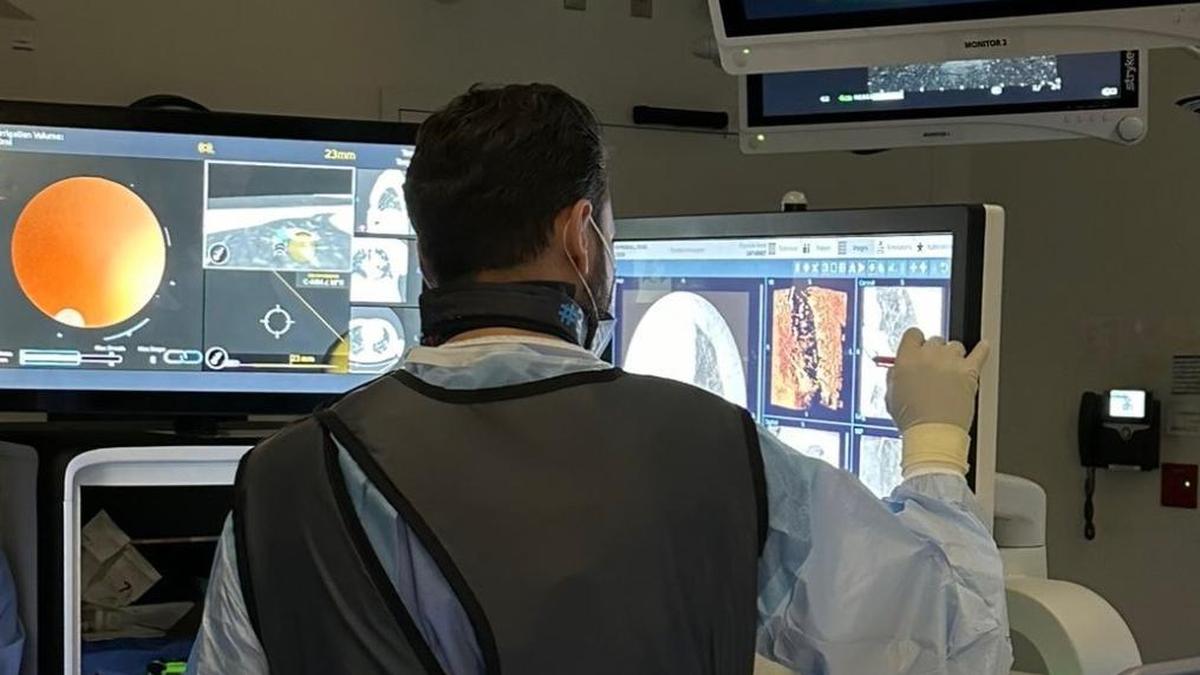
Dr. Aris Ramos keeps his phone on the nightstand, volume maxed, vibrating with a frequency that feels like a second heartbeat. It isn't just for hospital pages. It is for a notification from an automated tracker—a digital ghost that monitors the glacial movement of the United States Citizenship and Immigration Services (USCIS). For months, Aris has lived in a state of suspended animation. He is a cardiologist in a rural Ohio town where the nearest major medical center is an hour’s drive away. He saves lives on Tuesdays, but on Wednesdays, he stares at a static webpage, wondering if he will be deported by Friday.
This is the reality of the "hold." For a significant stretch of time, the gears of the American immigration machine ground to a halt for thousands of high-skilled professionals. Recently, the government flicked a switch. They lifted the freeze on green card processing for doctors like Aris. It sounds like a victory. In the press releases, it looks like progress. But if you zoom in on the fluorescent-lit corridors of a community clinic, you realize the victory is selective, and the silence for everyone else is deafening. If you liked this post, you might want to look at: this related article.
The Geography of Desperation
To understand why a bureaucratic pause matters, you have to look at the map of American healthcare. We are a nation of medical deserts. There are vast swaths of the Midwest and the South where "seeing a specialist" involves a tank of gas and a day off work. Into these gaps step foreign-trained physicians. They come through the J-1 waiver program, agreeing to work in underserved areas in exchange for a path to permanent residency.
It is a pact. The doctor provides the expertise; the government provides the stability. For another look on this story, see the latest update from Everyday Health.
When the government placed a "hold" on these applications, that pact cracked. Processing times for employment-based green cards stretched from months into years. For a doctor, this isn't just about a plastic card in a wallet. It is about whether they can buy a house in the town that relies on them. It is about whether their spouse can work. It is about whether they can travel home to bury a parent without fearing they will be barred from returning to their patients.
The lifting of the hold for physicians is a surgical strike—a necessary one. The U.S. is facing a projected shortage of up to 86,000 physicians by 2036. We simply cannot afford to let cardiologists sit on the sidelines because a clerk hasn't stamped a form. Yet, by carving out this exception, the system has created a hierarchy of human value.
The Waiting Room for the Rest
Step out of the hospital and into the tech hubs of Austin or the engineering firms of Detroit. Here, the hold remains. The "doctors first" policy has left engineers, researchers, and data scientists in a state of permanent "pending."
Consider a researcher developing carbon-capture technology. She is not a doctor. She does not wear a white coat. But her work might determine the quality of the air the doctor’s patients breathe thirty years from now. Under the current backlog, she is trapped in a different kind of waiting room.
The backlog is not a minor inconvenience. It is a slow-motion brain drain. When a visa holder is stuck in a multi-year limbo, they stop dreaming. They stop innovating. Why start a company when your right to stay in the country is tied to a specific employer’s whim? Why invest in the American economy when the American government treats your presence as an administrative burden rather than a competitive advantage?
The numbers are staggering. As of 2024, there are over 1.2 million individuals in the employment-based green card backlog. Most are from India and China, victims of per-country caps that were designed in the 1960s and have no bearing on the 21st-century economy. For some, the projected wait time for a green card is not years, but decades.
The Human Toll of the Paper Wall
Bureaucracy is often described as "red tape," a metaphor that suggests something easily snipped. A better metaphor would be a "paper wall"—thick, opaque, and soundproof.
When you are behind the wall, you lose your agency. You are 35 years old, a world-class expert in your field, yet you have to ask permission to change jobs. You have to renew "temporary" work permits every two years, a ritual of anxiety that involves biometric appointments, expensive legal fees, and the constant fear of a clerical error.
I spoke with an architect—let’s call him Elias—who has been in the backlog for nine years. He designed schools in California. He paid his taxes. He followed every rule. When the "hold" intensified, he stopped looking at the news.
"Every time there is a 'breakthrough' for one group, like the doctors, I feel a pang of guilt for being jealous," Elias told me. "I want the doctors to stay. We need them. But it feels like the government is saying my contribution doesn't matter because I don't hold a scalpel."
Elias eventually left. He moved to Canada, where he received permanent residency in six months. America didn't lose a "case number." It lost a builder of schools.
The Myth of the Line
People often say, "Why don't they just get in line?"
The "line" is a mathematical impossibility. Because of the 7% per-country limit, a software engineer from Bangalore who applies today might literally die of old age before their "priority date" becomes current. The lifting of the hold for doctors is a bypass—a way to jump the queue because the emergency is visible. But the emergencies in our infrastructure, our energy sector, and our classrooms are just as real; they are just quieter.
We are witnessing a policy of triage.
In a hospital, triage is necessary. You treat the chest pain before the broken toe. But immigration shouldn't be a trauma ward. It should be a gateway. When we treat it as a series of fires to be put out, we end up with a fragmented society where some residents are "more essential" than others.
The Ghost in the Machine
The recent shift to prioritize doctors was driven by a realization that the healthcare system was on the verge of collapse. It was a pragmatic move. But pragmatism without a soul leads to a revolving door of crises.
What happens to the children of these "waiting" professionals? They are known as "Documented Dreamers." They grow up in American suburbs, go to American schools, and play on American soccer teams. But if their parents’ green cards don't arrive by the time the child turns 21, the child "ages out." They lose their legal status. They are forced to "self-deport" to a country they may not even remember.
Imagine a doctor who is finally cleared to stay, only to watch her daughter be forced to leave. The "hold" was lifted for the mother, but the wall remains for the family.
The invisible stakes of immigration policy aren't found in GDP calculations or labor statistics. They are found in the dinner table conversations about whether it’s safe to book a vacation. They are found in the hesitation of a brilliant mind to share an idea because they feel like a guest who has overstayed their welcome.
The U.S. government’s decision to resume processing doctor applications is a confession. It is an admission that our system is broken and that we only fix the parts that hurt the most at any given moment. It is a flickering light in a long, dark tunnel.
For the doctors, the light is getting closer. For the thousands of others—the engineers, the teachers, the dreamers—the tunnel remains cold. They continue to wait, watching the tracker on their phones, hoping that one day, they too will be deemed "essential" enough to finally belong.
Aris Ramos still keeps his phone on the nightstand. He is one of the lucky ones now. But when he walks the halls of his hospital, he passes the janitors, the IT specialists, and the lab techs. He knows that many of them are also waiting for a stamp, a signature, a sign that they aren't just temporary tools, but permanent threads in the American fabric.
The paper wall hasn't fallen. It has just been moved a few inches.