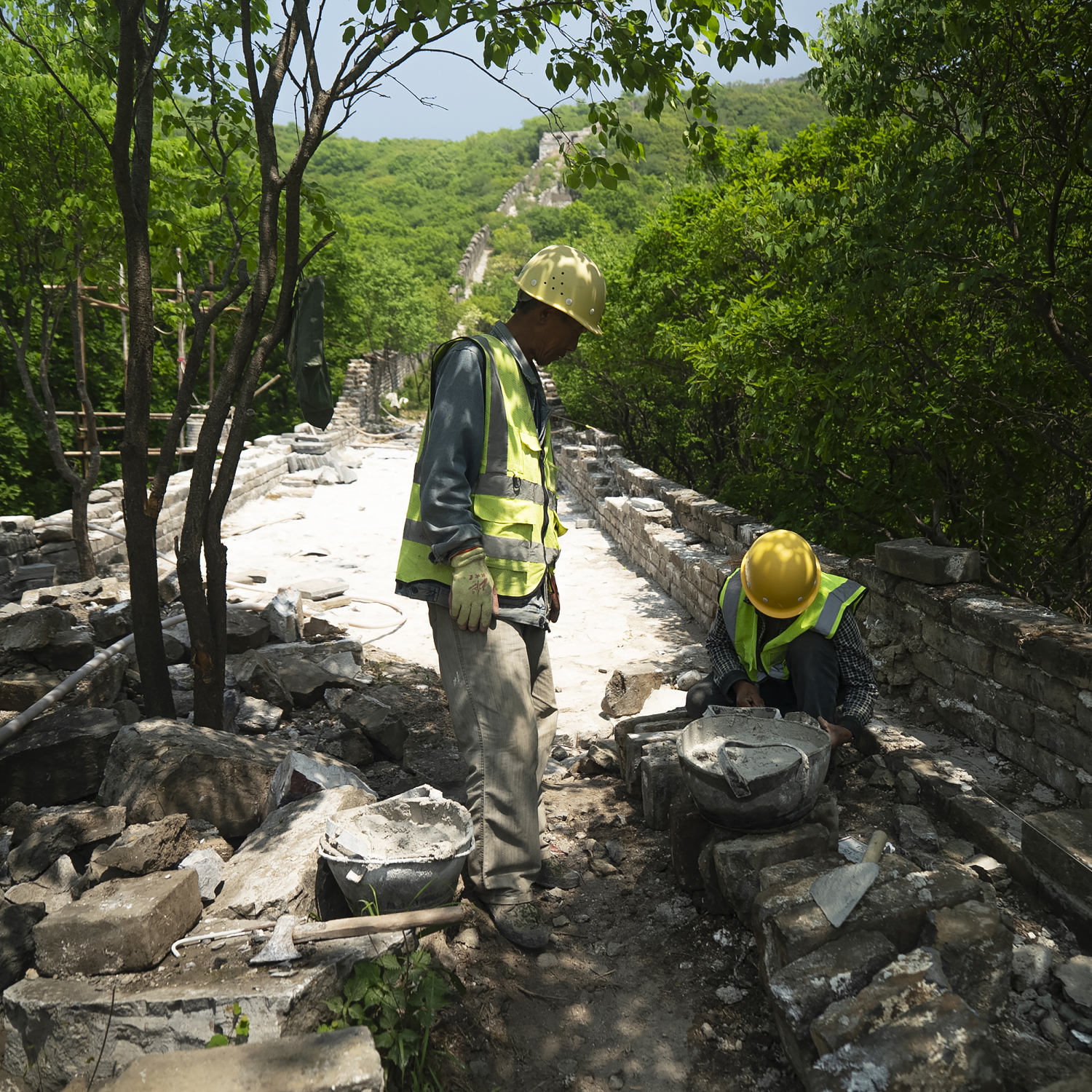
The Great Wall isn't actually a single wall. It's a messy, crumbling, thousand-mile collection of history that’s currently screaming for help. Most people think of those pristine, stone-paved walkways they see on postcards from Badaling. But that's a tiny fraction of the reality. Around 30% of the Ming Dynasty Great Wall has already vanished. Another massive chunk is in "poor" condition. If we don't change how we fix it, we're going to lose the world’s most ambitious architectural feat to erosion and bad DIY repairs.
Fixing this isn't about pouring concrete. It's about a painstaking, slow, and often dangerous process of manual labor. I’m talking about workers carrying individual bricks up vertical slopes on their backs or using mules to haul supplies where trucks can't go. This "one brick at a time" philosophy isn't just a poetic phrase. It’s the literal, technical standard required to keep the wall from becoming a pile of rubble.
The Wild Wall is Falling Apart
When you get away from the tourist traps, you hit the "Wild Wall." This is the authentic stuff. It’s overgrown with shrubs. The mortar has turned to dust. In some places, the structure is so fragile that a heavy rainstorm can take down a whole watchtower.
Nature is the primary enemy here, but humans aren't far behind. For decades, local villagers took bricks to build houses or pigsties. They didn't see a monument; they saw free building materials. Add in the "explorers" who hike off-path and kick loose stones, and you’ve got a recipe for a disaster.
The Chinese government realized a few years ago that the old way of "restoring" things—making them look brand new—was a mistake. They were accidentally erasing history. Now, the focus is on "minimal intervention." You don't want it to look new. You want it to stop falling.
Mules and Men versus Modern Machinery
You might wonder why we aren't using drones and cranes for everything. We use drones for the mapping part, sure. Technology like LiDAR gives us a 3D blueprint of every crack. But when it comes to the physical work? Machines are basically useless on a 70-degree incline made of loose shale.
The real work falls to specialists. These aren't just construction workers; they're more like masonry surgeons. They have to find bricks that match the original Ming-era dimensions. Often, they have to use traditional kilns to bake new ones because modern factory bricks don't breathe the same way. If the new material is harder than the old material, it actually causes the wall to crack faster during temperature changes.
- Manual Hauling: Workers often carry loads of 50 kilograms or more up narrow trails.
- Mule Teams: These animals are the backbone of the restoration, moving thousands of pounds of lime and water every week.
- Traditional Mortar: They use a mix that includes sticky rice flour. Seriously. It’s a technique from the Ming Dynasty that’s proven more durable than modern cement.
The Sticky Rice Secret
Archaeologists found that the secret weapon of the Great Wall’s longevity was literally lunch. Workers mixed a thick porridge of sticky rice with slaked lime. This created a chemical reaction that resulted in a mortar so strong that weeds can't grow through it and earthquakes struggle to shake it.
In modern restoration, engineers are going back to this recipe. Modern cement is too rigid. It traps moisture inside the wall. When that water freezes, it expands and blows the bricks apart. The rice-lime mixture is flexible. It lets the wall "breathe." This is the kind of expertise that only comes from looking back 600 years to see what actually worked.
Fixing Previous Mistakes
We have to be honest. Some of the restoration work done in the 80s and 90s was terrible. In 2016, a section of the wall in Liaoning province was "restored" by capping it with a flat layer of sand and cement. It looked like a sidewalk. People were outraged. It was a wake-up call for the State Administration of Cultural Heritage.
Now, the rule is "fix it as it was." If a section is slumped, they might leave it slumped but reinforce the internal structure. They aren't trying to build a theme park. They're trying to preserve a corpse so it doesn't rot further.
Why You Should Care
This isn't just about China. It’s about how we treat global heritage. If we treat history like something we can just "redo," we lose the soul of the site. The Great Wall is a testament to human will, and its restoration should be, too.
It's expensive. It’s slow. It’s frustratingly difficult. But doing it brick by brick ensures that the fingerprints of the original builders aren't covered up by a layer of modern laziness.
If you're planning to visit, stay on the official paths. I know the "Wild Wall" sounds cooler for your Instagram feed, but every step on an unrestored section is a step toward its destruction. The best way to support the restoration is to respect the boundaries.
Check out the official Great Wall protection projects if you want to see the progress. You can actually see the difference between the "fake" new sections and the "saved" old sections. Look for the texture of the mortar. Look for the slight irregularities in the brickwork. That’s where the real story lives. Don't just look at the wall. Look at the work it takes to keep it standing.
Stay away from the Liaoning "cement" sections. They’re a lesson in what not to do. Stick to places like Jiankou if you want to see the restoration crews in action from a distance. Just don't get in their way. They've got a few million more bricks to go.



.png)