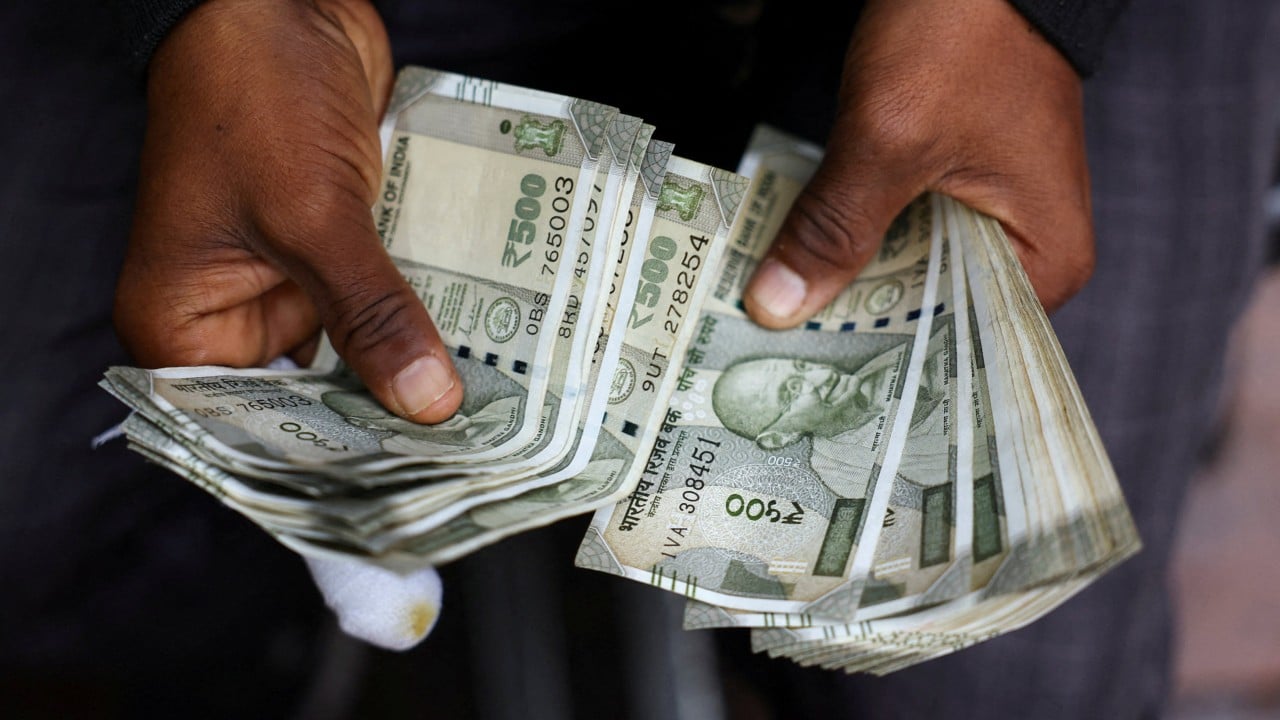
The financial press is obsessed with a ghost. They look at the Indian Rupee sliding against the Greenback and see a disaster. They call it a "struggle." They claim it contradicts the narrative of an emerging superpower. They are fundamentally, embarrassingly wrong.
In the world of macroeconomics, a "strong" currency is often a vanity metric for politicians and a trap for developing manufacturing hubs. The hand-wringing over the Rupee’s depreciation ignores the mechanics of global trade. If you want to build the next global factory, you don’t do it with an overvalued currency that makes your exports DOA.
The "lazy consensus" suggests that a falling Rupee is a sign of weakness. I’ve watched central banks burn through billions in foreign exchange reserves trying to defend "psychological levels" for the sake of optics. It is a waste of capital. A sliding Rupee isn't a bug; it's a feature of a country finally getting its trade priorities straight.
The Vanity of the Strong Currency
Why do analysts equate currency strength with economic health? It’s a hangover from the gold standard era. Today, currency value is relative. If the US Federal Reserve keeps interest rates higher for longer, the Dollar strengthens. That is a US policy outcome, not an Indian failure.
Critics point to the Rupee hitting record lows as if it’s a scoreboard. It’s not. It’s a pressure valve. By allowing the Rupee to find its level, the Reserve Bank of India (RBI) ensures that Indian textiles, software, and generic drugs remain competitive against Southeast Asian rivals.
Imagine a scenario where the RBI forced the Rupee to 70 against the Dollar today. Inflation would drop slightly in the short term, sure. But Indian exports would crater. The trade deficit would balloon because domestic goods would be priced out of the global market. You cannot "strong-arm" your way to a $5 trillion economy while strangling the very sectors that bring in foreign capital.
The Import Obsession
The most common counter-argument is oil. India imports the vast majority of its crude. A weaker Rupee makes that oil more expensive, which theoretically drives inflation.
This is a surface-level take.
Inflation in India is increasingly driven by domestic supply chain bottlenecks and food prices, not just the landed cost of Brent crude. More importantly, the "pain" of expensive imports is the exact catalyst needed to accelerate the transition to renewables and domestic ethanol blending. Cheap oil—subsidized by an artificially strong currency—only delays the inevitable structural shifts India needs.
I’ve seen portfolios wrecked by investors who thought a stable currency was a proxy for a stable economy. It’s often the opposite. A currency that refuses to move in the face of global headwinds is usually a sign of a central bank that is manipulated by political optics rather than economic reality.
The China Comparison Everyone Misses
For decades, the West screamed about China manipulating its currency. Why? Because Beijing knew that a "weak" Yuan was the oxygen for its industrial fire. They kept their currency undervalued to capture global market share.
India is now playing a more sophisticated version of this game. The RBI isn't "struggling" to keep the Rupee up; they are managing a graceful, controlled descent. This prevents the kind of volatility that scares off Foreign Institutional Investors (FIIs) while ensuring the "Make in India" initiative isn't gutted by high exchange costs.
If you are waiting for the Rupee to "recover" to 2015 levels before you buy into the India story, you aren't an investor. You're a tourist.
Foreign Reserves Are Not a War Chest for Vanity
India’s forex reserves are hovering near all-time highs. The "doom-and-gloom" crowd sees this and asks: "Why aren't they using that money to save the Rupee?"
Because that’s not what the money is for.
The reserves are an insurance policy against a balance-of-payments crisis, not a slush fund to satisfy the ego of currency traders. Using reserves to fight the US Dollar’s global dominance is like trying to put out a forest fire with a garden hose. You don’t win. You just get wet and run out of water.
The RBI is smarter than the pundits. They are letting the Rupee slide to absorb the shock of global volatility. This is a sign of a mature, confident economy that doesn't need a "strong" currency to prove it belongs at the table.
The Myth of the "Struggling" Rupee
Let’s dismantle the word "struggling."
A currency struggles when there is no demand for it. But Foreign Direct Investment (FDI) into India remains significant in key sectors. Global giants are moving supply chains from the Pearl River Delta to Tamil Nadu and Gujarat. They aren't doing this because they love the Rupee; they are doing it because the total cost of production—adjusted for currency—makes sense.
When the Rupee depreciates by 3% or 5% a year, it offsets India's higher inflation rate compared to the US. This is $Purchasing Power Parity (PPP)$ in action. If the currency didn't depreciate, Indian goods would become more expensive in real terms every single year. The "struggle" is actually a necessary recalibration to keep the economy from becoming uncompetitive.
Stop Asking the Wrong Questions
The media asks: "When will the Rupee stop falling?"
The right question is: "How much more productive is the Indian worker becoming?"
Currency is a medium of exchange. Productivity is the reality. If India continues to build out its physical and digital infrastructure, the nominal value of the Rupee becomes secondary.
- Productivity Gains: Digital public infrastructure (UPI, ONDC) is slashing the cost of doing business.
- Manufacturing Shift: The PLI (Production Linked Incentive) schemes are finally gaining traction.
- Demographics: A young workforce is entering its peak earning years.
None of these factors are diminished by a Rupee at 83, 85, or even 90. In fact, a slightly cheaper Rupee acts as a tailwind for these structural changes.
The Export Pivot
We are witnessing a pivot. India is moving from being a service-export giant to a hardware-export contender. You don't win the hardware game with a prestige currency. You win it with ruthless efficiency and price points that undercut the competition.
The bearish narrative around the Rupee is a distraction for the mathematically illiterate. It’s a way to sound "cautious" without actually understanding the underlying trade flows.
I’ve sat in rooms where analysts cried about the Rupee while ignoring the fact that corporate balance sheets in India are the cleanest they’ve been in a decade. The "Twin Balance Sheet" problem that plagued the last decade has been largely resolved. Banks are lending. Credit growth is up. Tax collections are hitting records.
If you want to bet against a country because its currency is adjusting to global reality, go ahead. But don't call it analysis. Call it a misunderstanding of how the world actually works.
The Rupee isn't falling because India is failing. The Rupee is adjusting because India is competing.
If you can't tell the difference, you shouldn't be in the market.