The Pacific Ocean is a fickle graveyard for metal, but on this particular morning, it felt like a cradle.
There is a specific kind of silence that exists in the moments before a hatch opens. It is not the absence of sound, but the heavy, vibrating presence of anticipation. For the engineers standing on the deck of the USS Portland, the air tasted of brine and diesel. For the Orion capsule bobbing in the swells, the air inside was something else entirely—a stale, recycled ghost of a journey that spanned a quarter-million miles of vacuum. If you found value in this piece, you might want to check out: this related article.
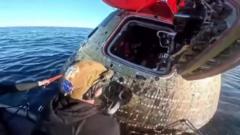
When the hinges finally groaned and the seal broke, the smell of the moon spilled out.
It isn’t cheese, and it isn't dust. Astronauts from the Apollo era described it as spent gunpowder. It is the scent of extreme survival. As the recovery teams leaned in to peer into the dark, cramped interior of the spacecraft, they weren't just looking at wires and seats. They were looking at the first tangible proof that we can go back—and that this time, we might actually stay. For another look on this story, see the recent update from Gizmodo.
The Weight of a Cold Metal Box
To the casual observer, Orion is a high-tech cone. To the people who spent a decade of their lives tightening its bolts, it is a cathedral of physics.
Consider the heat shield. During its descent, the capsule slammed into the Earth’s atmosphere at 25,000 miles per hour. That is roughly thirty times the speed of sound. At those velocities, the air doesn't just move out of the way; it compresses into a wall of plasma. The underbelly of the craft endured temperatures nearing 5,000 degrees Fahrenheit.
Physics is a brutal auditor. If a single tile fails, if a seal is a fraction of a millimeter off, the story ends in a streak of light across the sky. But it didn't.
Instead, the capsule sat in the recovery bay, charred and scorched like a toasted marshmallow. The technicians approached it with a reverence usually reserved for religious relics. They moved slowly. They touched the blackened hull with gloved hands, feeling the ridges where the heat had literally sculpted the material. There is a profound intimacy in touching something that has been where no human has set foot in fifty years.
The Invisible Passengers
Inside the capsule, there were no humans—not yet.
There were three "mannequins," though the term feels too hollow for what they represented. Commander Moonikin Campos, Helga, and Zohar were wired with thousands of sensors designed to feel everything a human body would feel. They felt the bone-shaking vibrations of the SLS rocket launch. They felt the eerie, weightless drift of the deep space void. Most importantly, they felt the radiation.
Deep space is a shooting gallery of subatomic particles. Beyond the protection of Earth’s magnetic field, the sun is a beautiful, terrifying radiator. Helga and Zohar were specifically designed to measure how this radiation affects soft tissue. One wore a protective vest; the other did not.
This wasn't just a hardware test. It was a biological reconnaissance mission. We are soft, watery creatures trying to survive in a place that is fundamentally hostile to life. The data pulled from those sensors is the difference between a future colony and a tragic footnote.
When the recovery crew opened the hatch, they weren't just retrieving dolls. They were retrieving the blueprints for our survival. They checked the monitors with the frantic energy of parents checking a baby monitor in the middle of the night. Every flickering light on those consoles told a story of a heartbeat that hadn't happened yet, but soon would.
The Ghosts in the Room
As the capsule was towed into the dark hangar of the ship, the atmosphere shifted. The celebration was quiet. Professional.
You could see it in the eyes of the veteran NASA engineers. Many of them were children during the Apollo missions. They grew up on the promise of the stars, only to see that promise deferred by budgets, politics, and the crushing weight of terrestrial concerns. For fifty years, we have been tethered to Low Earth Orbit, circling the block like a driver afraid to take the highway.
Orion represents the end of that fear.
The reunion wasn't just between the scientists and their machine. It was a reunion between humanity and its own ambition. There is a psychological cost to staying grounded. We are a species of explorers, and when we stop moving, we start to wither. The "Welcome Home" signs draped over the railings of the USS Portland weren't just for the capsule. They were for us.
We are finally coming back to ourselves.
The Logistics of a Miracle
It is easy to get lost in the poetry of the stars, but the reality of Orion is found in the grime.
The recovery team had to navigate "purple water"—the toxic runoff from the spacecraft's propellant. They had to account for the erratic pitching of the sea. They had to ensure that the delicate instruments inside weren't jarred by the transition from 0g to the heavy, unforgiving pull of Earth's gravity.
Every wire they disconnected and every sample they bagged was a victory over entropy.
People often ask why we spend billions on a metal box in the ocean when there are problems here on the ground. It is a fair question, and the answer isn't found in a spreadsheet. It’s found in the way a ten-year-old looks at the moon after seeing those parachutes bloom over the Pacific.
We do it because the pursuit of the impossible is the only thing that makes the possible worth living for. We do it because the technologies invented to keep Helga and Zohar safe will eventually find their way into our hospitals, our cars, and our homes. But mostly, we do it because we have to know what's over the next hill.
The Scent of the Future
As the sun began to set over the recovery fleet, the Orion capsule looked less like a spaceship and more like a weary traveler. It was stained by salt, scarred by fire, and stripped of its pristine white finish.
It was perfect.
The engineers began the long process of downloading the terabytes of data stored in its "brain." They worked through the night, fueled by lukewarm coffee and the adrenaline of success. They knew that in a few short years, the seats currently occupied by mannequins would be filled by people. They would have names, families, and beating hearts. They would look out those same windows and see the Earth as a small, fragile blue marble.
The "joyful reunion" described in the news reports wasn't about a piece of hardware returning to a warehouse. It was about the closing of a circle. We went out into the dark, we touched the silence, and we came back with the knowledge that the way is open.
The hatch is closed for now, but the air inside still smells of the moon. It is a sharp, metallic reminder that our ceiling is higher than we thought. As the ship turned toward the California coast, the Orion capsule sat quietly in the hold, a stowaway from the future, waiting for its next chance to fly.
The ocean was calm. The stars were out. And for the first time in a long time, they didn't feel so far away.