The air inside a darkened theater usually smells of artificial butter and recycled oxygen. But when the first low, guttural thrum of Hans Zimmer’s score for Dune vibrates through the floorboards, that smell changes. For the audience, it becomes the metallic tang of spice and the dry, suffocating heat of a world that wants you dead.
Outside those theater walls, a different kind of heat is rising. Warner Bros. just dropped a new trailer, a three-minute sensory assault designed to do more than just sell tickets. It is a declaration of war. Not against the Harkonnens, but against the reigning kings of the modern box office: the brightly colored, quippy, and seemingly invincible Avengers.
The numbers guys in Burbank aren't just looking at theater counts. They are staring at a cultural schism. On one side, you have the Marvel Cinematic Universe—a well-oiled machine that has defined the last decade of cinema through high-flying heroics and a formula that feels as comfortable as an old sweater. On the other, you have Denis Villeneuve’s Arrakis. It is bleak. It is dense. It is a story where the hero doesn't necessarily want to save the world, but is terrified he might accidentally destroy it.
The Weight of the Crown
Consider the "Blockbuster" as a living entity. For years, this beast has been fed a steady diet of snarky dialogue and CGI sky-beams. It grew fat and predictable. Fans knew that no matter how high the stakes, a joke was always waiting around the corner to deflate the tension. It was safe.
Then came the sand.
When the new Dune trailer flickers to life, we see Paul Atreides, played by Timothée Chalamet, looking less like a superhero and more like a boy drowning in a suit of armor three sizes too big. There is no quip. There is only the sight of a massive, prehistoric worm rising from the earth like a god. The scale is unsettling. It makes the viewer feel small, a sensation that modern blockbusters have spent years trying to avoid. Marvel makes you feel like you could be Captain America. Dune makes you feel like you are about to be crushed by a tectonic plate.
This is the "box office battle" the headlines keep shouting about. It isn't just a fight for screens. It is a fight for the soul of what we consider "big" movies.
The Invisible Stakes of the Spice War
Imagine a hypothetical moviegoer named Elias. Elias grew up on the Avengers. He knows the lore, he bought the shield, and he cried when Stark snapped his fingers. To Elias, movies are a reward. They are a bright, loud escape from a job that grinds him down forty hours a week.
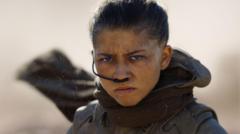
Now, Elias sits in front of this new Dune footage. He see Zendaya’s Chani, her eyes a haunting, unnatural blue, looking at the camera with a weary skepticism that feels uncomfortably real. He sees a world where water is more precious than gold and where politics are a knife in the dark.
The stakes for Elias are emotional. If Dune wins—if it actually captures the massive, diverse audience it needs to justify its existence—the "escape" Elias seeks might change. It might become more demanding. It might ask him to sit with silence, to parse out the nuances of religious fanaticism, and to accept a story where the "good guys" are just the ones with the slightly less horrific plan.
The industry is holding its breath. If Dune falters, the message to every studio in Hollywood is clear: don't take risks. Stay in the lane. Keep the colors bright and the stakes manageable. But if it soars? Then the gates swing open for a different kind of epic—one that respects the audience's intelligence as much as their appetite for spectacle.
The Ghost in the Machine
We often talk about these films as products, but they are built by hands that tremble. Villeneuve has spoken openly about his obsession with Frank Herbert’s novel since he was a teenager. This isn't a "gig" for him. It’s an exorcism.
Compare that to the assembly-line precision of a standard superhero flick. There is a reason the Dune trailer feels different; it carries the scent of a singular vision. Every frame is a painting, not because a committee decided it should be, but because a man who has spent decades dreaming of Arrakis finally got the keys to the desert.
The risk is enormous. Dune is a story about the dangers of following a "Chosen One." It is a cautionary tale wrapped in a space opera. In a world that currently feels like it’s teetering on the edge of several different types of ruin, a movie about a collapsing empire and a resource-driven war hits a little too close to home.
The Avengers offered us a world where the problems could be punched into submission. Dune offers us a world where the problems are us.
The Anatomy of a Trailer
The new footage leans heavily into the relationship between Paul and Chani. This is a tactical move. The studio knows that to beat the Marvel machine, they need a heartbeat. They need people to care about the faces behind the stillsuits.
We see glimpses of Austin Butler’s Feyd-Rautha, a pale, terrifying contrast to the bronze warmth of the desert. The choreography looks brutal and intimate. It’s a dance of blades rather than a barrage of energy blasts. This choice highlights the physical reality of the world. In the MCU, physics are a suggestion. In Dune, gravity is a character. Every step in the sand is a struggle. Every breath is a cost.
This groundedness is the secret weapon. In an era of digital fatigue, where everything on screen feels like it was rendered in a vacuum, Dune looks like it was dragged out of the dirt. You can almost feel the grit in your teeth.
The Bottom Line of the Soul
The "battle" is often framed in millions of dollars, but the real currency is attention. We only have so much space in our collective consciousness for myths. For the last fifteen years, that space has been occupied by capes and masks.
If you look closely at the trailer, there is a shot of Paul standing before a sea of Fremen warriors. They aren't cheering. They are waiting. There is a heavy, religious fervor in the air that feels dangerous. It’s a far cry from the triumphant "Avengers Assemble" moment. It’s a moment of terrifying responsibility.
That is the choice facing the audience this season. Do we want the comfort of the assembly, or the terror of the desert? Do we want to be told we are heroes, or do we want to be shown how fragile our civilizations truly are?
The industry expects a slaughter. They expect the established brands to steamroll anything that requires a glossary to understand. But there is a quiet, growing hunger for something that leaves a scar. People are tired of movies that disappear the moment the lights come up. They want something that stays in the room with them.
The trailer ends not with a punchline, but with a promise of fire. Paul Atreides isn't smiling. He is staring into a future he knows is paved with bodies. It’s a grim prospect for a summer blockbuster, but perhaps it’s exactly what we need.
The desert is coming. You can try to fight the storm, or you can learn to walk with it. Either way, the map of the cinematic world is about to be redrawn, and for the first time in a long time, the outcome isn't written in the stars. It’s written in the sand.
As the screen fades to black and the final note of that haunting, metallic wail dies out, one truth remains. The era of the "safe" epic is under siege, and the challenger doesn't have a cape—he has a knife and a vision of a world on fire.