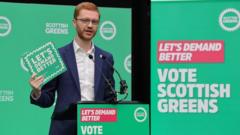
The Scottish Green Party just dropped a manifesto that reads like a letter to Santa Claus, written by someone who has never seen a balance sheet. They are promising a "transformation" of Scotland. What they are actually offering is a controlled demolition of the Scottish economy under the guise of "fairness" and "sustainability."
Everyone is nodding along to the talking points about a "just transition" and "taxing the rich." It sounds lovely. It feels moral. It is mathematically impossible.
The lazy consensus among the Scottish press is that the Greens are the "conscience" of the independence movement or the "radical edge" of environmentalism. They aren't. They are a fiscal liability. If you want to understand why Scotland's growth is stagnant while the rest of the world evolves, look no further than the policy anchors being dropped by the Green manifesto.
The Just Transition is a Just Fantasy
The Greens want to shut down the North Sea oil and gas industry with the speed of a guillotine. They claim this will be a "just transition" where workers move into high-quality green jobs.
Here is the cold, hard reality: You cannot replace a high-margin, global commodity industry with a subsidized, local utility sector and expect the tax base to survive.
I have spent years analyzing energy infrastructure. When an oil worker earns £80,000 a year, they contribute massive amounts to the Scottish tax pool. When that worker is "transitioned" into installing heat pumps—a job that often pays half that—the government loses. The "green jobs" the Greens talk about are often precarious, seasonal, or heavily dependent on government grants that the Greens won't have the money to pay for once they’ve killed the golden goose in Aberdeen.
We aren't talking about a pivot. We are talking about an amputation. By opposing new licenses and demanding an immediate halt to production, the Greens aren't saving the planet. They are merely ensuring that Scotland imports its energy from countries with lower environmental standards and higher carbon footprints for transport. It’s NIMBYism on a national scale.
Wealth Taxes are the Ultimate Ghost Chase
The manifesto leans heavily on taxing the "top 1%." This is the oldest trick in the populist playbook. The problem? Wealth is mobile. Especially in a post-pandemic world where the people the Greens want to tax can move their primary residence to Newcastle or Dubai with a single laptop click.
The Greens propose an annual wealth tax. They ignore the fact that every European nation that tried a broad wealth tax—France, Sweden, Germany—eventually scrapped or gutted it because the administrative costs were astronomical and the capital flight was devastating.
- The French Lesson: When France implemented its ISF (wealth tax), it lost an estimated 42,000 millionaires in a decade. They didn't just take their wealth; they took their investment capital, their businesses, and their future tax contributions.
- The Valuation Nightmare: How do you tax a private business that hasn't been sold? How do you tax a family estate that has no liquidity? You force fire sales. You destroy local ownership. You hand the keys of the Scottish economy to foreign private equity firms who are the only ones with the cash to buy the distressed assets the Green tax code would create.
The Greens think they are Robin Hood. In reality, they are the sheriff of Nottingham, driving the productive class out of the forest entirely.
The Rent Control Catastrophe
The manifesto doubles down on rent controls. It’s the "people also ask" favorite: "Why can't we just cap rents to make housing affordable?"
Because it doesn't work. It has never worked.
I’ve seen cities from Berlin to San Francisco try this. The result is always the same. Supply craters. Landlords stop maintaining properties because there is no ROI. New builds stop because the math doesn't square.
If you cap the price of a commodity without addressing the supply, you create a black market and a lottery system. The Greens want to protect tenants, but their policy will ensure that no young person in Scotland can find a new flat in five years. They are protecting the people who already have a lease at the expense of everyone who doesn't. It is intergenerational theft masked as social justice.
Independence Without an Engine
The Greens are the most vocal proponents of independence, yet their manifesto makes the economic case for it impossible.
To launch a new state, you need a stable currency, a plan for a deficit that doesn't trigger IMF intervention, and a growth engine. The Greens want to:
- Kill the primary export (Oil/Gas).
- Tax the primary investors (Wealthy individuals/Corporations).
- Increase the primary expense (Massive expansion of the public sector).
You cannot build a new country on a foundation of "de-growth." De-growth is a luxury belief held by people who already have enough. For the family in Dundee struggling with energy bills or the graduate in Glasgow looking for a career in tech, de-growth is just another word for poverty.
The Greens argue that "GDP is a broken metric." Fine. Let's use well-being. But well-being requires heated homes, modern hospitals, and a functioning transport system. All of those things require revenue. By attacking the mechanisms of wealth creation, the Greens are effectively campaigning for a poorer, smaller, more isolated Scotland.
The Myth of the "Green Investment Bank"
The manifesto talks about using a state-owned investment bank to spark a revolution. This is a misunderstanding of how capital works. Government-led investment banks are notoriously bad at picking winners. They pick political favorites. They fund projects that look good in a press release but fail in the market.
True innovation comes from risk-takers who have skin in the game. By creating a regulatory environment that is hostile to private capital, the Greens ensure that the only "investment" left is taxpayer-funded. That isn't a "transformed" economy; it's a command economy. And we know how those end.
The Missing Nuance: Real Environmentalism
If the Greens actually wanted to save the environment and the economy, they would be talking about:
- Nuclear Baseload: You cannot run an industrial nation on wind and hope alone. Their dogmatic opposition to nuclear energy is a betrayal of science.
- Deregulation for Density: Instead of rent controls, they should be demanding the abolition of planning laws that prevent high-density, energy-efficient housing.
- Carbon Capture at Scale: Instead of shutting down the North Sea, use the expertise there to become the world’s carbon sink.
But those things aren't "radical" in the way that gets you likes on social media. They require compromise. They require an understanding of engineering and global trade.
The Scottish Green manifesto is not a blueprint for a nation. It is a suicide note for an economy. It ignores the basic laws of supply and demand, the reality of global capital mobility, and the energy needs of a modern society.
Stop treating this manifesto as a serious political document. It is a collection of expensive wishes written in disappearing ink. If Scotland follows this path, the "transformation" will be real, but it won't be the one promised. It will be the sight of a nation turning its back on the future to chase a ghost.
Build something. Create something. Stop trying to tax and regulate Scotland into a museum.