The pre-dawn air in Chachoengsao province always smells faintly of river mud and exhaust. At 4:00 AM, the world is muted, cast in shades of deep indigo and the sickly orange of roadside halogen lamps. For the workers boarding the tour bus that morning, the day was supposed to be a celebration. They were heading to a Buddhist temple in Samut Prakan to mark the end of Vassa, the rain retreat. They wore their best clothes. They carried food for merit-making, wrapped carefully in plastic containers.
They never made it to the temple.
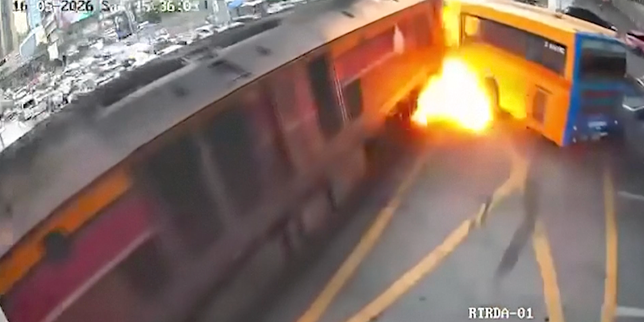
Instead, their journey ended in a sickening crunch of tearing sheet metal, shattered glass, and the terrifying, deafening horn of a freight train that could not stop. Eight lives vanished in a heartbeat. Dozens more were broken. It is a tragedy that repeats itself with horrifying regularity on the periphery of Bangkok, a city where infrastructure struggles to keep pace with the sheer velocity of human life.
To understand how this happens, you have to understand the geography of a crossing.
The Illusion of the Clear Track
Imagine a typical railway crossing in the rural stretches just outside the capital. It is not always a place of flashing lights and heavy dropped barriers. Often, it is just a gap in the trees. A couple of faded signs. A strip of asphalt cutting across rusted iron rails.
Let us look at a hypothetical driver—we will call him Prasert. Prasert has been driving buses for twenty years. He knows the roads, or at least he thinks he does. The cabin of a tour bus is its own world. It is filled with the chatter of passengers, the hum of the air conditioning, perhaps a local radio station playing country music softly in the background. It is an environment built to isolate the occupants from the harshness of the outside world.
But that isolation is dangerous.
When Prasert approaches a crossing at dawn, the light is deceptive. The tracks look empty. The human brain is wired to look for movement, but a train approaching head-on looks stationary until it is suddenly, catastrophically close. This is the phenomenon of size-arrival illusion. Because a train is massive, our eyes trick us into believing it is moving much slower than its actual speed.
Prasert presses the accelerator. He thinks he has time.
He doesn’t.
The Physics of an Unstoppable Force
A freight train carrying cargo from the eastern ports toward Bangkok does not operate on the scale of human reflexes. It weighs thousands of tons. Even when the engineer slams on the emergency brakes, the laws of physics are absolute. Friction takes time to win against that much momentum. A train travelling at seventy kilometers per hour requires nearly a kilometer of track just to come to a complete halt.
The engineer sees the bus. He pulls the horn. It is a desperate, screaming wail that echoes across the rice paddies. But inside the bus, the sound arrives too late.
The impact is not like a car crash. It is an erasure. The locomotive acts as a kinetic wedge, slicing through the fiberglass and thin aluminum shell of the bus with the ease of a knife through paper. The passengers on the side of the impact are thrown into a chaotic vortex of debris.
When the dust settles, the silence returns. But it is a heavy, broken silence.
The Cost of the Unprotected Crossing
The statistics paint a grim picture, but statistics are cold. They don't feel the weight of a missing parent or the sudden, violent end to a family's financial stability. Thailand’s roads are notoriously dangerous, frequently ranking among the most perilous in the world. Yet, the focus is often on the chaotic highways, while the quiet intersections where steel meets rubber are left overlooked.
There are hundreds of illegal or unregulated crossings scattered across the national rail network. These are paths carved out by locals over decades, shortcuts that became permanent roads without the formal approval of the State Railway. They lack gates. They lack lights. They rely entirely on the vigilance of individuals who are often tired, distracted, or blinded by the sun.
Consider the reality of the aftermath:
- The immediate rush of emergency responders, their red lights cutting through the morning fog.
- The grim task of identification, searching through scattered personal belongings for ID cards.
- The hospital waiting rooms, filled with relatives who woke up expecting a blessing and ended the day in mourning.
This is the hidden tax of rapid modernization. We build the tracks to move goods, and we build the roads to move people, but we fail to secure the points where those two worlds collide.
The Anatomy of Reflex and Regret
Why do drivers take the risk? It is easy to blame recklessness, to point fingers at a culture of impatience. But the truth is more complicated, rooted in human psychology.
When a driver approaches a familiar crossing that is usually empty, complacency sets in. The brain creates a mental shortcut: I have crossed here a hundred times, and a train has never been there. This cognitive bias creates a false sense of security. The driver stops looking for the train; they look for the absence of the train.
Combine this with poor visibility—overgrown vegetation, lack of reflective signage, or the glare of a rising sun—and the margin for error shrinks to zero.
The solution is not a mystery. It does not require experimental technology. It requires the systematic installation of automatic barriers, audible warning systems, and clear sightlines at every single intersection, no matter how remote. It requires treating every crossing as a potential disaster zone rather than a minor inconvenience on the map.
Until that happens, the tracks will remain a gamble.
The sun eventually rose fully over Chachoengsao that morning, illuminating the wreckage. A tangled mass of metal sat by the side of the rails, a stark contrast to the green fields surrounding it. A few hours later, the train was cleared, the tracks were inspected, and another locomotive rumbled through the same intersection, its horn blowing into the empty air. The world moved on, but for eight families, time stopped permanently at 4:00 AM.