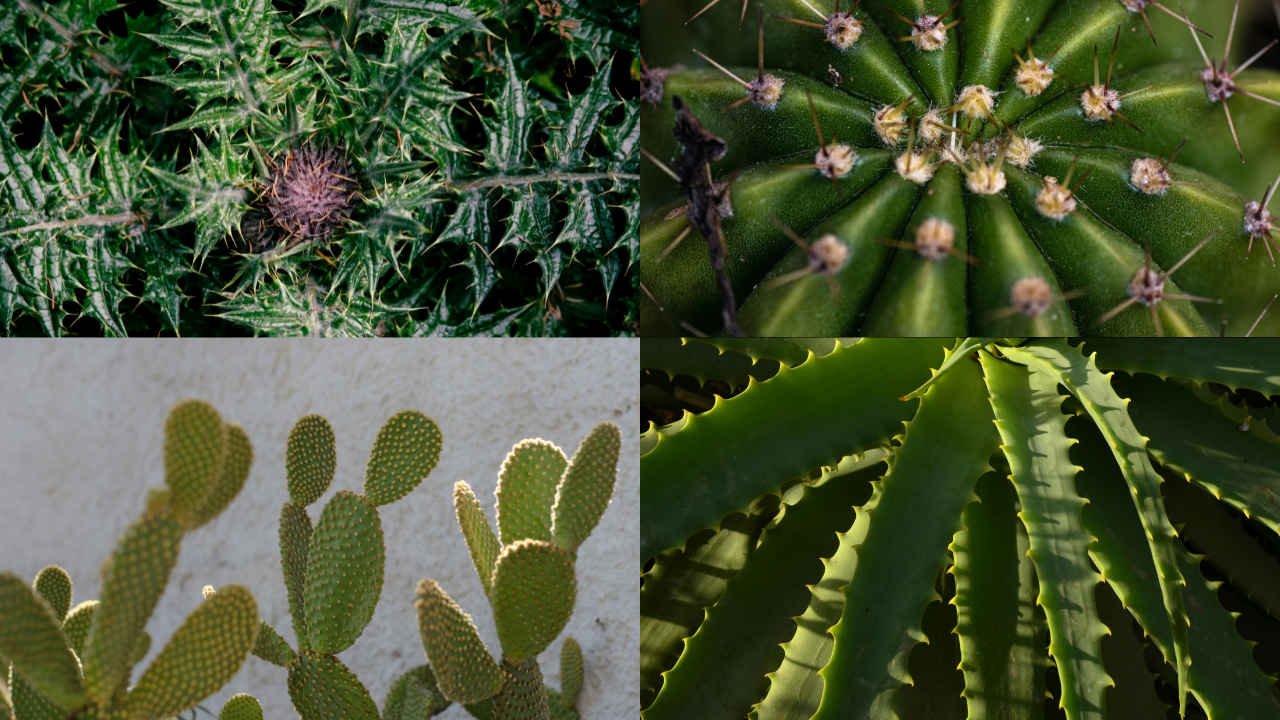
Every gardener has a version of the same scar. It is usually a thin, jagged line across the pad of the thumb or a series of angry red pinpricks along the forearm. You reach into the green thicket for a ripe tomato or a heavy-headed peony, and the plant bites back. We accept this as a tax on beauty. We call them thorns, though a botanist would insist on the word prickles for the roses and spines for the cacti. Whatever the name, these sharp, silent sentinels have guarded the green world for millions of years.
For centuries, we didn't know how they got there. We understood the why—starving herbivores with soft tongues—but the how remained locked inside a microscopic vault. It seemed as though nature simply reached for a weapon whenever life got difficult. But recently, a group of scientists at Cold Spring Harbor Laboratory cracked the code. They found the "on" switch for the world’s most successful defense system.
The Loneliness of the Defenseless
Imagine a world—not a metaphor, but a literal prehistoric reality—where every living thing is a buffet.
Plants are the ultimate sitting ducks. They cannot run. They cannot hide. They simply stand in the sun, converting light into sugar, essentially becoming delicious, stationary batteries for anything with teeth. This is the existential crisis of the botanical world. If you are a plant, you are a target.
Evolution is often described as an arms race, but for a long time, it looked more like a massacre. To survive, plants had to become architects of pain. They developed chemical warfare, flooding their leaves with bitter alkaloids or heart-stopping toxins. But chemicals are expensive to produce. They require metabolic energy that could otherwise go toward growing taller or making more seeds. Sharp edges, however, are a structural investment. A thorn is a one-time construction project that pays dividends for a lifetime.
The mystery that haunted biologists was the sheer coincidence of it all. How did a rose, a desert succulent, and a nightshade all arrive at the same jagged solution? They aren't close relatives. It’s as if three different inventors, living on three different continents with no way to communicate, all invented the exact same padlock at the exact same time.
The Master Key in the Code
The scientists didn't find a new gene. They found an ancient one.
They discovered that a specific family of genes, known as Lonely Guy (LOG), is responsible for the sharp protrusions across an incredible variety of species. It is a whimsical name for a brutal mechanism. These genes are usually involved in regulating hormones that tell a plant’s cells to divide and grow. But at some point in the deep past—roughly 400 million years ago—a mutation occurred.
The LOG genes began to trigger a localized explosion of growth. Instead of a flat leaf or a smooth stem, the plant began to build a spike.
This isn't just a win for the botany nerds. It is a revelation of how life actually works. It suggests that nature doesn't always have to reinvent the wheel. It has a toolbox. When a plant needs to defend itself, it doesn't wait for a million years of random luck to create a weapon from scratch. It reaches into the attic, finds the LOG gene, and repurposes it.
Consider the eggplant. For thousands of years, humans have been breeding the thorns out of crops to make them easier to harvest. We wanted the fruit, not the fight. By using CRISPR—a tool that acts like a pair of molecular scissors—researchers were able to toggle these genes in various plants. They took a wild, prickly relative of the eggplant and, by silencing the LOG gene, turned it into something smooth and defenseless.
The Human Cost of the Sting
Why does this matter to someone who doesn't spend their weekends weeding a garden? Because our relationship with the earth is defined by these barriers.
There is a hidden economy in the thorn. Think of the millions of hours lost to "harvester fatigue," where workers must move with agonizing slowness to avoid being shredded by the very crops that feed us. Think of the loss of yield when a plant spends 20% of its energy building a fence of spines instead of fattening its fruit.
When we understand the genetic switch, we gain the ability to dial the defense up or down. We could, theoretically, create "naked" versions of almost any crop, making farming safer and more efficient. But there is a haunting side to this power.
When we strip a plant of its armor, we make it entirely dependent on us. A thornless rose cannot survive in the wild. It is a captive beauty. We are effectively disarming the natural world to suit our convenience, trading the plant's autonomy for our comfort.
The Ghost of the Mammoth
There is a specific kind of thorn found on trees like the Honey Locust. These thorns are massive, sometimes growing several inches long and branching out like stag antlers. If you see them today, they look like overkill. No deer or rabbit is intimidated by a spike that sits six feet off the ground.
These are "ghost thorns."
They were evolved to stop creatures that no longer exist. They were built to pierce the thick hides of mastodons and giant ground sloths—beasts that have been extinct for millennia. The trees are still armored for a war that ended ten thousand years ago. They haven't received the memo that the giants are gone.
This reveals a profound truth about biology: it is conservative. It holds onto its weapons long after the enemy has vanished. The LOG gene is that memory. It is a molecular scar of every bite taken by a prehistoric mouth.
The Burden of Choice
We now stand at a strange crossroads. We have the map to the armory. We know which gene to strike to turn a briar patch into a silk meadow.
This technology is the ultimate "game-changer" in the most literal sense—it changes the rules of the game between humans and the environment. But as we move toward a world of smooth stems and painless harvests, we might lose something of the plant’s character. A rose without a thorn is a different creature entirely. It is a product, not a survivor.
There is a certain dignity in the prickle. it is a "Keep Out" sign written in the language of physics. It tells us that the plant has an interest in its own life, an agenda that does not include being eaten by us.
When you next see a rose, look closely at the base of the bloom. See the way the skin of the stem pinches upward into a sharp, translucent hook. That isn't just a random fluke of nature. It is the result of a 400-million-year-old gene firing a signal, a tiny biological command that says: I am here, I am alive, and I will not go quietly.
We can turn that signal off now. We can make the world smoother, softer, and easier to touch. But we should remember that those thorns were the only thing that kept the world green while the giants were walking.
The scar on your thumb is a bridge to that history. It is a reminder that even the most beautiful things in this world are prepared to fight for their place in it.
We have finally solved the mystery of the thorn, but in doing so, we have inherited the responsibility of the shield. We are no longer just observers of the garden. We are its editors. And as any editor knows, when you remove the conflict from a story, you risk making it very, very dull.
The thorn is the conflict. It is the tension. It is the sharp, stinging proof that life is not just something to be consumed, but something that insists on its own survival, one jagged point at a time.