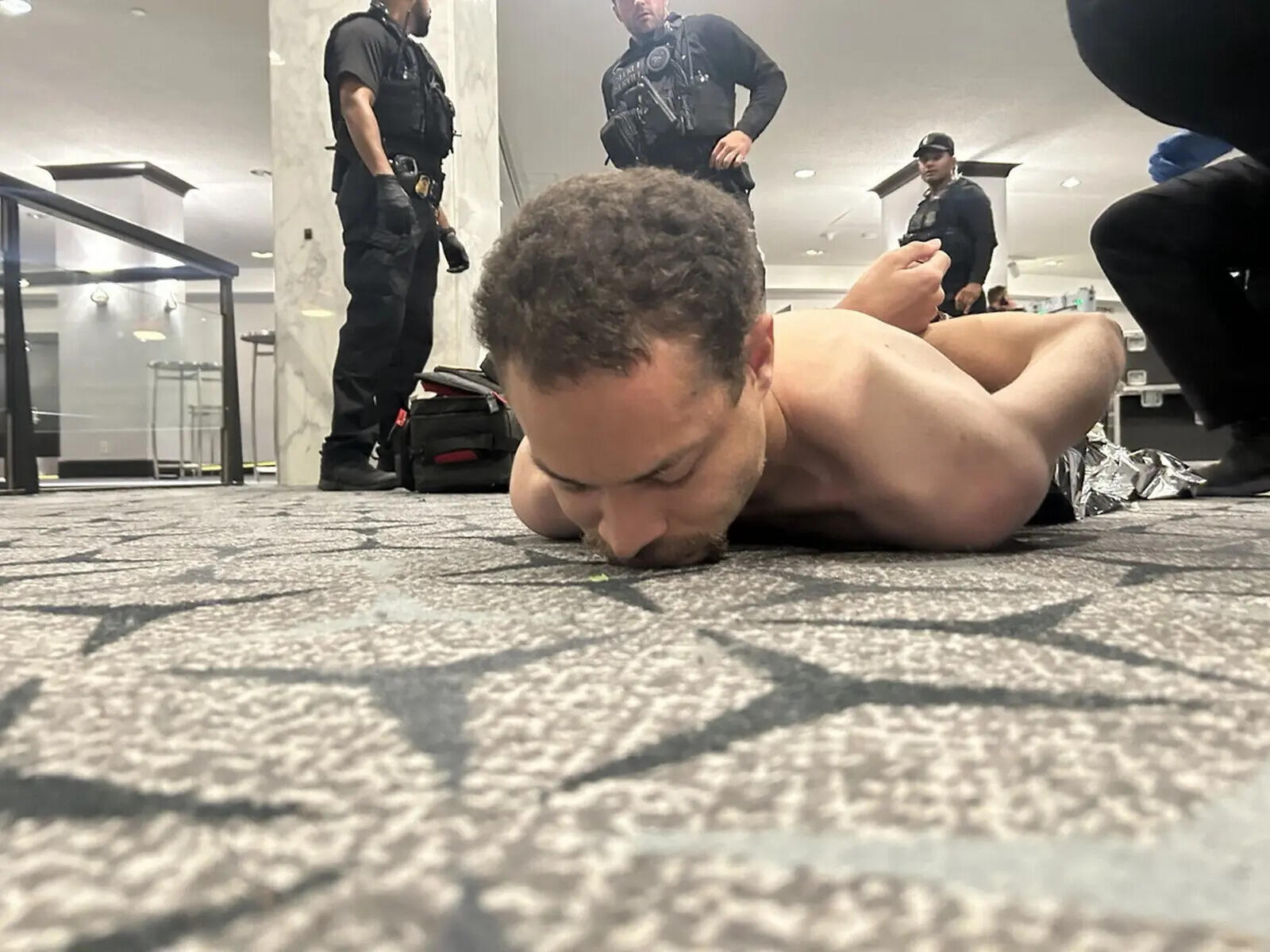
The attempted assassination of Donald Trump on April 27, 2026, represents a systemic collapse of "sterile zone" integrity rather than a simple lapse in peripheral surveillance. When Cole Allen allegedly fired during the private dinner event, the failure was not merely human but architectural. Security for high-profile political targets relies on a series of concentric circles where the probability of threat detection must increase as the distance to the target decreases. The breach at this event confirms that the innermost circle—the immediate physical environment of the venue—was compromised by a failure in technical screening protocols and personnel verification.
The Breach of Concentric Security Theory
Effective dignitary protection functions through the Principle of Nested Defenses. Each layer serves a specific diagnostic purpose:
- The Outer Perimeter: Managed by local law enforcement to filter vehicular and pedestrian traffic.
- The Middle Perimeter: The building envelope, where access control systems (ACS) and biometric or badge-based verification occur.
- The Sterile Zone: The immediate room or hall where the target is located, requiring 100% weapon-free certainty.
Cole Allen’s presence within the firing line of the President suggests a "social engineering" bypass or a failure in the Magnetometer Efficiency Rate. In high-speed event environments, security teams often face a trade-off between throughput and sensitivity. If the security posture was downgraded to accommodate the flow of high-net-worth guests at a private dinner, the "False Negative" rate for weapon detection inevitably rises. The investigation must quantify whether the weapon used—a concealed firearm—passed through a formal checkpoint or entered via a "back-of-house" logistical gap, such as a catering entrance or a service elevator that bypassed the primary screening matrix.
The Legal Architecture of 18 U.S.C. Section 1751
The federal charges against Cole Allen are governed by a specific statutory framework that differs significantly from standard attempted murder charges at the state level. Under 18 U.S.C. § 1751, the prosecution does not just need to prove the intent to kill, but must satisfy specific jurisdictional triggers related to the status of the victim.
- The Intent Requirement: Federal prosecutors must demonstrate a "premeditated and willful" attempt. This is often established through digital forensics—analyzing Allen’s search history, encrypted communications, and physical movements in the 72 hours preceding the event.
- The Proximity Variable: The legal definition of an "attempt" requires a "substantial step" toward the completion of the crime. Discharging a firearm in the direction of the President within a lethal range constitutes an irrefutable substantial step, removing the "abandonment of intent" defense often used in lesser criminal cases.
The charging document indicates that Allen is being held without bail, a standard procedure under the Bail Reform Act when a defendant poses a "clear and present danger to the community" or involves a "crime of violence." The judicial strategy here is to isolate the defendant to prevent "sympathetic contagion"—the risk that his actions might inspire decentralized actors to attempt similar breaches while the initial security flaws remain unpatched.
Technical Failure Analysis of the Protective Detail
The Secret Service’s "Counter-Sniper" and "Shift Shield" protocols are designed to neutralize a threat within seconds of the first kinetic action. The data suggests a delay between the identification of Allen as a suspicious person and the physical intervention. This latency period is the OODA Loop Failure (Observe, Orient, Decide, Act).
[Image of OODA Loop diagram]
In the Allen case, the "Observe" phase likely occurred, but the "Orient" phase failed. If Allen was a credentialed guest or worker, the security software would have flagged him as a "Green" or "Trusted" entity. This creates a cognitive bias known as Expectation Variance, where agents are slower to react to a threat originating from a supposedly "vetted" individual than from an external intruder.
The logistical data from the dinner reveals a high density of RF (Radio Frequency) interference, common in large hotels or gala venues. This creates a "Communication Blackout" risk. If the agent who first spotted Allen’s weapon could not transmit that data to the "inner-dial" agents within a sub-500-millisecond window, the protective barrier becomes reactive rather than preemptive.
The Cost Function of Political Instability
The attempt on Trump’s life introduces a "Volatility Premium" into the domestic political economy. Markets respond to the threat of executive decapitation by devaluing currency stability and increasing the cost of hedging.
- Information Asymmetry: In the immediate aftermath of the shooting, the lack of data regarding Trump’s condition created a localized market panic.
- Institutional Stress: The incident forces a reallocation of federal resources. The "Protective Intelligence" budget will likely see an emergency expansion, diverting funds from cyber-defense or counter-narcotics operations.
The prosecution of Cole Allen will serve as a bellwether for the "Political Violence Sentencing" trend. If the Department of Justice pursues the maximum allowable sentence under federal guidelines, it signals a shift toward Deterrence-Based Jurisprudence. This approach assumes that the severity of the punishment will increase the "Entry Cost" for future lone-wolf actors who calculate the trade-off between political expression and lifetime incarceration.
Forensic Trajectory and Ballistic Constraints
The physical evidence from the dinner scene provides a high-fidelity map of the attempt. Ballistic experts use 3D Laser Mapping to reconstruct the shot’s origin. This process determines:
- Muzzle Velocity and Drop: Defining the exact lethality of the weapon at the specific range Allen fired from.
- Acoustic Triangulation: Using the audio signatures from security body-cams and guest mobile devices to pin down the exact millisecond the trigger was pulled relative to the Secret Service’s response time.
The weapon choice is a critical data point. A small-caliber, high-concealment firearm suggests a strategy focused on "Access over Accuracy." Conversely, a larger-caliber weapon would indicate a failure of the physical screening hardware (magnetometers and X-ray scanners). If Allen utilized a non-metallic or 3D-printed composite firearm, the security failure shifts from a human error to a Technical Obsolescence crisis, where current screening tech is no longer capable of detecting modern threats.
Structural Vulnerabilities in Public-Private Security Partnerships
The dinner was held at a private venue, which necessitates a "Handshake Protocol" between federal agents and private security firms. This creates a Structural Cleavage in the chain of command.
- Data Silos: Private security may have access to guest lists and employee background checks that are not fully integrated into the Secret Service’s real-time threat database.
- Jurisdictional Friction: Who has the authority to "Stop and Frisk" a VIP guest in a private setting? This ambiguity often leads to "Soft Spots" where individuals like Allen can exploit social etiquette to bypass hard security checks.
The indictment of Cole Allen will likely lead to a mandatory overhaul of the National Special Security Event (NSSE) guidelines. This will include the elimination of "Private/Public" distinctions for Presidential movements, mandating that the Secret Service assumes total "Command and Control" over venue staff, logistics, and digital infrastructure, regardless of the private nature of the gathering.
The Strategic Shift in Protective Intelligence
The apprehension of Allen provides a massive data set for Protective Intelligence. By "Scrubbing" Allen’s digital footprint, investigators are constructing a Threat Profile Matrix. This involves mapping his radicalization timeline against specific policy announcements or media cycles.
The objective is to move from "Kinetic Defense" (stopping the bullet) to "Predictive Interdiction" (stopping the person). The Allen case proves that the "Lone Wolf" label is an analytical oversimplification. Every "Lone Wolf" exists within a digital ecosystem that provides the ideological framework and tactical knowledge required for an attack. The failure to intercept Allen before he entered the venue highlights a "Gap in Sentiment Analysis" and social media monitoring tools that failed to flag him as a high-risk entity.
Future security operations must prioritize the Neural Integration of surveillance data. This means real-time facial recognition linked to a "No-Fly/No-Access" list that updates in milliseconds. If a person’s behavioral patterns—purchasing body armor, visiting the venue site multiple times, or expressing specific violent intent online—are not synthesized into a single "Red Flag" score, the physical security team is essentially operating blind.
The prosecution must now navigate the "Political Martyrdom" risk. A public trial provides Allen with a platform, while a closed-door proceeding fuels conspiracy theories. The strategic recommendation for the Department of Justice is a "Fast-Track Evidentiary Hearing" that prioritizes technical facts over ideological motivations, stripping the event of its political utility and treating the attempted assassination as a high-level security breach and a clear violation of federal statute.