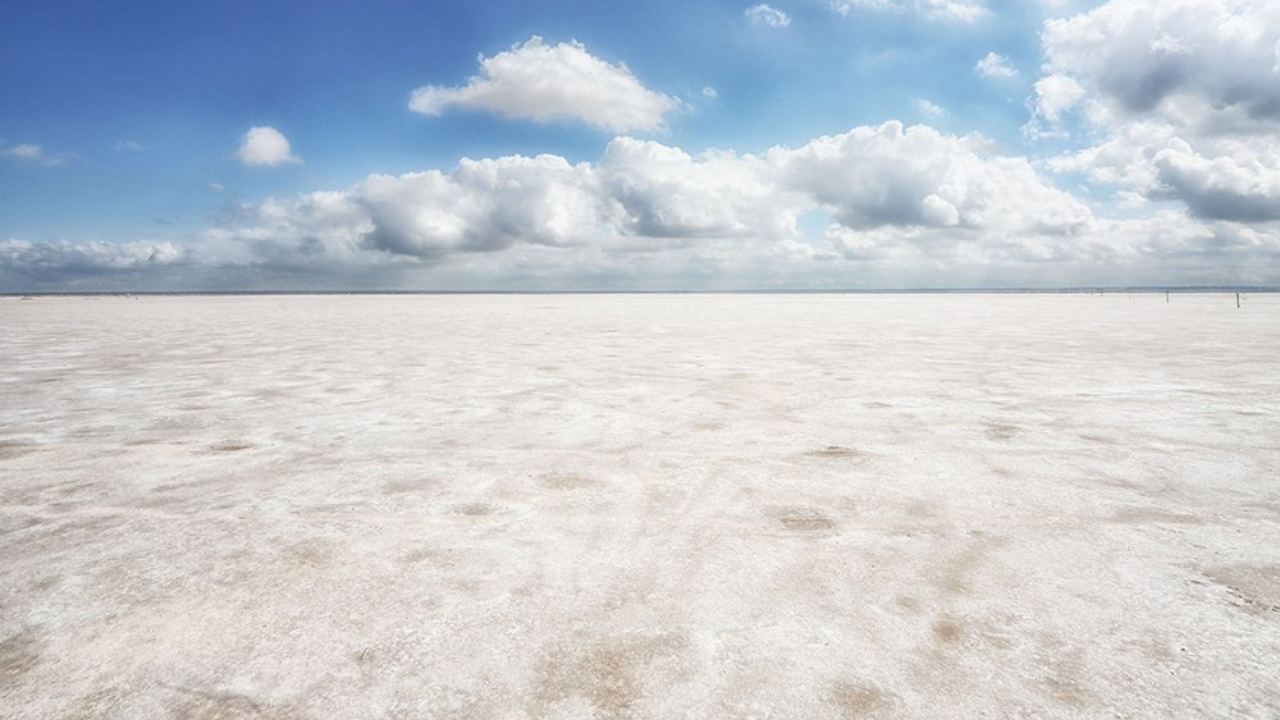
The Great Salt Plains of Oklahoma represent a geological anomaly where hydrologic pressure and specific mineral concentrations converge to produce the world’s only documented occurrence of hourglass selenite crystals. While casual observation classifies this as a recreational digging site, a structural analysis reveals a complex geochemical engine driven by the Permian-age salt deposits of the Cimarron River. The value of the site is not found in the market price of the gypsum, but in the specific environmental conditions required to precipitate a crystal lattice around moving sand and silt, creating the distinct internal hourglass inclusion.
The Geochemical Framework of Selenite Formation
Selenite is a crystalline variety of the mineral gypsum ($CaSO_4 \cdot 2H_2O$). At the Salt Plains National Wildlife Refuge, the formation process is governed by a high-salinity groundwater system rather than open-pit evaporation. The mechanism relies on three distinct environmental variables: Discover more on a similar issue: this related article.
- Saturated Brine Migration: Groundwater moves through subterranean salt deposits, becoming hyper-saturated with calcium sulfate. This brine is forced toward the surface via capillary action and hydrostatic pressure.
- Alluvial Substrate Integration: Unlike most crystals that grow in open cavities or veins, these crystals form within the soil matrix. The crystal lattice expands around the surrounding chocolate-brown silt and clay.
- Cyclical Evaporative Concentration: As moisture evaporates from the surface of the 11,000-acre salt flat, the concentration of minerals in the upper soil layers reaches a critical threshold, triggering precipitation.
The "hourglass" phenomenon occurs because the crystal grows rapidly during periods of high groundwater saturation. As the selenite blades expand, they trap iron oxide and clay particles in a specific pattern. The impurity is not random; it aligns along the diagonal axes of the crystal as it forms, resulting in a dark, sand-filled "X" or hourglass shape visible when held to the light.
Operational Constraints for Extraction
The Salt Plains National Wildlife Refuge operates under a rigid seasonal mandate designed to balance public access with migratory bird conservation. The extraction window is restricted to April 1 through October 15. This window aligns with the nesting patterns of the Interior Least Tern and the Snowy Plover, both of which utilize the salt flats for breeding. More reporting by Travel + Leisure highlights related views on this issue.
The extraction process follows a specific "wet-digging" methodology. Because the crystals are fragile and form in the top 12 to 24 inches of the salt-saturated soil, mechanical tools are ineffective and prohibited. Successful recovery requires a three-stage tactical approach:
- Pore Water Utilization: Excavators dig a hole until they reach the water table, typically found within two feet of the surface.
- Hydro-Displacement: By splashing the water against the sides of the hole, the soft clay is washed away, exposing the brittle crystal clusters without applying direct physical pressure that would shatter the gypsum.
- Manual Recovery: Once exposed, the crystals are extracted by hand. At this stage, they are extremely soft; exposure to air and the subsequent evaporation of internal moisture are required to harden the selenite into a stable state.
Resource Management and Regulatory Boundaries
The United States Fish and Wildlife Service (USFWS) maintains strict limits on resource extraction to prevent commercial exploitation and environmental degradation. The current regulatory framework permits an individual to remove up to 10 pounds of crystals plus one large cluster per day. For the casual collector, this represents a significant volume, but for the analytical observer, it serves as a price floor that keeps the material from entering the gemstone market in bulk.
The secondary constraint is the ban on resale. Crystals collected from the refuge are legally classified as "for personal use only." This prevents the commoditization of the site and ensures that the "cost" of the crystal remains tied to the labor of the individual rather than a market-clearing price.
Environmental Volatility and Site Accessibility
The salt flats are the remnants of a prehistoric sea, and their current state is an equilibrium between the Great Salt Plains Lake and the surrounding watershed. This creates a high-variance environment.
- Flooding Risk: Heavy rainfall in the Cimarron River basin can submerge the digging areas under several inches of water. Because the flats are exceptionally level, drainage is slow. If the water table rises too high, the digging pits become inaccessible, and the salt crust—which provides the necessary surface tension for travel—dissolves into a mudflat capable of trapping vehicles.
- Thermal Extremes: During the peak of the digging season (July–August), surface temperatures on the white salt crust can exceed 110°F. The albedo effect of the white salt reflects a high percentage of UV radiation upward, increasing the risk of thermal exhaustion and severe solar radiation burns.
Geological Longevity and Replenishment
A common misconception is that the crystal supply is a finite, depleting resource. In reality, the Great Salt Plains is a self-replenishing system. The crystals are "grown" annually. As the water table rises and falls with the seasons, new concentrations of gypsum are deposited. Large-scale excavation pits from one season are often filled with silt and new mineral deposits by the next spring, effectively "resetting" the field. This makes the Salt Plains a rare example of a renewable mineral resource, provided the underlying hydro-geological cycle remains uninterrupted by upstream damming or significant groundwater depletion.
Strategic Execution for Visitors
To maximize the probability of recovering high-quality, intact hourglass specimens, one must optimize for the following variables:
- Timing: Arrive at the opening of the season (April) or immediately after the flats dry out following a mid-summer rain. These periods offer the least-disturbed soil matrices.
- Tooling: Prioritize a small garden spade for initial excavation and a large bucket for water transport. Specialized sieve trays are useful for separating small individual bladed crystals from the heavy clay.
- Preservation: Freshly dug selenite is hydrous and susceptible to "bruising." Transporting the finds in a container of site-specific salt water prevents premature drying and cracking before the crystals can be cleaned with fresh water at home.
The Great Salt Plains represents a rare intersection of Permian geology, federal conservation policy, and accessible mineralogy. The site’s primary value lies in its status as a geological laboratory where the mechanics of evaporative precipitation are visible in real-time. For the collector, the objective is to secure specimens that exhibit the sharpest internal hourglass definition, which requires targeting areas with high clay content where the iron oxide staining is most pronounced.
Success in this environment is predicated on understanding that the crystal is a byproduct of a specific hydrologic rhythm; time your arrival to the retreat of the water table, and you secure the best of the season's yield.