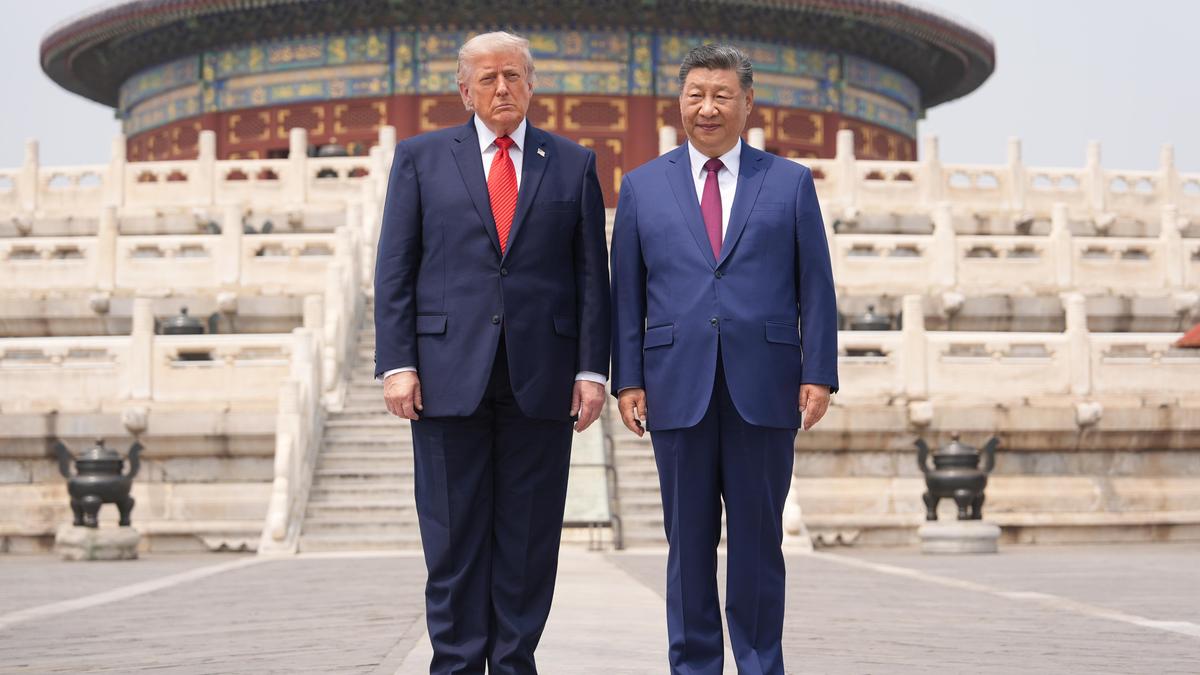
The heavy oak doors of the Oval Office have a way of muffling the chaos of the outside world, but they cannot stop the weight of history from pressing against the glass. When news broke that Donald Trump extended an official invitation to Chinese President Xi Jinping for a September 24 visit to the White House, the initial reaction from the global press was a familiar flurry of clinical geopolitical analysis. Stock tickers blinked. Pundits debated trade tariffs. Analysts calculated currency fluctuations.
But focus too closely on the balance sheets, and you miss the real theater.
This isn't just a meeting of two heads of state. It is a collision of two entirely different philosophies of time, power, and human ego. To understand what will happen on September 24, one must step away from the sterile briefing rooms and look at the flesh-and-blood human beings who operate the levers of global empire.
The Art of the Host
Every state visit is a carefully choreographed play where even the choice of water glass carries diplomatic weight. For Donald Trump, the White House is not just an office; it is the ultimate stage for performance art. His approach to diplomacy has always been intensely personal, driven by a belief that complex international friction can be dissolved—or at least leveraged—through the sheer force of personality over a dinner table.
Consider the contrast in the room.
On one side sits a man raised in the hyper-fluid, transactional world of New York real estate, where deals are made on instinct, broken on a whim, and measured by immediate, visible victories. On the other side is a leader molded by the decades-long, hyper-disciplined ladder of the Chinese Communist Party, a man who views history not in terms of the next fiscal quarter, but in terms of centuries.
When these two styles clash, the air in the room changes.
Hypothetically, imagine a quiet moment just before the formal bilateral talks begin. A mid-level staffer adjusts a briefing binder. The silence is thick, broken only by the low hum of the air conditioning. In that brief window, before the cameras are allowed in, the entire trajectory of the global economy hinges on a nod, a handshake, or a calculated pause. If Trump leans forward to press a point on manufacturing, Xi might respond with a slow, deliberate metaphor about patience. It is a high-stakes poker game where neither side is playing with their own money, but with the livelihoods of hundreds of millions of ordinary citizens.
The Invisible Ghost at the Banquet
While the headlines focus on the two men at the center of the frame, the true weight of the September 24 meeting will be felt thousands of miles away from Washington. The real story belongs to the people who will never get an invitation to Pennsylvania Avenue.
Think of a soybean farmer in Iowa, looking out over fields that depend entirely on the shifting whims of Beijing’s purchasing orders. Or a factory supervisor in Shenzhen, navigating the fallout of supply chain disruptions that can be triggered by a single late-night tweet. These individuals are the uncredited actors in this grand drama. They live in the spaces between the policy decisions, vulnerable to every shift in the political wind.
The economic relationship between the United States and China is often described with sterile terms like "interdependence" or "decoupling."
These words are too cold.
The reality is closer to a bad marriage where neither partner can afford a divorce. The American consumer relies on Chinese factories to maintain a certain standard of living; the Chinese economic engine relies on the American consumer to keep its populace employed. It is an intricate, fragile web of mutual reliance. When one thread is pulled too hard, the vibration shakes households across both hemispheres.
History shows us that trade wars are rarely won on the battlefield of macroeconomic theory. They are won and lost in the grocery store aisles and the small-town manufacturing plants. By inviting Xi to the White House in late September—a crucial window just as the American political calendar reaches a fever pitch—Trump is signaling that he wants to resolve these tensions on his own terms, face to face, where the theatrical stakes are highest.
The Protocol of Tension
To the uninitiated, the schedule of a state visit looks incredibly boring. Arrival ceremonies. Working lunches. Joint press statements where every word has been scrubbed of flavor by committees of diplomats.
But the tension is found in the margins.
It is in the body language. Watch how the two men stand during the national anthems. Notice who reaches out for the handshake first. Observe whether they look at each other when the translators speak, or if they keep their eyes fixed on the middle distance.
Western diplomacy is built on the concept of the immediate breakthrough—the grand signing ceremony, the historic declaration. Chinese diplomacy operates on the principle of the long game, where yielding a small point today is merely a tactic to secure a massive advantage two decades down the road. This fundamental misunderstanding of time is where modern international relations frequently go off the rails. One side is playing speed chess; the other is playing Go.
The September 24 date is not accidental. It positions the meeting right before the global community gathers for the United Nations General Assembly, ensuring that whatever happens in the Oval Office will set the tone for the entire international community for the remainder of the year. It is a bold, risky move that strips away the safety net of lower-level diplomatic channels.
Beyond the Script
We live in an era that distrusts institutional power, yet we remain utterly fascinated by the individuals who wield it. It is easy to look at a meeting like this with cynicism, to dismiss it as a photo opportunity designed for domestic consumption on both sides.
That cynicism is a luxury we cannot afford.
The reality of 2026 is that the margin for error in global politics has grown incredibly thin. The systems that govern our world—from the microchips in our pockets to the shipping lanes in the South China Sea—are highly sensitive to the emotional climate of the world's most powerful leaders. A successful dinner can stabilize markets for months; a misunderstood remark can trigger an escalatory cycle of tariffs and military posturing that takes years to undo.
When the presidential motorcade eventually rolls up the White House driveway this September, the world will be watching the flags and the red carpet. But the true test of that day will happen in the quiet, unscripted moments. It will be found in the tone of voice used when the microphones are turned off, and the realization that despite all the machinery of statehood, the future of global stability still rests on the fragile, unpredictable nature of human interaction.
The sun will set over the Potomac, the reporters will filing their copy, and two men will sit in a room, trying to rewrite the rules of the world.
:max_bytes(150000):strip_icc():focal(819x186:821x188)/Murdaugh-Family-e90854a716884d608fb6fd925e18d840.jpg)
