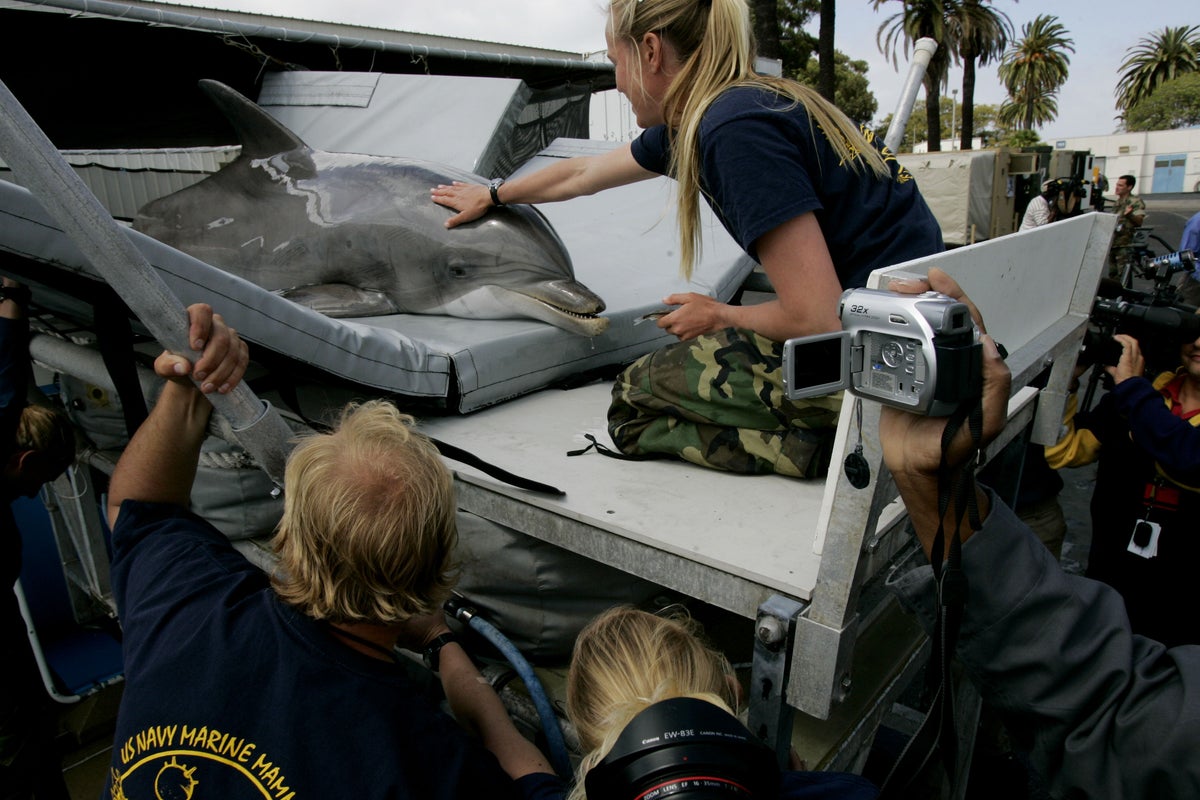
The United States Navy maintains a fleet that does not require fuel, dry docks, or microchips to function. Stationed primarily in San Diego, the Navy Marine Mammal Program utilizes bottlenose dolphins and California sea lions to perform underwater tasks that still baffle the most sophisticated robotics engineers. While the public often views these animals through the lens of aquarium shows, the reality is a gritty, high-stakes military operation where biological sonar remains the gold standard for detecting undersea threats. These animals are not pets; they are specialized biological assets integrated into the world's most advanced naval defense systems.
Despite decades of research into unmanned underwater vehicles (UUVs), the biological reality is that a dolphin’s biosonar can identify a mine buried feet deep in seafloor sediment with a precision that synthetic sensors cannot match. This capability is not a luxury. It is a fundamental component of port security and carrier strike group protection. When a multi-billion dollar vessel enters a contested harbor, the difference between a safe passage and a catastrophic hull breach often rests on the pulse-click of a dolphin.
The Biological Edge Over Silicon
The military did not choose dolphins for their charm. The decision was rooted in the cold physics of underwater acoustics. Water is a brutal medium for sensors. Light doesn’t travel far, and radio waves are effectively useless over long distances. Synthetic sonar systems struggle with "clutter"—the noise of snapping shrimp, shifting sands, and thermal layers that bounce signals in unpredictable ways.
Dolphins evolved over millions of years to solve this exact problem. Their melon, a fatty organ in the forehead, focuses sound waves into a beam that provides a three-dimensional acoustic map of their surroundings. A trained Navy dolphin can distinguish between a stainless steel sphere and an aluminum one of the same size, even when they are buried under silt.
Sea lions offer a different, but equally vital, skill set. They possess extraordinary low-light vision and directional hearing. In the murky waters of a busy port, a sea lion can track a human diver or a suspicious object with predatory efficiency. The Navy exploits this by training them for the Mark 6 Mod 1 system, where the sea lion carries a spring-loaded clamp in its mouth. Once it locates an intruder, it attaches the clamp to the diver's leg, allowing sailors on the surface to haul the suspect in like a hooked fish.
The Cold War Genesis of Marine Assets
This program is not a modern experimental whim. It was born during the peak of the Cold War. In the 1960s, the Navy began looking at "hydrodynamic" efficiency, originally hoping that studying dolphin skin would lead to faster hull designs for submarines. They quickly realized that the real value lay in the animal’s brain, not its skin.
During the Vietnam War, the Navy deployed dolphins to Cam Ranh Bay to guard ammunition piers against North Vietnamese "combat swimmers." The program remained classified for years, fueling rumors of "killer dolphins" armed with needle-guns or toxic darts. The Navy has spent decades denying these claims, asserting that the animals are used strictly for detection and recovery, not offensive combat. The logic is practical rather than moral. If a dolphin were trained to attack, it might not be able to distinguish between a friendly diver and an enemy combatant. A biological weapon that can’t tell a friend from a foe is a liability, not an asset.
The High Cost of Maintenance and Ethics
Operating a marine mammal program is an logistical nightmare that would break most private contractors. You cannot simply turn a dolphin off and put it in a warehouse when the budget gets tight. These are sentient, social creatures that require constant veterinary care, high-quality nutrition, and psychological stimulation.
The Navy’s budget for the program hovers around $40 million annually. This covers a fleet of roughly 70 dolphins and 30 sea lions. Each animal is treated with the same bureaucratic precision as a fighter jet, complete with its own service record and medical history. Yet, the ethical shadow cast by the program is long. Animal rights organizations have fought for decades to de-commission the unit, arguing that the acoustic stress of naval environments and the physical toll of transport are inhumane.
There is also the risk of deployment. During the invasion of Iraq in 2003, dolphins were flown to the Persian Gulf to clear mines in the port of Umm Qasr. Transporting a 400-pound mammal halfway across the world in a fleece-lined stretcher inside a C-130 Hercules is a feat of engineering, but it is also a massive stressor on the animal’s physiology. The Navy justifies this by pointing to the lives saved, but the tension between military utility and animal welfare remains an unresolved friction point.
The Failure of the Robotic Replacement
For the last twenty years, the Navy has been trying to fire the dolphins. The goal is to replace biological assets with the Knifefish UUV or similar autonomous platforms. Robots don't need to eat, they don't get sick, and they don't have lobbyists defending their rights.
However, the transition has been plagued by delays and technical failures. In high-clutter environments like shallow bays or kelp forests, the processing power required for a robot to match a dolphin's brain is still out of reach. A dolphin doesn't just "see" a mine; it perceives the density and shape through a process of cognitive integration that we still do not fully simulate. The Navy recently extended the program's lifespan because the technology simply isn't ready. We are in a strange era where the most sophisticated military in history is still dependent on a creature that breathes through a hole in its head.
Strategic Vulnerabilities in a New Era of Warfare
As we move toward a conflict model defined by "gray zone" tactics and littoral warfare, the importance of port security has spiked. Near-peer adversaries like Russia and China have observed the American model and developed their own programs. Satellite imagery has confirmed dolphin pens at Russian naval bases in the Black Sea, likely used to defend against Ukrainian sub-surface drones and divers.
This creates a new kind of biological arms race. If both sides are using marine mammals, the undersea environment becomes a crowded, invisible battlefield. The vulnerability here isn't just the loss of an animal; it is the loss of the capability they provide. If a dolphin fleet is neutralized by environmental factors or targeted sabotage, a carrier strike group suddenly becomes blind to the most basic of threats: the tethered bottom mine.
The Logistics of the San Diego Hub
The center of this universe is Point Loma. This is where the breeding, training, and tactical development happen. The trainers are often young sailors or civilian contractors who must build a bond of total trust with the animals. This is not "command and control" in the traditional sense. It is a partnership. A dolphin in the open ocean can leave at any time. They are not leashed. The fact that they return to their handlers after a mission is a testament to the social conditioning and positive reinforcement used in the program.
The training uses "successive approximation," a method where complex tasks are broken down into small, repeatable steps. A dolphin learns to touch a sensor with its rostrum (snout) when it hears a specific frequency, then learns to drop a marker buoy when it finds a target. It is a slow, methodical process that produces a reliable biological sensor.
The Geopolitical Signature of Marine Mammals
The presence of these animals is a clear signal of strategic intent. When the Navy deploys sea lions to a specific region, it is a loud, albeit submerged, declaration that they expect underwater sabotage or human-led incursions. Unlike a radar installation, which can be masked or jammed, a biological asset is difficult to deceive. You can’t "hack" a dolphin’s brain with a line of code or a frequency jammer.
This inherent un-hackability makes them invaluable in an age of cyber warfare. As digital systems become more vulnerable to electronic interference, the military is leaning back into "analog" solutions. The dolphin is the ultimate analog sensor.
The Impending Obsolescence Trap
Despite their current necessity, the program is trapped in a cycle of diminishing returns. The pool of experts capable of training these animals is small. The cost of maintaining the specialized facilities is rising. Meanwhile, AI-driven acoustic processing is slowly closing the gap.
The military is currently pouring funds into Deep Learning models that attempt to mimic the dolphin's neural pathways for sound processing. If these models succeed, the Navy will likely phase out the mammals within a decade. But we have heard that promise before. Every time the "dolphin-killer" technology is tested, it fails to account for the sheer unpredictability of the ocean floor. The ocean is not a laboratory; it is a chaotic, shifting mess of biology and geology.
The military dolphin stands as a reminder that for all our technological hubris, nature has already solved the hardest problems of physics. We are merely borrowing their solutions.
When the next major naval engagement occurs, the first line of defense won't be a satellite or a laser. It will likely be a sea lion in a dark harbor, watching for a ripple that doesn't belong.