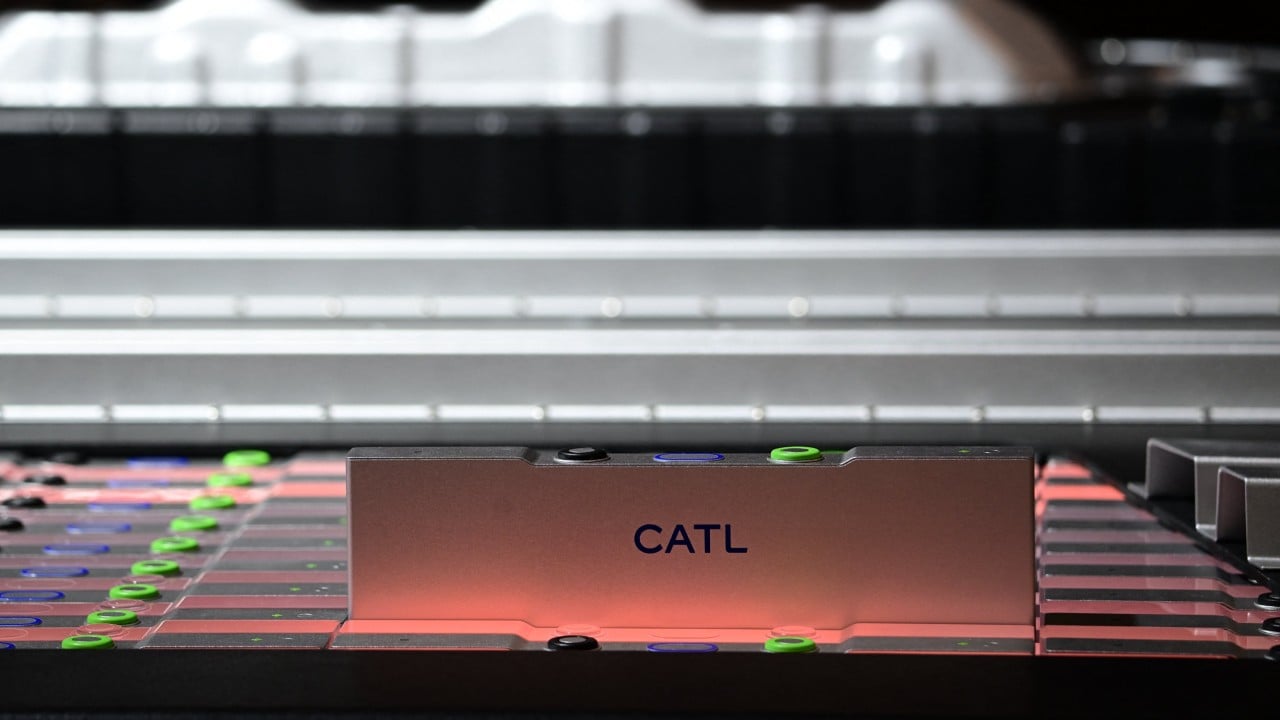
The air in Ningde is heavy with the scent of the East China Sea and the hum of something much larger than the tides. Here, in a city that most of the world couldn't find on a map, the heartbeat of the global energy transition isn't a roar. It is a whisper. It is the sound of lithium-ion cells sliding into casings, destined for the underbellies of sedans in Berlin and the sprawling battery farms of the American Midwest.
When Contemporary Amperex Technology Co., Limited—better known by the four letters CATL—reported its recent surge in profits, the financial wires treated it like a math problem. They spoke of margins. They debated year-over-year percentages. They tracked the ripple effects that sent Hong Kong’s battery stocks climbing as if they were watching a scoreboard at a stadium. For a different perspective, check out: this related article.
But numbers are ghosts. They tell you that a profit jumped, but they don't tell you about the anxiety of a grid operator in South Australia who needs to balance the sun’s afternoon glare with the city’s evening lights. They don’t tell you about the sheer, terrifying scale of the metal we are moving across the planet to ensure that when we flip a switch, the darkness stays at bay.
The truth is that we are no longer just building cars or gadgets. We are rebuilding the circulatory system of the human race. Further coverage regarding this has been shared by Reuters Business.
The Weight of the Storage Boom
For a long time, the biggest hurdle for renewable energy wasn't the wind or the sun. It was the clock. The sun shines when it wants; the wind blows at its own whim. To make that power useful for a society that demands coffee at 6:00 AM and streetlights at midnight, we had to learn how to bottle lightning.
CATL didn't just participate in this shift. They weaponized the scale of it.
Imagine a shipping container. Now imagine thousands of them, stacked not with sneakers or electronics, but with massive modules of energy storage. This is the "BESS" (Battery Energy Storage Systems) market. It is the reason CATL's bottom line is swelling. While the electric vehicle market occasionally stutters under the weight of high interest rates or changing subsidies, the demand for stationary storage is a different beast entirely.
It is a necessity of infrastructure. It is the difference between a functional green grid and a series of rolling blackouts.
When CATL’s earnings hit the sunlight, investors in Hong Kong didn't just see a company making money. They saw a moat. In the world of batteries, scale is the only thing that protects you. The more you build, the cheaper it gets. The cheaper it gets, the more the world abandons coal and gas. It is a feedback loop that has turned a former fishing region into the undisputed capital of the new energy era.
The Geography of the Ledger
To understand why Hong Kong’s markets reacted with such fervor, you have to look at the map of the invisible.
Hong Kong acts as the pressure valve for Chinese industrial might. It is where the raw, frantic energy of mainland manufacturing meets the cold, calculating eyes of global capital. When CATL thrives, it validates an entire ecosystem of suppliers, chemical processors, and mineral miners.
Consider a hypothetical investor named Elias. Elias doesn't care about the chemistry of lithium iron phosphate. He cares about the "energy density" of his portfolio. When he sees CATL’s profit margins widening despite a brutal price war in the EV space, he realizes that the battery story has evolved. It’s no longer just a "car thing." It’s a "world thing."
He buys into Tianqi Lithium. He looks at Ganfeng. He watches the smaller players who provide the membranes and the electrolytes. The "battery stock" rally in Hong Kong isn't just excitement; it is a recognition that the floor of the industry has risen.
But there is a tension beneath the surface. To gain this much power is to invite scrutiny. The higher these profits climb, the more the rest of the world—the US, the EU, the emerging markets—starts to feel a prickle of unease. Dependency is a heavy word in 2026.
The Chemistry of Survival
We often speak of batteries as if they are static bricks. In reality, they are living chemistry experiments, breathing in ions and exhaling electrons. The technological lead CATL maintains isn't just about having more factories; it’s about a relentless, almost paranoid commitment to R&D.
They are moving toward "Shenxing" batteries that charge in the time it takes to grab a sandwich. They are exploring sodium-ion cells that don't rely on the precarious politics of lithium. This isn't just business strategy. It’s a race against the limits of the periodic table.
The profit jump everyone is talking about was driven largely by falling raw material costs. Lithium carbonate prices, once astronomical, came crashing back to earth. This allowed the giants to breathe. They kept their prices steady while their costs plummeted, harvesting the "spread" like a farmer in a record-breaking season.
But this period of ease won't last. The cycle always turns.
The Invisible Stakes
Why does this matter to someone who doesn't own a single share of a Hong Kong stock?
Because the cost of your future is being decided in these boardrooms. The price of the battery is the single greatest factor in whether the transition to a sustainable world happens in ten years or fifty. If CATL can maintain high profits while simultaneously driving down the cost per kilowatt-hour, they become the most important utility company in history.
If they fail, or if geopolitical friction tears the supply chain apart, the "energy storage boom" becomes a bottleneck.
The stakes aren't just financial. They are existential. We are betting the stability of our climate on the ability of a few massive companies to manage the most complex supply chain ever devised. We are asking them to dig up mountains in South America, refine them in Asia, and power homes in Europe, all while staying profitable enough to keep the lights on in their own offices.
Beyond the Spreadsheets
The rally in Hong Kong will eventually cool. The headlines will move on to the next quarterly report, the next political spat, the next technological breakthrough. But the factories in Ningde will keep humming.
There is a specific kind of silence in a high-tech battery plant. It’s a clean-room silence, broken only by the rhythmic click of robotics. It feels like the future, but it is built on very old human impulses: the desire to master the environment, the urge to win the race, and the need to find a way to make the light last just a little bit longer.
The numbers on the screen in Hong Kong are just a reflection of that hum. They are the scoreboard for a game that has no end, played with elements we barely understand, for stakes we can’t afford to lose.
The world is getting hungrier for power, and for now, the kitchen is in Ningde. Every time a stock price ticks upward, it’s a reminder that we are no longer waiting for the energy revolution to arrive. We are simply trying to figure out how to pay for the one that is already here.
The battery isn't just a product. It is a promise that the sun will still be working for us long after it has set.
Would you like me to dive deeper into the specific mineral supply chains that could disrupt this growth, or perhaps examine the emerging sodium-ion technologies that threaten to upend the current lithium-ion dominance?