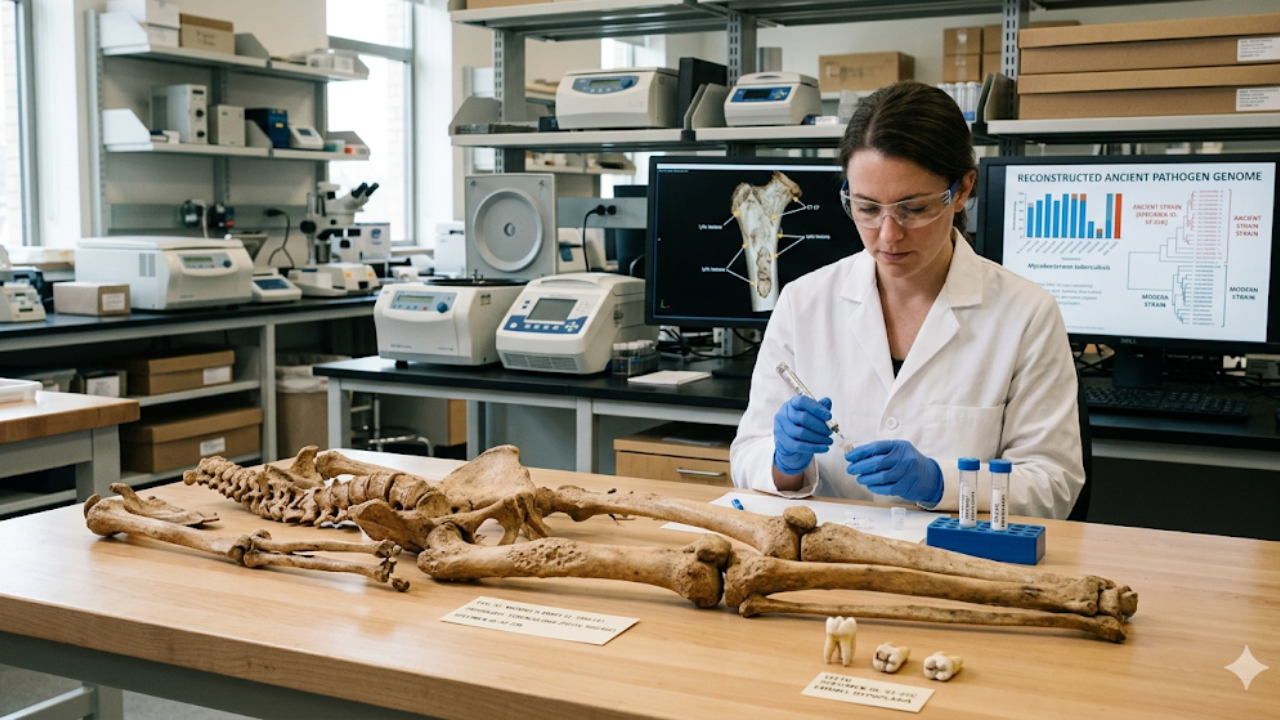
Modern medicine is currently obsessed with the future of mRNA and CRISPR, yet the most significant breakthroughs in understanding human health are coming from the dirt. We are finally learning to read the biological records left behind by the dead. By extracting genetic material from centuries-old teeth and skeletal remains, researchers are mapping the evolution of pathogens that shaped human history. This field, known as paleogenomics, provides a literal blueprint of how diseases like the Black Death, tuberculosis, and syphilis mutated to bypass the human immune system. Understanding these ancient adaptations is no longer just a historical curiosity; it is a defensive necessity for predicting the next global health crisis.
The Molecular Graveyard in Our Teeth
For decades, archaeology relied on physical observations. A pitted skull or a fused spine suggested a lifetime of suffering, but the specific culprit remained a mystery. Bone can only react to infection in a limited number of ways. Now, the focus has shifted from the bone itself to the microbial "dark matter" trapped within it. Also making headlines in related news: The Shocking Failure of Bureaucracy Over Bioethics Why the Ban on Skin Shocks is Decades Late.
Dental calculus—the hardened plaque on ancient teeth—acts as a biological time capsule. It seals in food particles, environmental pollutants, and, most importantly, the DNA of every bacteria that circulated in a person’s bloodstream at the time of their death. When a person dies from a systemic infection, the pathogen's DNA is often preserved within the dense mineral structure of the teeth.
The Extraction Process
Retrieving this information is a grueling, high-stakes surgical operation performed in "clean rooms" to prevent modern contamination. A single flake of skin or a stray sneeze from a researcher could overwhelm the fragile, fragmented ancient sequences. Scientists drill into the tooth root or the petrous bone—the densest part of the mammalian skull—to extract a few milligrams of powder. Further details on this are detailed by World Health Organization.
The process involves chemical baths to strip away minerals and proteins, leaving behind short, degraded strands of genetic code. Through a method called "shotgun sequencing," computers piece these fragments back together, comparing them against modern reference genomes. It is like trying to reconstruct a charred book from a handful of scattered, burnt pages.
The Black Death and the Myth of Immunity
The most famous case study in this field involves Yersinia pestis, the bacterium responsible for the Bubonic Plague. Conventional wisdom long held that the plague eventually vanished because humans developed a natural immunity or the bacteria became less lethal. The genetic data tells a far more unsettling story.
When researchers sequenced the genomes of plague victims from the 14th century and compared them to modern strains, they found remarkably little change in the core virulence of the bacteria. The plague didn't "mellow out." Instead, human behavior changed. Improved sanitation, better housing that separated people from rat populations, and eventually antibiotics pushed the pathogen into the shadows.
However, the DNA reveals that Y. pestis underwent a specific genetic mutation roughly 4,000 years ago that allowed it to survive inside fleas. Before this "switch," the plague was likely a respiratory illness that didn't spread nearly as fast. This one genetic tweak turned a manageable disease into a continent-clearing killer.
Tracking the Invisible Killers
While the plague grabs headlines, paleogenomics is shedding light on slower, more insidious killers like tuberculosis (TB) and leprosy. These diseases leave distinct markers in the DNA, even when they don't stay long enough to scar the bone.
The Mystery of Tuberculosis
One of the most significant discoveries in recent years involves the origins of TB in the Americas. It was long assumed that Europeans brought the disease with them during colonization. DNA evidence from 1,000-year-old skeletons in Peru proved this wrong. The ancient American strains were closely related to a version of TB found in seals and sea lions. This suggests that the disease jumped from marine mammals to humans long before any European ship hit the horizon.
The Leprosy Paradox
Leprosy provides another sobering lesson in pathogen resilience. By sequencing the DNA of Mycobacterium leprae from medieval Europe, scientists discovered that the strain ravaging the continent 600 years ago is almost genetically identical to the strains found today in parts of Asia and Africa.
This means that the disappearance of leprosy from Europe wasn't caused by the bacteria evolving. It was likely outcompeted by tuberculosis. The two diseases share similar cell wall structures, and exposure to the more aggressive TB may have provided medieval populations with a cross-immunity to leprosy. It was a brutal form of natural selection where one plague acted as a crude vaccine for another.
The Evolutionary Arms Race
Pathogens do not exist in a vacuum. They are in a constant, high-stakes race against the human immune system. By looking at ancient DNA, we can see exactly when our ancestors developed specific defenses.
There is a specific gene variant called ERAP2. If you had two copies of the "protective" version during the Black Death, you were about 40% more likely to survive. Today, that same gene variant is linked to a higher risk of Crohn’s disease and other autoimmune disorders. The very genetic traits that saved our ancestors from the plague are now making our own immune systems attack our bodies.
This trade-off—survival in the past for chronic illness in the present—is a fundamental law of evolutionary biology that we are only now beginning to quantify. We are the products of every plague our ancestors survived, and we carry the scars of those battles in our genetic code.
The Threat of Thawing Pathogens
The study of ancient disease is moving from the cemetery to the permafrost. As global temperatures rise, land that has been frozen for tens of thousands of years is beginning to melt. This isn't just a problem for infrastructure; it is a biological hazard.
In 2016, an anthrax outbreak in Siberia was linked to a thawed reindeer carcass that had been dead for 75 years. While anthrax is a well-known threat, the real concern lies in "giant viruses" and bacteria that have been dormant for millennia. Researchers have already successfully "revived" viruses from the Siberian permafrost that had been inactive for 30,000 years. While these specific viruses only infect amoebas, the principle remains terrifying.
If a pathogen that humans haven't encountered in 50,000 years re-emerges, our modern immune systems will be functionally "naive." We will have no biological memory of how to fight it. Paleogenomics is our only way to study these dormant threats before they wake up.
The Ethics of Resurrection
There is a fine line between studying a disease and accidentally reviving it. When scientists reconstruct the genome of a prehistoric pathogen, they create a digital blueprint. With modern synthetic biology, that blueprint can be used to recreate the actual virus or bacteria in a lab.
This "dual-use" research is highly controversial. Proponents argue that recreating ancient viruses allows us to test modern vaccines against them, giving us a head start. Critics argue that the risk of a lab leak or the weaponization of this data is too high. The 1918 Spanish Flu virus has already been reconstructed in a controlled environment to understand why it was so deadly to young adults. While the insights were invaluable, the existence of the physical virus in a lab is a permanent risk.
Beyond the Microscope
The data extracted from ancient remains is also rewriting the history of human migration. We no longer have to guess where people moved based on the shape of their pottery; we can follow their parasites.
The spread of the hepatitis B virus, for example, mirrors the movement of people across Eurasia over the last 10,000 years. By tracking the mutations in the virus, we can see exactly when different groups met, traded, and intermarried. The pathogens are the ultimate unbiased witnesses to history. They don't care about borders or kings; they only care about the next host.
The Limits of the Science
We must be careful not to view paleogenomics as a magic wand. Ancient DNA is often heavily contaminated by soil bacteria. The fragments are tiny, and the chemical damage over time can create "false mutations" that didn't exist when the person was alive.
Furthermore, having the DNA of a pathogen doesn't tell you everything about the disease. Environment, diet, and co-infections all play a massive role in how a person experiences an illness. A bacterium that killed a malnourished peasant in 1348 might only cause a mild fever in a modern human with a healthy microbiome.
The New Front Line
The next pandemic likely won't be a brand-new creation of nature. It will be a variation on a theme that has been played for thousands of years. Pathogens have a limited "utility belt" of tricks. They change how they enter a cell, how they hide from the immune system, and how they move between hosts.
By cataloging every trick used by ancient diseases, we are building a library of enemy tactics. We are moving from a reactive model of medicine—where we wait for an outbreak and then scramble for a cure—to a proactive model.
The dead are finally speaking. Their bones and teeth hold the records of every biological war our species has ever fought. If we choose to listen, we might finally stop repeating the same lethal history.
Stop looking at ancient DNA as a window into the past. It is a mirror reflecting our biological future. Every mutation we find in a 5,000-year-old tooth is a warning of what a pathogen is capable of doing when pushed to the brink. The war against disease is not a series of isolated battles; it is a single, continuous struggle that began before we were even human. The data is there, buried in the dark. We just have to be brave enough to dig it up and read it.
.jpg?width=1200&auto=webp&trim=1%2C0%2C2%2C0)