The floodlights at Elland Road cast long, shivering shadows across the turf, the kind of cold West Yorkshire evening that settles into your marrow. For most of the thirty-odd thousand packed into the stands, the rhythm of the match is a sequence of surges, shouts, and the rhythmic thud of a ball against leather. But for a handful of players on the pitch, the game is a secondary battle against the clock and their own physiology.
Ibrahim is a hypothetical composite of the modern midfielder, but his reality is shared by hundreds of professionals across the English pyramid. Since the sun rose, he hasn't tasted a drop of water. Not a crumb of bread. His mouth is a dry valley. His legs feel like they are filled with lead weights, yet he covers kilometers of ground, tracking runners and snapping into tackles. This is Ramadan. It is a month of spiritual sharpening, but on a football pitch, it is an exercise in extreme physical discipline.
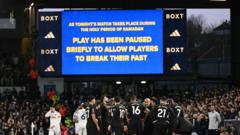
When the sun finally dips below the horizon, the referee checks his watch. This is the moment the Premier League and EFL agreed upon—a brief pause in the frantic machinery of professional football to allow players like Ibrahim to take a sip of water and a quick energy gel. It is sixty seconds of grace.
But as the whistle blew during the recent clash between Leeds United and Hull City, the silence that should have greeted this gesture was punctured.
The Sound of a Fractured Community
A scattering of boos echoed from the stands. They weren't universal, but they were loud enough to ripple through the air, curdling the atmosphere. For a club like Leeds United, a storied institution built on the grit of the northern working class, those sounds were more than just a momentary lapse in etiquette. They were a signal of a deeper, more jagged disconnect.
Leeds United quickly issued a statement calling the reaction "disappointing." It is a polite word, the kind of word used by PR departments to describe a PR disaster. In reality, the sound was a serrated edge. It sliced through the idea that football is a universal language, a space where the specific needs of an individual are respected by the collective.
Consider the physics of the moment. A player has spent seventy minutes sprinting in a fasted state. His blood sugar is cratering. The "pause" isn't a tactical timeout or a theatrical display of piety; it is a medical and performance necessity. When a player collapses from dehydration, nobody boos the stretcher-bearers. Yet, when the break is codified and tied to faith, the reaction shifts from concern to contention.
The Invisible Stakes of the Dressing Room
We often treat footballers as avatars in a video game, indestructible figures who exist only for our entertainment. We forget the fragile ecosystem of the dressing room. In that small, humid space, teammates of every creed and color rely on one another. When a player sees his own supporters jeer a moment of respite for his teammate, the chemistry of the group changes.
I remember talking to a former pro who played through the early 2000s, before these pauses were sanctioned. He spoke of "hiding" his fast, of rinsing his mouth with water and spitting it out so as not to draw attention, of the dizzy spells he’d hide from his manager for fear of being dropped. We have moved past those dark ages, or so we thought. The introduction of the Ramadan pause was supposed to be a milestone of progress—a sign that the game had finally grown enough to accommodate the humanity of its participants.
The boos at Elland Road suggest that progress is not a straight line. It is a zig-zag, often doubling back on itself. The irony is that the fans who booed likely demand 100% effort from their players. They want the lung-busting recovery runs. They want the last-minute winners. Yet, they vocalized their frustration at the very mechanism that allows a fasting player to sustain that level of performance into the final whistle.
The Myth of the "Political" Pause
There is a growing sentiment in modern sports culture that any deviation from the "pure" game is a political intrusion. This is a fallacy. Providing a glass of water to a thirsty man is not a political statement; it is a basic tenet of human decency.
In the English game, we pause for injuries. We pause for VAR checks that last three minutes and drain the life out of the stadium. We pause for goal celebrations that involve choreographed dances. Why, then, does a sixty-second window for a player to nourish themselves trigger such vitriol?
The answer lies in the "othering" of the athlete. When the pause is linked to Ramadan, it becomes, in the minds of some, an "extra" privilege rather than a standard requirement. It is viewed through the lens of identity politics rather than sports science. But the body does not care about politics. The kidneys and the liver do not care about cultural wars. They care about glucose and hydration.
The Weight of the Shirt
Leeds United is a club that prides itself on its "Marching on Together" mantra. It is a song about unity, about a collective identity that transcends the individual. When the club expressed its disappointment, it wasn't just defending its players; it was defending the soul of that anthem.
For the young Muslim kid in the academy, or the family sitting in the East Stand watching their first match, those boos weren't just background noise. They were a fence. They were a signpost saying: You are welcome here, but only on our terms. Your traditions are an inconvenience.
The "invisible stakes" here aren't about points on a league table. They are about the social fabric of a city. Leeds is a vibrant, multicultural hub. The football club is the heartbeat of that city. When the heart skips a beat—or worse, when it beats with a rhythm of exclusion—the whole body feels the tremor.
Beyond the Official Statement
The club's disappointment is a start, but it isn't a cure. You don't fix a cultural rift with a PDF posted on Twitter. You fix it by humanizing the struggle.
Imagine Ibrahim again. He isn't a "Muslim player." He is a father, a son, a teammate who has spent his entire life training for this ninety-minute window. He has chosen to honor his faith while honoring his contract, a balancing act that would break most of the people sitting in the stands. He isn't asking for a head start or a penalty. He is asking for a sip of water so he can keep running for the badge on his chest.
The game eventually resumed against Hull City. The ball moved, the tackles flew, and the clock ticked toward ninety. But the air had changed. The sport, which is supposed to be an escape from the divisions of the world, had briefly become a mirror of them.
We like to think of the pitch as a sacred green rectangle where the only thing that matters is the score. But the pitch is part of the world, and the world is currently a loud, reactionary, and often unkind place. The sixty-second silence was supposed to be a moment of inclusion. Instead, it became a litmus test that we, as a sporting culture, didn't quite pass.
The lights eventually went out at Elland Road. The fans went home, the players retreated to the sanctuary of the locker room, and the table showed whatever result the night had yielded. But the echoes of those boos stayed behind, trapped in the cold air, a reminder that the hardest part of the game isn't what happens with the ball at your feet. It’s what happens when the ball stops moving.
The next time the whistle blows for a pause, the stadium has a choice. It can be a place of noise, or it can be a place of understanding. One of those options requires nothing but a lack of thought. The other requires us to remember that under the nylon shirt, there is a person who is simply trying to catch their breath.