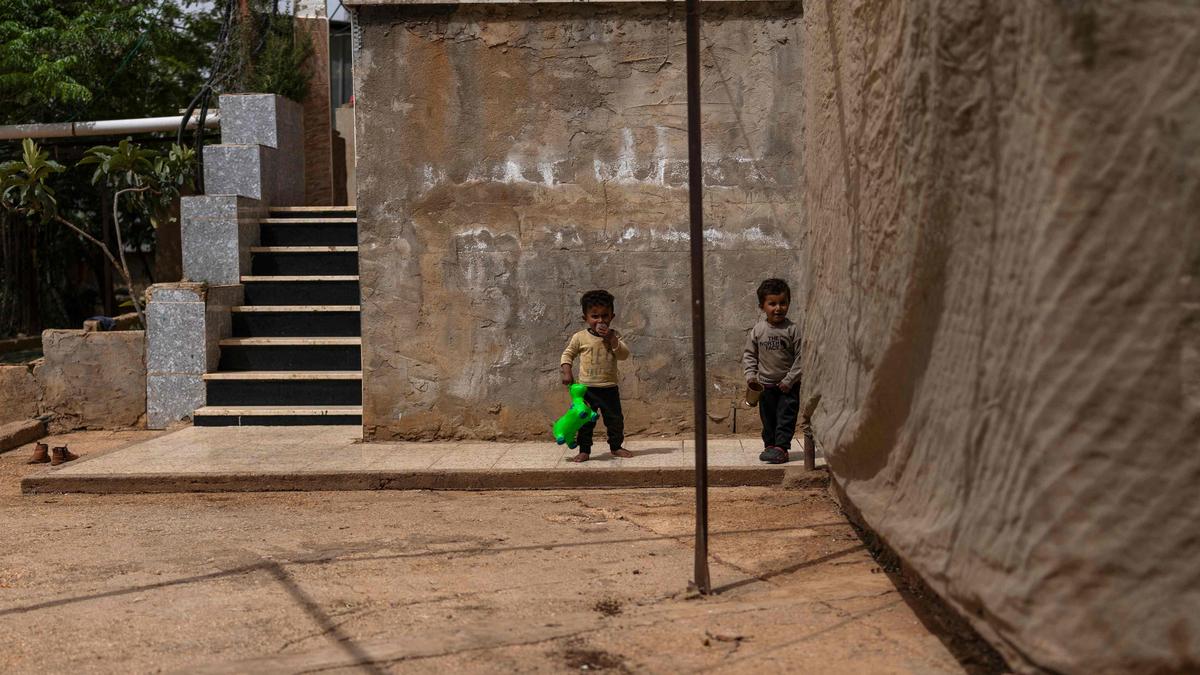
The air in the West Bank doesn't just carry the scent of dust and wild thyme. It carries a heavy, vibrating silence that settles in the lungs. It is the silence of a playground that has forgotten how to be loud. In the narrow alleys of Jenin and the sloping streets of Tulkarm, the ground often holds the heat of the sun long after it sets, but for many families, the warmth has left their homes for good.
The United Nations recently released a set of figures that should be impossible to read without a catch in the throat. Since October 7, 2023, the scale of loss among children in the West Bank has reached a point that defies standard military logic. We are talking about 171 children killed in a little over a year. That is more than double the number killed in the preceding year.
Numbers are cold. They are clean. They sit on a spreadsheet and wait to be filed away. But a number like 171 doesn't stay on the page. It breathes. It has a favorite color. It had a math test it was dreading or a goal it wanted to score on a dirt pitch behind a row of olive trees.
The Anatomy of a Raid
Consider a hypothetical child named Amin. He is twelve, an age where the world is beginning to expand beyond the front door. In the old rhythm of the West Bank, a raid meant the sound of heavy engines and the metallic clatter of boots. You stayed inside. You waited for the storm to pass.
But the storm has changed.
The UN report highlights a terrifying shift in the "tools of engagement." It isn't just ground incursions anymore. For the first time in two decades, the sky has become a source of lethal precision. Shrapnel from drone strikes and missiles fired from fighter jets now account for a significant portion of these young casualties. When a missile hits a crowded urban center, the concept of "collateral damage" becomes a grotesque euphemism for a child who was simply standing on the wrong side of a concrete wall.
Amin isn't just a victim of a bullet. He is a victim of a transformed environment where the distinction between a combatant and a passerby has been blurred into non-existence by the sheer speed and power of modern weaponry. The UN high commissioner for human rights didn't mince words, noting that many of these deaths occurred in circumstances that suggest a total disregard for the principles of necessity and proportionality.
The Cost of Living in the Grey
The violence isn't always a sudden explosion. Sometimes it is a slow, grinding pressure.
Beyond the 171 who have died, over 1,000 children have been injured. This creates a secondary layer of tragedy that often goes unrecorded in the headlines. A thousand children are now navigating a world with missing limbs, clouded vision, or the deep, invisible scars of neurological trauma. In a region where medical supplies are often stalled at checkpoints and hospitals are overwhelmed, a "non-fatal" injury can be a life sentence of pain.
There is a psychological architecture to this kind of conflict. When a child sees their peer taken away, or watches their school wall pockmarked by heavy caliber rounds, the internal compass breaks. The UN reports that the "climate of fear" is now a permanent resident in the classroom. Education, once a beacon of hope and a structured escape, has become a site of anxiety.
Imagine trying to explain to a ten-year-old why they cannot walk to the shop for bread. You can’t use the language of geopolitics. You can’t talk about "operational security" or "sovereignty." You only have the truth of the locked door and the darkened window.
The Vanishing Middle Ground
The data suggests that the majority of these deaths occurred during massive operations by Israeli security forces. The justification is almost always the pursuit of militants or the dismantling of "terror infrastructure." But the UN’s investigation points to a recurring, haunting pattern: children shot in the head or chest, often from distances that imply a clear line of sight.
This isn't the chaotic crossfire of a panicked skirmish. It is something far more precise and, therefore, far more chilling.
When an international body uses words like "unlawful killings," they are signaling a breakdown of the most basic human contract. That contract states that even in the darkest moments of human disagreement, the innocent are a boundary that cannot be crossed. In the West Bank, that boundary is being erased with terrifying regularity.
The world watches these events through a fragmented lens. One side sees a necessary defense against a rising tide of local militancy. The other sees a systematic campaign of displacement and intimidation. But if we move the lens closer, past the flags and the talking points, we find the empty chairs at the dinner tables.
The Invisible Stakes
Why does this matter to someone thousands of miles away?
It matters because the erosion of international law in one corner of the world acts as a permission slip for its erosion everywhere else. If we accept that 171 children can be killed in a year of "police operations" without a massive, systemic shift in policy, we are admitting that the life of a child is a variable, not a constant.
The stakes are not just about the survival of a specific group of people. They are about the survival of the idea that there is a limit to what we will tolerate.
The UN has called for independent, transparent investigations. They are asking for accountability. In a world of deep-seated biases, accountability is the only thing that keeps the scale from tipping entirely into the abyss. Without it, the cycle of grief fuels a cycle of vengeance, and the children of today become the desperate actors of tomorrow.
A Walk Through the Aftermath
If you were to walk through a neighborhood in the West Bank today, you wouldn't see a "war zone" in the traditional sense of scorched earth and leveled cities. You would see a place where life is trying, desperately, to remain normal. You would see laundry hanging on lines and hear the clink of coffee cups.
But you would notice the posters.
They are everywhere. Taped to shop shutters and plastered on stone walls. They feature the faces of the young. These aren't the faces of hardened soldiers. They are the faces of boys with bad haircuts and girls with bright, expectant eyes. They are the "shadows" that now define the geography of the region.
The UN report is a warning. It is a signal flare sent up from a place where the light is failing. It tells us that the current trajectory is not just unsustainable; it is a moral catastrophe that will resonate for generations.
A mother in Hebron doesn't care about the wording of a resolution in Geneva. She cares about the fact that her son's shoes are still by the door, and he is never coming home to put them on. She cares about the silence in his bedroom. That silence is the loudest thing in the West Bank, a screaming void that no amount of political maneuvering can fill.
The ground is soaked with more than just the memories of an ancient land. It is heavy with the weight of the small, the young, and the gone.