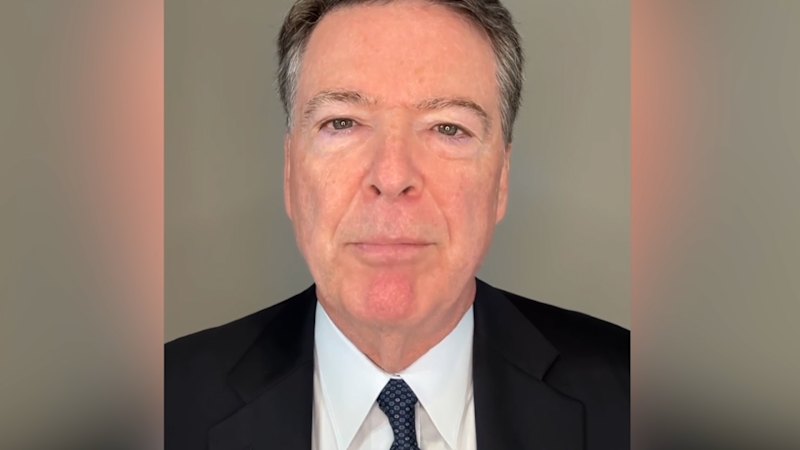
The air in a courtroom doesn’t move like the air outside. It is heavy, filtered through layers of mahogany and history, thick with the scent of old paper and the unspoken weight of consequence. When a man who once stood at the pinnacle of the world’s most powerful investigative agency finds himself on the wrong side of a charging document, that air becomes stifling. James Comey, the former Director of the FBI, a man whose career was defined by the clinical application of the law, now faces the very machinery he once commanded.
It began with a notification. A legal strike. A formal accusation of threatening a former president. Also making waves in this space: Why the Tuapse Refinery Attack Changes Everything for Russian Oil.
The headlines flashed across screens with the rhythmic pulse of a digital fever. They spoke of charges, of legal statutes, and of the unprecedented nature of a high-level law enforcement official being accused of such a visceral crime. But the headlines missed the silence that followed in the rooms where these decisions are actually made. They missed the look on a man’s face when he realizes the shield he carried for decades has turned into a target.
Comey did not retreat. He did not issue a dry, three-paragraph statement through a spokesperson. He took to the digital town square with two words that echoed with the resonance of a challenge. Additional insights regarding the matter are explored by TIME.
"Let’s go."
The Anatomy of a Threat
We often think of threats as shouted words in a dark alley or anonymous letters composed of magazine clippings. In the upper echelons of political power, however, a threat is rarely that simple. It is a nuanced dance of intent and perception. To charge a man of Comey’s stature with such an offense requires more than just a heated exchange; it requires a demonstration that his words were intended to coerce, to frighten, or to obstruct the very foundations of the executive branch.
The core of the allegation centers on a series of communications regarding Donald Trump. The government’s case suggests that Comey’s rhetoric crossed the invisible line between fiery dissent and criminal intimidation. It is a razor-thin margin. On one side lies the First Amendment, the sacred right to criticize those in power. On the other lies the safety of the state and the protection of its leaders.
When the Department of Justice moves against one of its own, the tremors are felt in every hallway of the J. Edgar Hoover Building. Imagine the younger agents, those who entered the academy with Comey’s portrait on the wall, now watching the evening news. They are seeing the personification of the "straight arrow" archetype being dismantled by the system he helped refine. It creates a crisis of identity. If the man who wrote the book on ethical leadership can be led away in handcuffs, what does that say about the book itself?
The Weight of Two Words
"Let’s go" is a fascinating choice of phrase. It isn’t a plea for mercy. It isn't a denial. It is an invitation to combat.
In the lexicon of the American legal system, this is the sound of a glove hitting the floor. Comey is leaning into the storm. By signaling his readiness for a fight, he is betting on the transparency of the process. He is betting that when the evidence is laid bare, the jury will see not a criminal, but a man who spoke truth to power and was punished for the volume of his voice.
But there is a danger in this bravado. Legal battles of this magnitude are not won on Twitter or in the court of public opinion; they are won in the grueling, soul-crushing minutiae of discovery. It is months of depositions. It is the forensic imaging of every device he has touched in the last five years. It is the systematic peeling back of a private life until nothing—not a single stray thought or frustrated text message—remains hidden.
Consider the human cost of that exposure. Every person has a "backstage" version of themselves. We all say things in private that we would never utter in a deposition. When the government decides to prosecute, they aren't just looking for a crime. They are looking for a character flaw they can amplify until it fills the entire room.
The Mirror of the Law
The law is supposed to be a mirror, reflecting our actions back at us without bias. Yet, in cases involving high-ranking officials and former presidents, that mirror often feels more like a kaleidoscope. The facts shift depending on the angle from which you view them.
For Comey’s detractors, these charges are the long-awaited arrival of accountability. They see a man who used his position to influence elections and settle personal scores, finally being held to the same standard as any other citizen. To them, the "Let’s go" response is the height of arrogance—a final act of defiance from a man who thinks he is above the reach of the statutes he once enforced.
For his supporters, this is the ultimate weaponization of the legal system. They see a vengeful administration using the courts to silence a critic who knows where the bodies are buried. In their eyes, the charge of "threatening" is a reach, a desperate attempt to find a hook where none exists. They see a hero being martyred for his refusal to bend the knee.
Both sides are looking at the same set of facts and seeing two entirely different movies. This is the tragedy of our current era. The truth has become a secondary concern to the narrative.
The Invisible Stakes
Beyond the personal fate of James Comey, there is a larger, more terrifying stake at play. We are watching the erosion of the boundary between political disagreement and criminal prosecution.
When the precedent is set that a former FBI Director can be charged for his rhetoric against a political figure, the rules of engagement change for everyone. It creates a chilling effect that ripples through the entire civil service. If you are a mid-level analyst or a high-ranking official, do you dare speak out against perceived corruption if you know that a "threatening" charge could be waiting for you the moment you leave office?
The law should be a shield for the powerless, not a sword for the powerful. When it begins to look like a tool for political retribution, the very concept of justice starts to fray at the edges.
The process will now move into the cold, methodical phase of pre-trial motions. There will be arguments about venue, about the admissibility of private journals, and about the definition of what constitutes a "true threat" in the digital age. The lawyers will bill thousands of hours. The cable news pundits will scream until their throats are raw.
And in the center of it all is a man who spent his life studying the law, now waiting to see if it still works the way he told everyone it did.
James Comey’s "Let’s go" wasn't just a response to a charge. It was a gamble on the soul of the American legal system. If he wins, he becomes a symbol of resilience against overreach. If he loses, he becomes a cautionary tale of how the mighty fall when they forget that the law is a jealous god.
The gavel will eventually fall. It always does. But until it strikes the wood, we are left in this uncomfortable, echoing silence, watching a man who once held the keys to the kingdom standing outside the gate, waiting to be let in—or shut out forever.
The sun sets over the Potomac, casting long, distorted shadows across the marble monuments of Washington. The buildings look permanent, but the people inside them are fragile. They are moved by pride, by anger, and by the desperate need to be remembered as the protagonist of their own story. As the lights go on in the Department of Justice, one can’t help but wonder if anyone truly wins these battles, or if we are all just watching the slow, steady dismantling of the trust that holds a society together.
James Comey is ready for his day in court. But the court may not be ready for what his case reveals about the state of the union.
The documents are filed. The teams are assembled. The stage is set.
Let’s go.