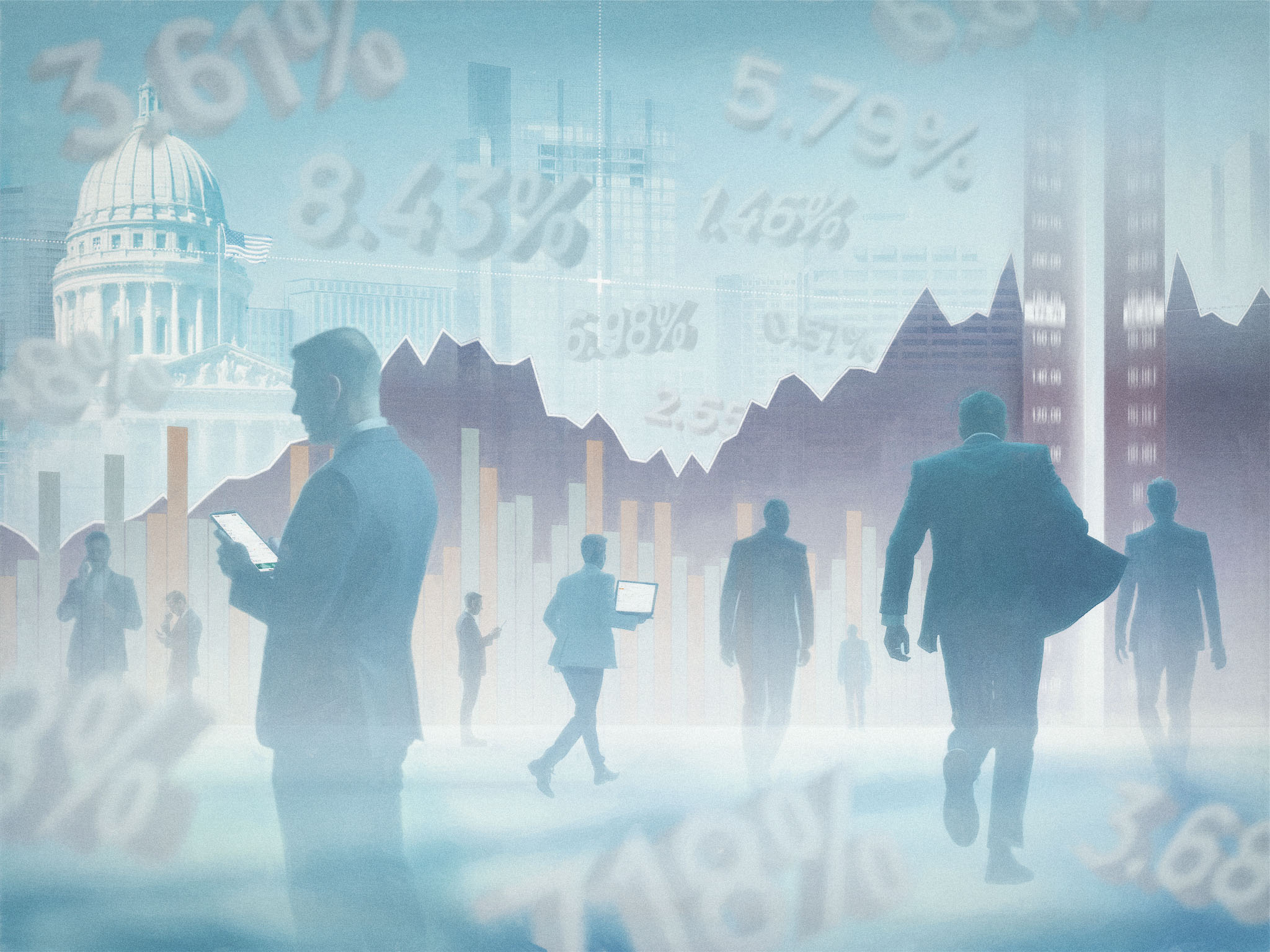
The financial press is currently obsessed with a ghost. They call it stagflation. They point to the 1970s like it’s a horror movie sequel ready for a reboot. They see a flicker of high prices and a sneeze in GDP growth and immediately start screaming about the death of the middle class.
They are wrong. They are lazy. And they are looking at the wrong map.
The standard definition of stagflation—stagnant economic growth coupled with high inflation—is an outdated relic of the industrial age. It assumes that the economy is a steam engine that just needs more coal. If the engine slows down while the coal gets more expensive, the engineers panic. But we aren't running a steam engine anymore. We are running a global, digital, decentralized network of value.
The "spectre" of stagflation isn't a threat to the economy; it's a threat to the egos of central bankers and institutional fund managers who can no longer control the narrative with a single interest rate lever.
The Efficiency Myth of the 1970s
Everyone loves to cite Paul Volcker. They treat him like a saint who slayed the dragon of inflation by hiking rates until the economy bled. The logic is simple: if people have less money, they buy less stuff, and prices go down.
This logic is flawed because it ignores productivity.
In the 70s, we had a rigid, unionized, energy-dependent manufacturing base. When oil prices spiked, the system had zero flexibility. Today, we have the opposite. We have a hyper-flexible, software-driven economy that eats inefficiency for breakfast.
When costs go up today, companies don't just sit there and die. They automate. They outsource to AI. They pivot to digital goods with zero marginal cost. The "stagnation" that economists see in GDP numbers is often just a failure to measure the massive value being created in the digital commons.
Why GDP is a Broken Metric
If you spend $50 on a physical CD in 1995, GDP goes up. If you stream 1,000 songs for $10 a month today, the "value" to you is infinitely higher, but the GDP impact is lower. Economists see this as a slowdown. I see it as an explosion of efficiency.
We aren't in a period of stagnant growth. We are in a period of invisible growth.
The "stagnation" part of stagflation is a measurement error. If the economy is producing more utility for more people at a lower cost, who cares if the arbitrary GDP number doesn't hit a 3% target?
Inflation is Not Your Enemy, Inertia Is
The "inflation" part of the equation is equally misunderstood. Most people think inflation is a monolithic beast. It isn't. There is a massive difference between monetary inflation (printing too much money) and scarcity inflation (not enough stuff).
The current "inflation" everyone is terrified of is a mix of both, but with a twist the suits don't want to admit: much of it is actually a repricing of reality.
For thirty years, the West enjoyed artificially low prices built on the back of cheap Russian energy and cheap Chinese labor. That era is over. The "inflation" we see is simply the world adjusting to the real cost of things. Trying to "fight" this with interest rate hikes is like trying to stop the tide with a bucket.
The Institutional Lie
Central banks want you to believe they can "fix" inflation. They can't. They can only destroy demand.
I've seen boards of directors freeze hiring and kill R&D projects because they’re terrified of a 25-basis-point hike. They are playing a defensive game based on a 50-year-old playbook.
If you are a business leader, the "contrarian" move isn't to hunker down and wait for stagflation to pass. It’s to realize that volatility is a filter. It filters out the companies that relied on cheap debt and low-quality labor. It leaves behind the lean, the automated, and the truly innovative.
The Death of the Phillips Curve
For decades, the Phillips Curve was the holy grail of economics. It suggested an inverse relationship between unemployment and inflation.
$\pi = \pi^e - \beta(u - u_n) + v$
The theory goes: if you want lower inflation, you need higher unemployment.
This is absolute nonsense in the modern era. We are currently seeing "sticky" inflation alongside record-low unemployment. Why? Because the labor market has decoupled from the traditional corporate structure.
The gig economy, remote work, and the "solopreneur" movement mean that the old ways of measuring "full employment" are dead. A person can be "unemployed" by government standards while earning $100k a year through three different side hustles and a YouTube channel.
The "spectre" of stagflation assumes that workers are helpless victims of the economic cycle. They aren't. They are more mobile and more resilient than ever before.
The Zero-Marginal-Cost Shield
Imagine a scenario where the price of physical goods (bread, gas, lumber) goes up by 10% a year. In 1974, you were screwed. In 2026, you offset that by shifting your consumption to digital goods that are effectively free or getting cheaper.
- Education? YouTube and Open Source.
- Entertainment? Subscriptions that cost less than a single steak.
- Communication? Near-zero cost.
The "cost of living" is a deceptive metric because it focuses on the things we used to need, rather than the things that actually define a modern life.
Stop Looking for a Soft Landing
The most common question I get from clients is, "Will there be a soft landing?"
It's the wrong question.
A "soft landing" means a return to the status quo. It means returning to a world of 2% inflation and cheap money. That world was a hallucination. It was built on debt and global dependencies that have fractured.
We don't need a soft landing; we need a hard reset.
The fear of stagflation is really a fear of the end of the "easy mode" economy. If you can't run a profitable business without 0% interest rates, you don't have a business; you have a subsidy.
How to Actually Play This
Most "experts" will tell you to move into "defensive" stocks—utilities, consumer staples, healthcare. This is the "lazy consensus."
If you want to survive and thrive, you don't play defense. You play anti-fragility.
- Eliminate Human Bottlenecks: If a task can be done by a script, it should be. The labor shortage isn't a crisis; it's a forced upgrade.
- Price for Value, Not Cost: Stop doing "cost-plus" pricing. Inflation is your excuse to finally charge what your product is actually worth to the customer.
- Ignore the Macro: I’ve seen companies go bankrupt during "booms" and mint millionaires during "recessions." The macro-economy is weather; your micro-economy is your house. Fix the roof.
The Brutal Reality of "Stagnation"
Let’s be honest: when economists talk about "stagnation," they are talking about the fact that they can't force the numbers to go up anymore.
The central planning model is failing. We are moving toward a "barbell" economy. On one end, you have massive, automated infrastructure (Amazon, Google, Microsoft). On the other, you have millions of hyper-specialized, agile small players.
The "middle"—the bloated corporations, the mid-tier retailers, the traditional banks—is what is "stagnating." And honestly? They deserve to.
They are the ones crying about stagflation because they are the ones who can't survive in a world where you can't just borrow your way to growth.
The Misunderstood Debt Trap
The competitor article probably told you that high debt levels make stagflation worse. They’re half right.
High debt makes incompetence worse.
Debt is a tool. If you used debt to buy back your own shares and juice your executive bonuses, you are about to get eviscerated. If you used debt to build an automated supply chain that operates at 1/10th the cost of your competitors, you are the one who wins.
Inflation actually helps people with fixed-rate debt, as they pay back their loans with "cheaper" dollars. The "spectre" only haunts those who don't know how to use the tools.
Your New Compass
Stop reading the headlines about CPI and GDP. They are lagging indicators of a world that no longer exists.
The real indicators you should watch are compute per dollar, energy density, and talent mobility.
If compute is getting cheaper (it is), energy is becoming more decentralized (it is), and talent is moving toward high-value projects (it is), then "stagflation" is nothing more than a scary word used by people who are afraid of the future.
The economy isn't dying. It's shedding its skin.
You can either sit around mourning the old skin or start figuring out how to thrive in the new one.
The boogeyman isn't real. The only thing you have to fear is your own refusal to adapt to a world where the old rules have been set on fire.
Stop asking when things will get back to normal. Normal was a trap. This is the reality. Deal with it.