The coffee hadn't even gone cold when the knock came. It wasn't a polite tap. It was the sound of a world shifting on its axis, delivered by a man in a high-visibility vest who looked like he’d rather be anywhere else. He told the residents of Keyham to leave. Not in an hour. Now.
Underneath the floorboards of a quiet garden on St Michael Avenue, a relic of 1941 had decided to wake up. It was a SC500—a 500kg German high-explosive bomb. For eighty years, families had mowed the grass above it. Children had played tag. Neighbors had argued over fence lines. All while several hundred pounds of volatile Amatol sat in the dark, corroding, waiting for a shovel to strike its rusted flank.
Plymouth is a city built on the bones of the Blitz, but we usually prefer our history in museums or memorial plaques. We don’t expect it to force 10,000 of us out of our beds.
The Weight of Three Days
Imagine—and this is a reality thousands just endured—being told your home is no longer a sanctuary, but a potential blast radius. You grab the cat. You grab the photo albums. You leave the dishes in the sink because suddenly, the mundane details of a Tuesday morning are irrelevant.
The evacuation of Keyham became one of the largest UK peacetime operations since the war itself. It wasn’t just about the logistics of moving people; it was the psychological toll of the "what if." For three days, the neighborhood became a ghost town, patrolled by police and watched over by experts from the Royal Navy and the Army.
The experts faced a binary choice, and both options were terrifying. They could try to defuse it where it lay, or they could move it. To defuse a bomb that has spent eight decades reacting with the minerals in the soil is to play a game of chess with a ghost who doesn't follow the rules. The "fuse" isn't just a mechanical part anymore; it's a chemical enigma. If they got it wrong, the street would simply cease to exist.
A Funeral Procession for a Monster
The decision was made: the bomb would go to sea.
This required a feat of engineering and nerves that felt like a choreographed dance with a titan. A 300-meter "cordon of steel" was established. The bomb was carefully lifted onto a flatbed truck, cushioned and shrouded, looking strangely small for something capable of such carnage.
Then began the slow crawl.
It was a funeral procession for a monster. The truck wound through the narrow streets of Plymouth, past the boarded-up windows and the silent cafes. Thousands of people watched from behind the safety of the perimeter, or through the glowing screens of their phones, holding their breath as the convoy moved toward Torpoint Ferry slipway. There is a specific kind of silence that descends when a city realizes its survival depends on the steady hands of a few men in uniform.
Once at the water's edge, the bomb was transferred to a barge. The Royal Navy took the hand-off. They towed the SC500 out past the Breakwater, into the deep, cold embrace of the Plymouth Sound.
The Moment of Release
We talk about "controlled explosions" as if they are clinical, tidy events. They are anything but.
Out in the open water, divers attached a fresh charge to the German casing. They moved to a safe distance. The countdown wasn't just a sequence of numbers; it was the final heartbeat of a conflict that supposedly ended in 1945.
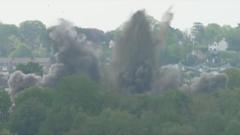
When the button was pressed, the sea didn't just splash. It erupted.
A white plume of water, hundreds of feet high, tore through the surface. It was a violent, beautiful geyser—a literal ghost of the Luftwaffe being exorcised from the Devon coastline. The shockwave rolled across the water, a dull thud felt in the chests of those standing miles away on the Hoe.
Then, the water settled. The mist cleared. The threat was gone.
The Invisible Map We Walk Upon
There is a temptation to see this as a freak occurrence, a one-off headline to be scrolled past. But the reality is that the soil beneath our feet is a library of unexploded intent. Between 1940 and 1941, Plymouth was targeted by the Luftwaffe because of its dockyards, but the bombs didn't always find the military targets. They found gardens. They found schools. They found the soft earth of residential streets and went deep, failing to detonate because of a faulty fuse or a soft landing.
The Ministry of Defence estimates that thousands of tons of unexploded ordnance (UXO) remain buried across the UK. We are living on a map where the "X" marks are invisible until a property developer or a gardener digs a few inches too far.
In Keyham, the "human element" wasn't just the fear; it was the sudden, jarring realization of our connection to the past. We think of history as something behind us, a linear path we’ve walked away from. But the SC500 proved that history is actually beneath us. It is a physical presence that can wait eighty years to demand our attention.
The people of Plymouth returned to their homes on Friday night. They found their kettles where they left them and their beds cold but safe. There was no crater where St Michael Avenue used to be. The only thing that had changed was the silence. It was no longer the heavy, expectant silence of a sleeping bomb. It was the quiet of a town that had looked a forgotten war in the eye and watched it finally sink into the sea.
Somewhere at the bottom of the Sound, the twisted metal of the SC500 now sits in the silt, neutralized and empty. It is no longer a weapon. It is just scrap metal. But for the families who walked back to their front doors, the ground feels different now. Every step is a reminder that peace isn't just the absence of war—it's the hard-earned safety of a garden that no longer holds a secret.
The tide comes in and the tide goes out, washing over the spot where the plume rose. The sea has a way of hiding things, but for one week in Plymouth, the earth refused to keep its secrets any longer.