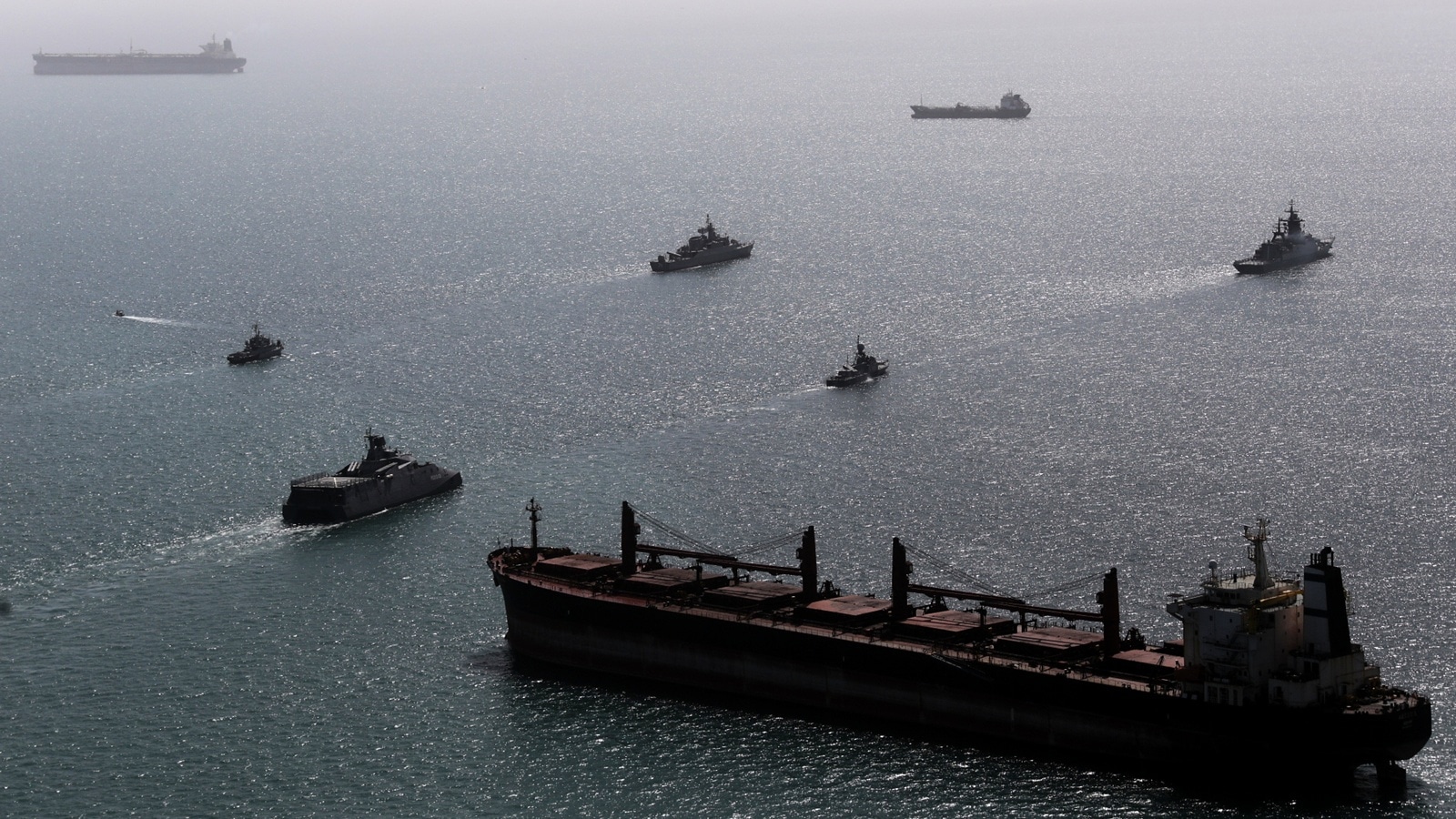
The sea does not care about your cargo. It does not care about the fluctuating price of oil in Karachi or the desperate need for industrial machinery in the ports of the north. To the Indian Ocean, a merchant ship is a slow, heavy intruder—a steel box filled with the lifeblood of a nation’s economy, floating on a surface that has grown increasingly hostile.
But the ocean is no longer the only threat.
Somewhere in the Gulf of Aden, a captain stares at a radar screen. His palms are damp. He knows the statistics. He knows that the Red Sea and the surrounding arteries of global trade have become a shooting gallery. One stray drone, one boarding party in a skiff, and the lights in a thousand Pakistani homes could flicker and die. This is the invisible reality of maritime trade. We see the products on our shelves, but we rarely see the warships that ensure they get there.
Pakistan has made a choice. It is a choice born of necessity, whispered through the corridors of power and executed with the heavy thud of a frigate’s hull hitting the swell. The Pakistan Navy has deployed its assets to provide permanent escort for its commercial vessels. This isn't just a military maneuver. It is a lifeline.
The Fragility of a Floating Economy
Consider a hypothetical merchant vessel, let’s call her the Indus Star. She is deep-laden, her waterline high, carrying thousands of tons of essential goods. To a pirate or a regional insurgent, she is a trophy. To the people of Pakistan, she is a paycheck.
When global shipping lanes become volatile, insurance premiums skyrocket. If a route is deemed too dangerous, shipping companies simply stop coming. For a country like Pakistan, which relies heavily on the sea for its energy needs and trade, a blockade—even an informal one caused by fear—is a slow-motion catastrophe.
The decision to send naval escorts is an admission that the world has changed. The era of "freedom of navigation" as a given is over. Now, freedom must be defended with 76mm guns and sophisticated radar suites.
The Pakistan Navy is not just "patrolling." They are creates a corridor of certainty. When a Pakistani merchant ship enters the high-risk areas of the Middle East, it is no longer a lone target. It is part of a pack. There is a psychological weight to seeing a grey hull on the horizon. For the crew of the merchant ship, it means they might actually see their families again. For the nation, it means the gears of industry keep turning.
The Shadow War in the Straits
The geography is a curse. The Bab el-Mandeb strait is a narrow throat through which the world’s wealth must pass. It is a chink in the armor of global stability.
Recent months have seen a surge in "asymmetric" threats. You don’t need a billion-dollar navy to sink a ship anymore. You need a cheap drone and a lucky shot. This democratization of destruction has forced traditional navies to rethink everything.
Pakistan’s naval leadership understands that they cannot be everywhere at once. But they can be exactly where their people are. By focusing specifically on escorting their own flagged vessels and those carrying vital national interests, they are playing a targeted game of protection.
The sailors on these frigates aren't just technical operators. They are exhausted. They spend weeks in the heat of the Gulf, eyes strained against the glare, looking for the tell-tale wake of a fast-attack craft. They are the human barrier between the chaos of Middle Eastern geopolitics and the stability of a domestic market.
The Cost of Silence
What happens if we stop?
If the escorts were withdrawn tomorrow, the ripple effect would be felt within forty-eight hours. Shipping lanes would shift. The "war risk" surcharges would be passed directly to the consumer at the petrol pump and the grocery store.
We often talk about national security in terms of borders and boots on the ground. We think of fences and checkpoints. But Pakistan’s most vital border is liquid. It is a shifting, blue frontier that stretches from the Arabian Sea into the heart of the world's most volatile energy corridors.
The presence of these warships is a message. It tells the world—and the various actors looking to disrupt the flow of trade—that Pakistan is not a passive observer of its own fate. It is an active participant.
There is a quiet, rhythmic violence to life on a warship during an escort mission. The constant hum of the engines, the repetitive drills, the tension of a "bogie" on the radar that turns out to be a fishing boat. It is a grueling, thankless task. There are no parades for a successful escort. The victory is simply that nothing happened.
The Weight of the Grey Hull
Naval power is often seen as an abstract concept, something for history books and documentaries. But when you are the captain of a defenseless tanker in the middle of a conflict zone, that abstract concept becomes the most real thing in your world.
The Pakistan Navy’s deployment serves a dual purpose. It protects the physical ship, but it also protects the sovereign dignity of the nation. It asserts that Pakistani interests do not end at the coastline.
This isn't about aggression. It's about resilience.
Every time a frigate pulls alongside a merchantman, a signal is sent. We are here. You are not alone. In an age where global alliances are shifting and old certainties are dissolving into the spray of the Indian Ocean, that signal is the only thing keeping the dark at bay.
The steel guardian watches the horizon. The merchant ship continues its slow, steady pulse toward the harbor. The lights stay on. The market stays open. The invisible war continues, won one quiet mile at a time, beneath a sun that offers no mercy and over a sea that never forgets.
The water remains indifferent, but the men on the bridge are anything but. They are the thin line of grey on the blue, holding the world together with nothing but vigilance and the cold, hard reality of a loaded gun.