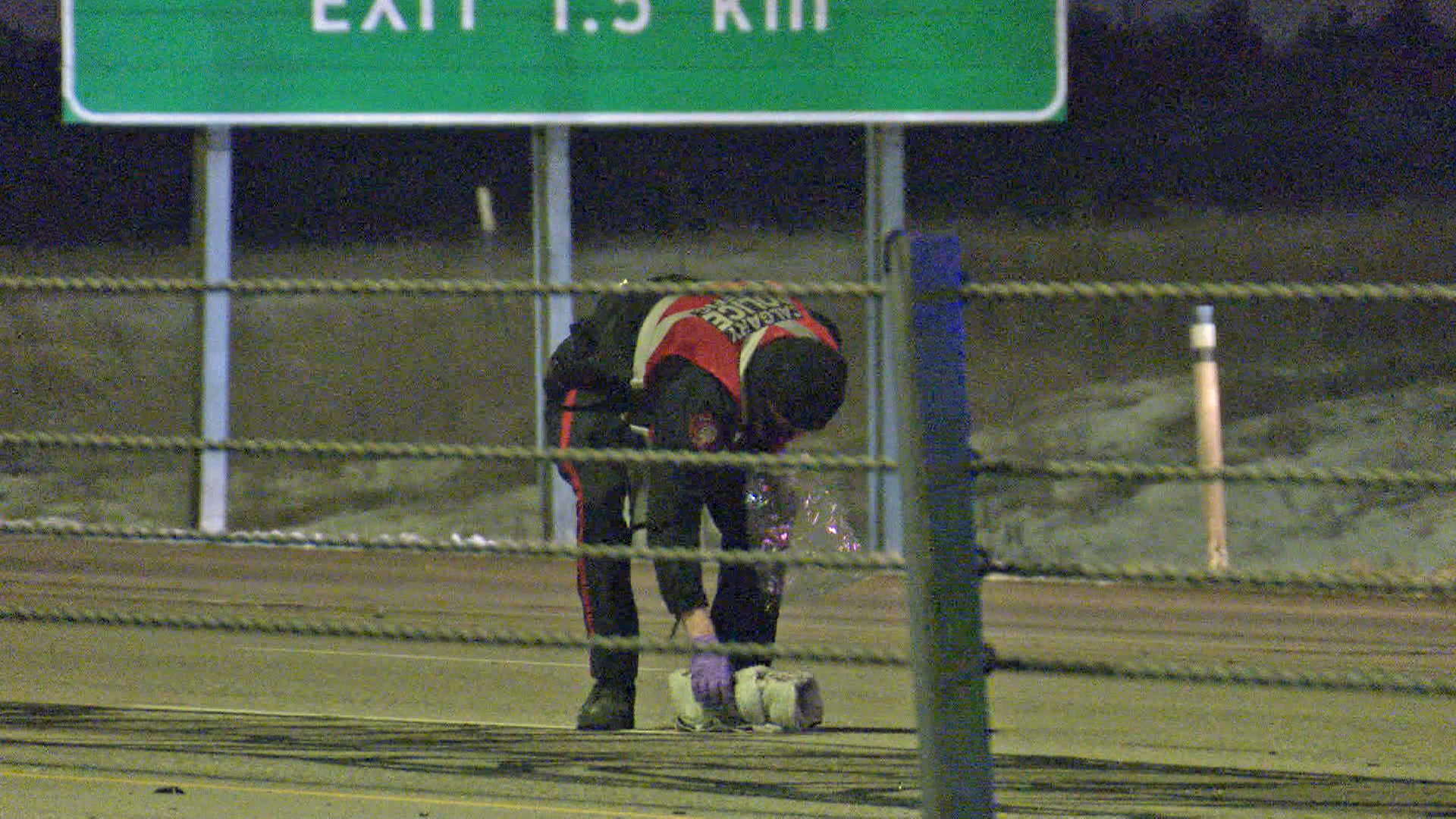
The death of a pedestrian on Stoney Trail in Calgary is not merely an isolated traffic incident but a failure of the urban-industrial interface. When a high-speed arterial bypass intersects with human movement, the result is a catastrophic kinetic energy transfer that the infrastructure is explicitly designed to prevent. This analysis deconstructs the mechanics of the collision, the geographical constraints of the Stoney Trail corridor, and the systemic variables that lead to pedestrian incursions on controlled-access highways.
The Physics of Lethality in High Speed Corridors
The primary determinant of a fatal outcome in vehicle-pedestrian interactions is the velocity at the point of impact. Stoney Trail (Highway 201) operates with posted limits of 100 km/h, creating a terminal environment for any unprotected human presence. Also making headlines lately: Why Chinese Activity Near Taiwan Waters Still Matters in 2026.
The probability of a pedestrian fatality follows an exponential curve relative to vehicle speed. At 30 km/h, the risk of death is approximately 10%. At 50 km/h, it rises to 40%. By 100 km/h, the survival rate drops to near zero. The kinetic energy ($E_k$) of a vehicle is calculated as:
$$E_k = \frac{1}{2}mv^2$$ More insights on this are detailed by Reuters.
Because velocity is squared, a vehicle traveling at highway speeds carries four times the destructive energy of a vehicle traveling at 50 km/h. On Stoney Trail, the infrastructure assumes a 0% presence of non-motorized entities. When this assumption fails, the safety systems—such as medians and guardrails—which are designed for vehicle-to-vehicle or vehicle-to-barrier redirection, provide no protection for the pedestrian.
Structural Variables of the Stoney Trail Incident
The Calgary Police Service confirmed the incident occurred on the evening of March 31, 2026, on Northbound Stoney Trail at the 17th Avenue S.E. interchange. To understand why a pedestrian was present in a zone specifically engineered for high-speed throughput, we must examine the Triad of Environmental Facilitation:
- Permeability of the Perimeter: Unlike traditional European motorways which often utilize continuous fencing, North American ring roads like Stoney Trail rely on "implied exclusion." Grassy embankments and drainage ditches serve as psychological barriers rather than physical ones.
- The Connectivity Gap: Urban expansion in Calgary’s east and west quadrants often outpaces the construction of dedicated pedestrian overpasses. If a transit user or resident needs to cross the corridor, the distance between legal crossings (interchanges) can exceed 2.5 kilometers, incentivizing high-risk "desire lines" across the highway.
- Low-Light Visability Degradation: The incident occurred during hours of darkness. The human eye's ability to perceive depth and speed is significantly compromised in low-contrast environments. For a driver at 100 km/h, the total stopping distance—incorporating perception time, reaction time, and braking distance—exceeds 150 meters. In many sections of Stoney Trail, fixed lighting is optimized for vehicle guidance, not for illuminating small, slow-moving objects on the shoulder or travel lanes.
Forensic Reconstruction and the Investigation Matrix
The CPS Traffic Section utilizes a multi-layered investigative framework to determine the causal factors of a fatal crash. This process moves beyond the immediate impact to identify the "root failure" of the event.
Vehicle Dynamics and Human Factors
Investigators analyze the "black box" or Event Data Recorder (EDR) of the involved vehicles to determine pre-impact speed, braking inputs, and steering maneuvers. Simultaneously, the pedestrian’s trajectory is mapped to determine if the entry into the roadway was a crossing attempt or a result of a secondary event, such as a vehicle breakdown leading to a driver exiting their car.
The Problem of Controlled Access Breaches
A critical component of the investigation is determining how the pedestrian accessed the right-of-way. Controlled-access highways are designed to eliminate "conflict points." When a pedestrian enters this space, they introduce a random variable into a deterministic system. The investigation must categorize the entry as:
- Intentional Bypass: Circumventing existing barriers for a perceived shortcut.
- Disabled Motorist: A driver who has transitioned into a pedestrian role due to mechanical failure, significantly increasing their vulnerability.
- Psychological or Impairment Factors: Reduced risk-aversion due to substance use or mental health crises.
Urban Planning and the High-Speed Buffer Zone
The Stoney Trail corridor represents a "Severance Effect" in Calgary’s geography. As the city grows outward, the highway becomes a barrier that bisects communities. The current engineering philosophy prioritizes Level of Service (LOS) for vehicles—measuring delay and throughput—but often neglects the Social Cost of Atmospheric Isolation.
When a pedestrian is killed on a ring road, it signals a failure in the buffer zone. Strategic urban planning requires the implementation of "Hardened Borders" in areas where residential density meets high-speed transit. This includes:
- Anti-Climb Fencing: Moving from standard livestock fencing to high-tensile security mesh in high-risk zones near interchanges.
- Graduated Lighting Transitions: Increasing the lux levels at interchanges where pedestrians are most likely to mistakenly enter the highway ramps.
- Intelligent Transportation Systems (ITS): Using thermal imaging and AI-driven camera feeds to detect non-vehicular heat signatures on highway shoulders, triggering immediate speed reductions via Variable Message Signs (VMS).
Macro-Economic Impact of Highway Fatalities
Beyond the human tragedy, a fatality on a major artery like Stoney Trail incurs massive economic friction. The closure of northbound lanes for several hours results in:
- Supply Chain Latency: Stoney Trail is a primary heavy-goods corridor. Thousands of hours of trucking productivity are lost during forensic investigations.
- Emergency Resource Allocation: The simultaneous deployment of EMS, Fire, and Police Traffic Units represents a significant operational cost to the municipality.
- Secondary Collision Risk: Statistical data shows that the "tailback" or congestion resulting from a primary fatality significantly increases the probability of rear-end collisions as traffic reaches the back of the queue at speed.
Infrastructure Resilience and Future Risk Mitigation
The Northbound Stoney Trail fatality at 17th Avenue is a data point in a larger trend of increasing pedestrian-vehicle conflict in sprawling urban environments. The mitigation of these risks requires a shift from reactive policing to proactive engineering.
The integration of pedestrian-detecting radar on high-speed corridors is the next logical step in highway safety. These systems can communicate directly with the on-board safety systems of modern vehicles via V2I (Vehicle-to-Infrastructure) protocols, initiating autonomous braking before a human driver even perceives the pedestrian in the dark.
Until such systems are deployed, the safety of the Stoney Trail corridor remains dependent on the absolute separation of modes. Any breach of this separation, whether due to poor lighting, lack of physical barriers, or human error, will continue to result in fatal outcomes. The immediate strategic requirement for the City of Calgary and Alberta Transportation is a comprehensive audit of "Desire Line" footprints along the ring road to identify where physical barriers must be reinforced to prevent the next fatal incursion.
Municipal authorities must move to harden the 17th Avenue S.E. interchange perimeter. The presence of a pedestrian on the northbound lanes suggests a breach point that is currently unaccounted for in existing safety protocols. Immediate installation of high-visibility signage and physical deterrents at the ramp-to-mainline transitions is the only viable short-term intervention to prevent a recurrence of this specific failure mode.