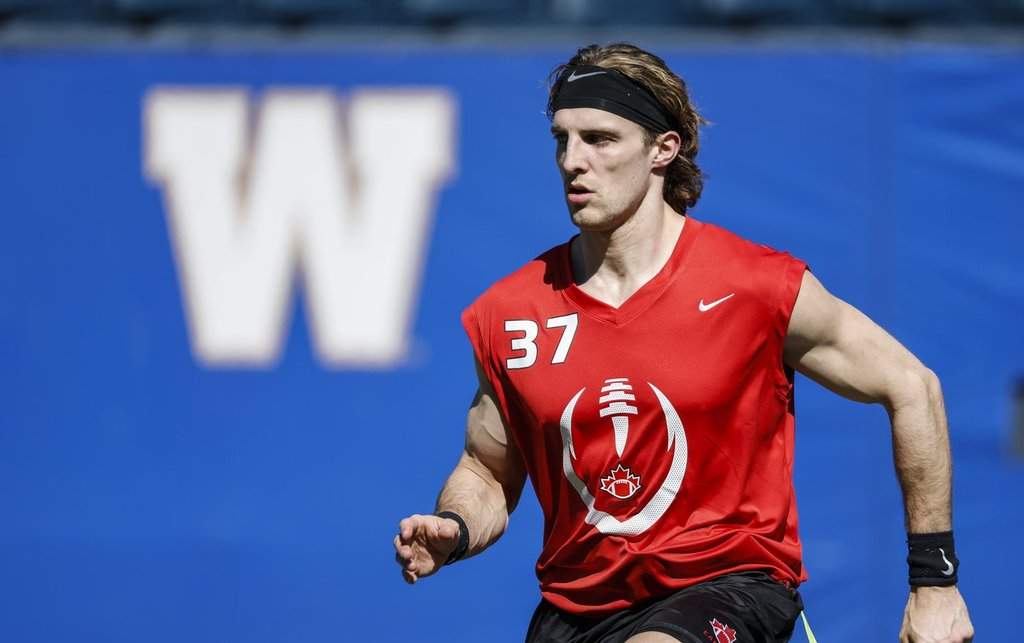
The lazy media narrative surrounding the Canadian flag football national team selection camp is nauseating. They focus on the stethoscope in the doctor’s bag of Émile Chênevert or the former CFL credentials of the roster. It is a comforting, human-interest story designed to make you feel warm and fuzzy about "transitioning" athletes.
It is also completely missing the point.
The prevailing consensus is that high-level flag football is essentially a waiting room for frustrated tackle football players who still want to chase a dream. That is not just wrong; it is a fundamental misunderstanding of the sport’s physics and tactical requirements. While the casual observer sees a group of athletes running around in shorts, the reality is a high-speed game of geometric chess played at a velocity that makes traditional football look like a slow-motion car wreck.
The Myth of Transferable Skill
You hear it constantly: "He played in the CFL, so he will be great at flag." That logic belongs in 1995.
Flag football is not a watered-down version of the gridiron. It is an entirely distinct discipline. In the CFL or NFL, defensive backs rely on contact, jams at the line of scrimmage, and physical redirection to dictate the movement of a receiver. In elite international flag football, that contact is a penalty. If you try to play with the aggressive, hands-on habits of a professional tackle defensive back, you will spend your entire tournament on the sideline watching the opponent rack up points.
I have seen former professional athletes arrive at these camps thinking they can rely on raw athleticism to dominate. They get shredded by specialized flag players who understand spatial awareness, subtle head fakes, and the precise art of the flag pull. Being a "team-player guy" matters, but knowing how to shift your center of gravity to avoid a pull is worth more than having 4.4 speed in a straight line.
The Geometry of Space
Look at the field dimensions. Traditional football is about winning the battle for the line of scrimmage. Flag football is about winning the battle for void.
Because there is no blocking, every single offensive player is a viable receiver on every snap. The defense has five players to cover five, often against complex, non-static sets. You cannot rely on a pass rush in the traditional sense; you have to rely on a "blitzer" who is constrained by strict distance rules.
This creates a tactical reality that forces a different kind of preparation. You don't train for grit. You train for reaction time and pattern recognition. If you are training like a linebacker, you are preparing to fail. The elite Canadian players who actually deserve the roster spot are the ones who have spent years internalizing the micro-movements of their opponents, not those relying on their glory days in university or professional tackle leagues.
The Olympic Distraction
The siren song of the 2028 Los Angeles Olympics has created a massive influx of "tourists"—athletes trying to jump on the bandwagon because they think the path to a gold medal is easier in a non-contact sport.
This influx is a liability.
When you prioritize athletes with big-name credentials, you erode the specialized knowledge base of the national team. A player who has spent four years mastering the nuanced art of the "flag-pull defensive shift" is infinitely more valuable to a championship-level squad than a guy who used to play slotback for a middling pro team.
Imagine a scenario where a roster is filled entirely with former pro tackle players. They would have the speed and the conditioning, but they would get picked apart by a disciplined team that understands the game’s unique rules on motion, zone-shifting, and the specific timing of the rush. The "CFL experience" is a resume booster for fans, but for a coach, it is often a corrective burden. You don't have time to teach a 30-year-old habits he has spent 20 years trying to unlearn.
Why The Conventional Training Model Fails
Most camps are designed around conditioning and basic drills. This is the mistake. At this level, conditioning is the baseline—it is expected. The differentiator is processing speed.
The successful approach isn't about running until you puke; it is about cognitive load. Elite flag squads need to be trained to read defensive shells in milliseconds. They need to understand that the "gap" in coverage isn't physical space, but a window of time created by the offensive formation.
Stop looking at the roster names. Stop looking at the medical degrees or the past professional highlights. Start looking at who is actually playing with the discipline of a practitioner rather than the nostalgia of a retired pro. If Canada wants to stand on an Olympic podium, they need to stop recruiting like a football team and start recruiting like a tactical unit.
The sport has outgrown its parent. If you’re still waiting for the pads to come on to evaluate talent, you’ve already lost the game.