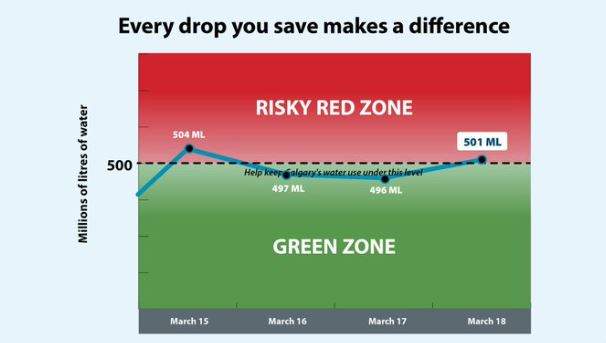
Calgary is currently held hostage by a flow meter. Every day, citizens wake up to a color-coded dashboard telling them whether they can take a shower without feeling like a criminal. The media tracks "water use" with the frantic energy of a day trader watching a collapsing stock. We are told we are in the "risky red zone" because we dared to use 500 million liters of water.
This panic is a distraction. It is the product of lazy governance and a fundamental misunderstanding of infrastructure resilience. By focusing on individual conservation, the city is masking a decades-long failure to build a redundant, high-capacity system that matches its status as a modern metropolis.
Conservation isn't the solution. It's a symptom of a system that has already failed.
The Myth of the Good Citizen
The current narrative is simple: If you don't flush, the city survives. If you water your lawn, the hospitals run out of water. This is a classic "tragedy of the commons" manipulation used to shift the burden of infrastructure maintenance onto the consumer.
When a city reaches a point where 10% of its population doing a load of laundry puts the entire system at risk, you are no longer looking at a "water shortage." You are looking at a failed utility model. In my years analyzing municipal infrastructure, I’ve seen this script played out across North America. When the pipes break—literally or figuratively—the first move is always to blame the lifestyle of the resident rather than the lack of foresight in the boardroom.
The "risky red zone" is an arbitrary threshold designed to create social pressure. It treats the symptoms of a ruptured feeder main while ignoring the underlying illness: a singular reliance on aging, non-redundant arterial lines.
Why Conservation is Counter-Productive
Here is the counter-intuitive truth: Aggressive, long-term conservation actually makes your infrastructure more brittle.
- Revenue Erosion: Water utilities are funded by usage. When you tell everyone to stop using water, the revenue needed to fix the pipes disappears. You end up in a death spiral where rates must rise to cover the shortfall, punishing the people who followed your instructions.
- The Stagnation Problem: Sewer systems are designed for specific flow volumes. When you drop water usage too low, solids settle in the pipes. You trade a water shortage for a sewage backup crisis.
- The False Sense of Security: By hitting "green" targets, the public stops demanding the massive capital expenditures required to build secondary feeder mains. We pat ourselves on the back for saving a bucket of water while the city remains one valve failure away from a total shutdown.
The Engineering Reality of the Bearspaw Failure
The June 2024 break of the Bearspaw South Main wasn't an act of God. It was an inevitability. We are talking about Prestressed Concrete Cylinder Pipe (PCCP). Anyone in the industry knows the track record of PCCP laid in the late 70s and early 80s. The wires corrode. The concrete embrittles.
The "nuance" the headlines miss is that Calgary’s system lacks a true "loop." In a robust hydraulic network, you should be able to isolate any single major artery and reroute flow with minimal impact on the end-user. Calgary is built like a tree with one trunk. When the trunk cracks, the branches die.
The city is currently patting itself on the back for "monitoring" the line with acoustic sensors. That is like putting a microphone on a ticking bomb and calling it a bomb disposal strategy.
The PPA (People Also Ask) Dismantled
Can we just build another pipe?
The short answer: Yes. The honest answer: It’s politically expensive. Politicians hate burying money. You can’t cut a ribbon on a secondary feeder main. It’s invisible. They would rather spend your tax dollars on a new arena or a "beautification" project than on the boring, essential redundancy that keeps your taps running.
Why is the "Red Zone" so dangerous?
The danger isn't that the Bow River is dry. The danger is that the pumps can't keep the reservoirs full enough to maintain fire suppression pressure. If a major fire breaks out while we are in the "red zone," the city literally cannot fight it. That isn't a "usage" problem. That is a "storage and delivery" problem. If your city is one hot day away from being unable to put out a fire, your leadership has failed you.
Stop Rewarding Mediocrity
Every time the Mayor goes on television to thank Calgarians for their "sacrifice," she is normalizing a lower standard of living. Why are we okay with this? Calgary sits at the confluence of two major rivers. We aren't Las Vegas. We aren't Phoenix. We have the water; we just don't have the guts to build the pipes to move it.
The contrarian move here isn't to buy a low-flow showerhead. It’s to demand a massive, multi-billion dollar overhaul of the water distribution network that makes "conservation" an elective environmental choice rather than a mandatory survival tactic.
We should be measuring success not by how much we saved, but by how much capacity we added. A world-class city does not operate on a knife’s edge.
The Actionable Pivot
Stop looking at the dashboard. Start looking at the capital budget.
If you want to actually "save" Calgary, stop worrying about your neighbor’s yellow lawn. Start asking why the City hasn't fast-tracked a secondary north-south bypass. Start asking why the "infrastructure deficit" is treated as a secondary concern to "climate targets" when the immediate threat to the city is a 50-year-old pipe snapping like a twig.
Infrastructure is the only thing that matters. Everything else is just PR.
If the city cannot provide a basic utility without asking its citizens to stop living like human beings, then the city is no longer functional. Demand the redundancy. Pay the bill. Build the damn pipes.
The "risky red zone" is a choice made by bureaucrats. Choose a different path.
Stop flushing your time away on "awareness" and start demanding the concrete and steel that a real city requires.