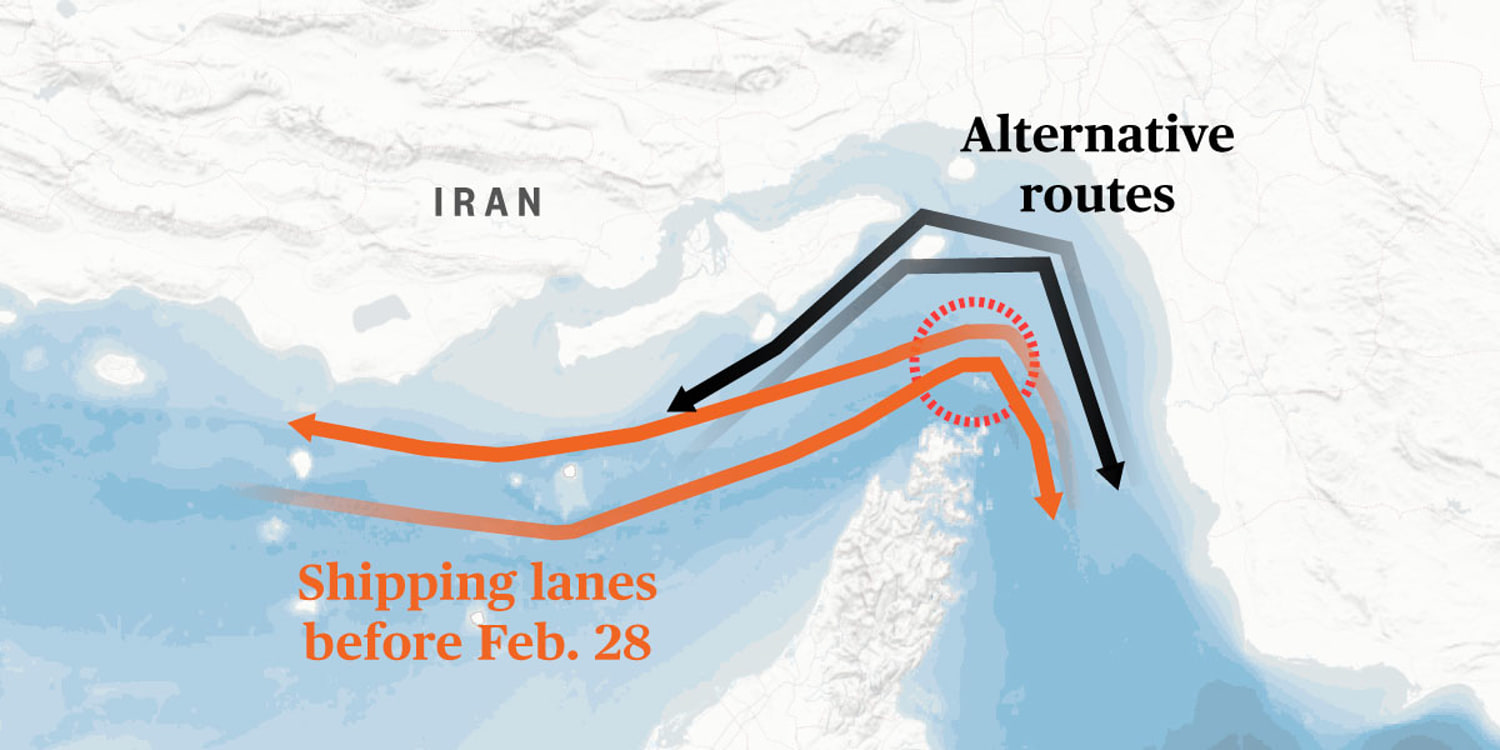
The Strait of Hormuz functions as the primary jugular of the global energy market, facilitating the transit of approximately 21 million barrels of oil per day. This equates to roughly 21% of global petroleum liquids consumption. Unlike other maritime chokepoints, such as the Suez Canal or the Panama Canal, the Strait of Hormuz lacks a viable maritime bypass. If transit through this 21-mile-wide passage ceases, the global energy supply chain experiences an immediate, non-linear price shock because the alternative overland routes—specifically pipelines across Saudi Arabia and the UAE—possess a combined spare capacity of only 3.5 to 5 million barrels per day. The fundamental math of global energy security dictates that 75% of the oil transiting the Strait cannot be rerouted.
The Mechanics of the Transit Corridor
To analyze the traffic flow through the Strait, one must understand the Traffic Separation Scheme (TSS) managed by the Sultanate of Oman. The corridor consists of two two-mile-wide lanes: one for inbound traffic and one for outbound traffic, separated by a two-mile-wide buffer zone.
Navigation through this corridor is dictated by the United Nations Convention on the Law of the Sea (UNCLOS), specifically the "transit passage" regime. This legal framework allows vessels to navigate through the territorial waters of coastal states—Iran and Oman—provided they remain in continuous, expeditious transit.
The operational density of the Strait is driven by three primary vessel classes:
- VLCCs (Very Large Crude Carriers): Capable of carrying 2 million barrels of oil. These vessels represent the core of the transit volume.
- LNG Carriers: Transporting Liquefied Natural Gas, primarily from Qatar. Qatar accounts for a significant portion of global LNG exports, nearly all of which must pass through the Strait.
- Product Tankers: Carrying refined fuels like gasoline, diesel, and aviation fuel from mega-refineries in the Persian Gulf to international markets.
The Cost Function of Maritime Friction
Any disruption in the Strait of Hormuz introduces "friction" into the global economy. This friction is quantified through three primary variables: War Risk Insurance premiums, freight rates, and the "Fear Premium" in Brent and WTI crude futures.
When a security incident occurs—such as a seizure or a kinetic strike—insurers move the Persian Gulf into "Listed Areas." Shipowners must then pay an Additional Premium (AP) to enter the zone. During periods of heightened tension, these premiums can spike from 0.02% of the hull value to over 0.5% for a single seven-day voyage. For a $100 million VLCC, this adds $500,000 in operating costs per transit, a cost inevitably passed to the end consumer.
The freight rate volatility is exacerbated by the "deadweight tonnage" (DWT) bottleneck. Because the Strait is a mandatory waypoint for the largest ships on earth, a slowdown in transit times reduces the effective global supply of tankers. This creates a feedback loop: slower transits lead to higher tanker demand, which drives up daily charter rates, further inflating the landed cost of energy.
Asymmetric Threats and Kinetic Variables
The Strait’s geography favors asymmetric naval strategies. The northern shore is controlled by Iran, which possesses a coastline of approximately 1,350 nautical miles along the Persian Gulf and the Gulf of Oman. The strategic depth provided by the mountainous terrain and numerous islands (such as Kish, Qeshm, and Hormuz) allows for the deployment of anti-access/area-denial (A2/AD) capabilities.
The threat matrix includes:
- Anti-Ship Cruise Missiles (ASCMs): Land-based batteries that can target any point within the 21-mile width of the Strait.
- Fast Attack Craft (FAC): Small, maneuverable boats capable of swarming larger, slower-moving tankers.
- Limpet Mines and UUVs: Underwater threats that are difficult to detect and can disable a vessel without sinking it, causing maximum logistical disruption with minimal political blowback.
- Electronic Warfare (EW): GPS spoofing and AIS (Automatic Identification System) interference, which force captains to rely on visual navigation in one of the world's most crowded waterways.
Dependency Mapping by Geographic Sector
The vulnerability to a Hormuz closure is not distributed evenly across the globe. It is heavily weighted toward Asian economies. Approximately 76% of the crude oil moving through the Strait is destined for Asian markets, specifically China, India, Japan, and South Korea.
China’s reliance on the Strait is a primary driver of its "Malacca Dilemma." While China has invested heavily in the China-Central Asia Gas Pipeline and the Eastern Siberia–Pacific Ocean (ESPO) oil pipeline, these overland routes cannot replace the massive volumes delivered by sea.
In contrast, the United States has reached a level of "net-exporter" status for petroleum products. However, the U.S. is not immune. Because oil is a fungible global commodity, a supply shock in the Strait of Hormuz forces global prices up. Even if the U.S. does not consume a single drop of Middle Eastern oil, the price of gasoline in Houston will track the price of Brent crude, which would likely see a vertical spike in any closure scenario.
The Infrastructure Bypass Limitation
The belief that pipelines provide a "safety valve" for the Strait of Hormuz is a common analytical error. The physical infrastructure simply does not support the necessary volume.
The East-West Pipeline (Petroline) in Saudi Arabia can transport approximately 5 million barrels per day from the Eastern Province to the Red Sea. However, much of this capacity is already utilized for domestic consumption or normal export. The Habshan–Fujairah pipeline in the UAE bypasses the Strait to reach the Gulf of Oman, but its capacity is capped at 1.5 million barrels per day.
The total theoretical bypass capacity is less than 25% of the total daily transit volume. Furthermore, these pipelines terminate at ports (Yanbu and Fujairah) that still require maritime loading, creating new bottlenecks and potential targets for disruption.
Structural Logic of a Sustained Closure
A total blockade of the Strait of Hormuz is historically improbable due to the concept of "Mutual Economic Destruction." Iran’s economy is heavily dependent on the export of oil and the import of essential goods through the Persian Gulf. A permanent closure would result in the collapse of its own fiscal structure.
Instead, the logic of disruption favors "grey zone" tactics—controlled escalations designed to increase insurance costs and diplomatic pressure without triggering a full-scale regional war. These disruptions are characterized by:
- Selective Targeting: Boarding ships based on flag state or ownership to signal specific geopolitical grievances.
- Delayed Clearances: Increasing the time required for security inspections, which disrupts the "Just-in-Time" delivery schedules of global refineries.
- Mine Planting: The threat of sea mines is more effective than the mines themselves. The mere suspicion of a minefield requires weeks of specialized clearing operations, effectively closing the Strait to commercial traffic during that period.
Strategic Response and Fleet Optimization
Market participants must move beyond simple tracking of "ship counts" and instead monitor the "Velocity of Transit." A reduction in average knots through the Strait is a leading indicator of risk, often preceding official diplomatic statements or military action.
Data-driven strategies for energy importers involve three layers of mitigation:
- Strategic Petroleum Reserves (SPR): Maintaining 90 days of net imports to buffer against the immediate 20-million-barrel-per-day deficit.
- Virtual Pipelines: Utilizing VLCCs as floating storage outside the Persian Gulf to decouple supply from immediate transit risks.
- Refinery Reconfiguration: Ensuring that refineries can process diverse crude grades (light vs. heavy) to allow for the substitution of Middle Eastern crudes with Atlantic Basin or US Shale grades.
The tactical reality is that the Strait of Hormuz cannot be "solved." It is a geographic constraint that must be managed through redundancy and risk-pricing. The primary failure in current maritime analysis is treating the Strait as a binary (open/closed) variable. In reality, it is a variable of efficiency. Every hour of delay, every dollar of insurance premium, and every nautical mile of deviation represents a direct tax on global industrial output.
Investors and strategists should focus on the "Delta of Transit Time" as the most accurate metric of regional stability. When the average transit time through the TSS increases by more than 15%, it signals an operational friction that the futures market has likely not yet priced in. The strategic play is not to predict a closure, but to hedge against the inevitable increase in the cost of passage.