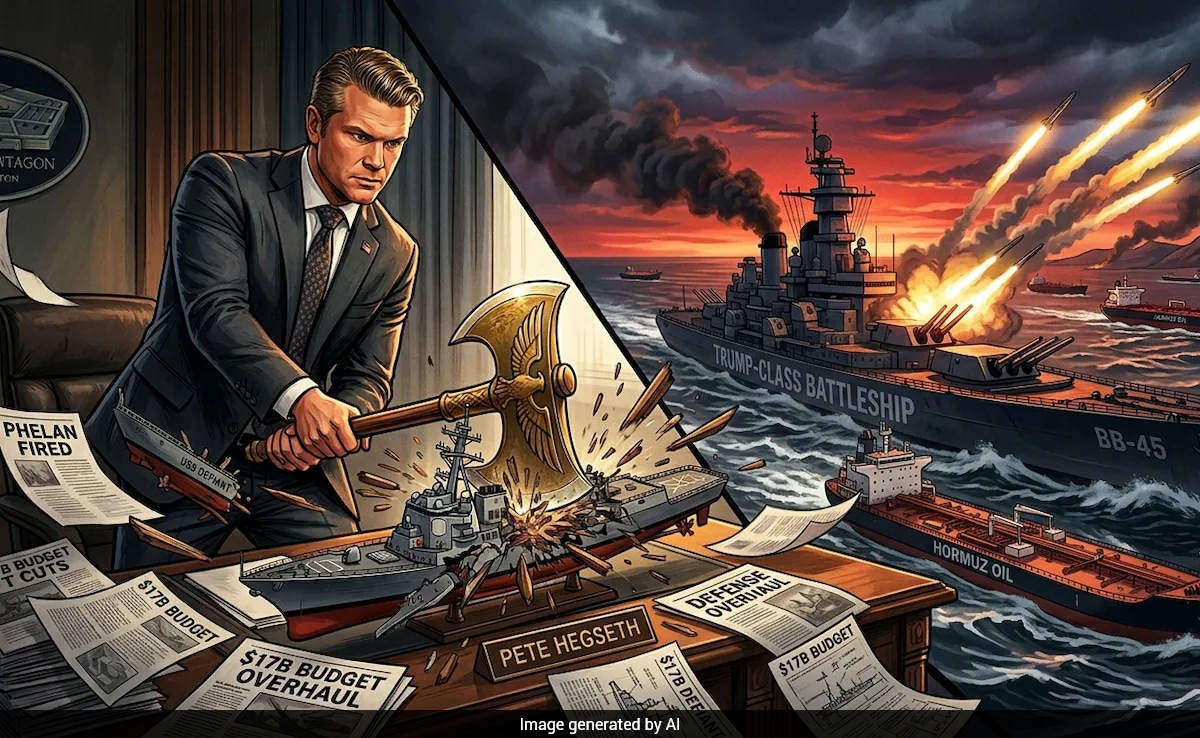
The removal of top Navy leadership amid the ballooning costs of the CVN-78 Gerald R. Ford class carrier program signals a terminal breakdown in the Pentagon’s acquisition logic. At a unit cost exceeding $17 billion, the Ford-class is no longer merely a weapon system; it is a concentrated financial risk that threatens to cannibalize the structural integrity of the United States' maritime strategy. The crisis is defined by a tri-node failure: technological over-extension, a broken procurement feedback loop, and the erosion of civilian-military consensus on the utility of supercarriers in a peer-competitor environment.
The Architecture of Cost Overruns
To understand why a single vessel now commands a price tag equivalent to the GDP of a small nation, one must examine the Concurrency Trap. Historically, the Navy utilized evolutionary design, integrating one or two new technologies per ship class. With the Ford, the Department of Defense mandated the simultaneous integration of at least 23 unproven technologies. This created a cascading failure effect: if the Electromagnetic Aircraft Launch System (EMALS) failed to meet specifications, it delayed the integration of the Advanced Arresting Gear (AAG), which in turn halted the certification of the Dual Band Radar (DBR).
The cost function of the CVN-78 is driven by three primary variables:
- First-of-Class Non-Recurring Engineering (NRE): The transition from steam-powered catapults to electromagnetic systems required an entirely new internal electrical architecture. The ship’s power plant produces 300% more electricity than the previous Nimitz class, yet the infrastructure to manage this load suffered from significant design-build overlaps.
- Reliability Deficits: The "Mean Cycles Between Critical Failure" (MCBCF) for the EMALS and AAG consistently fell short of operational requirements during the first five years of the program. This necessitated retroactive "engineering changes" (ECs) on a ship that was already commissioned, effectively rebuilding the vessel while it was afloat.
- Labor Inflation and Industrial Base Atrophy: The US naval shipbuilding industry is a monopsony. With only one shipyard (Huntington Ingalls Industries) capable of building nuclear-powered carriers, the lack of competitive pressure removes the incentive for radical cost-efficiency.
The Operational Paradox of the $17 Billion Target
The central strategic tension lies in the Concentration of Value vs. Dispersion of Risk. As the unit price of a carrier rises, the political and strategic "cost of loss" becomes prohibitive. This leads to a tactical paralysis where the Navy’s most capable asset is kept at a distance from high-threat zones to avoid the catastrophic loss of a $17 billion asset and 4,500 personnel.
This creates a mismatch between the carrier's designed intent and its actual employment. The Ford was built for high-tempo sortie generation—launching more aircraft faster than any ship in history. However, the proliferation of Anti-Access/Area Denial (A2/AD) systems, specifically long-range hypersonic anti-ship missiles, forces the carrier to operate outside its effective strike radius. The result is an expensive platform that requires an ever-increasing percentage of its own air wing and escort fleet just to defend itself, rather than projecting power.
The Institutional Failure of the Navy Secretariat
The dismissal of the Navy’s civilian leadership by the Pentagon reflects a loss of confidence in the branch’s ability to manage its own "350-ship plan." The internal friction stems from a fundamental disagreement over the High-Low Mix. While the Navy’s traditionalist core views the supercarrier as the indispensable center of the fleet, the Pentagon’s senior leadership is increasingly prioritizing smaller, unmanned, and more numerous distributed platforms.
The Ford class has become a "Sunk Cost Fallacy" at a bureaucratic level. Every dollar spent on fixing the Ford is a dollar not spent on the Constellation-class frigate or the Next-Generation Air Dominance (NGAD) program. The inability of the Navy Chief’s office to provide a transparent, fixed-price roadmap for CVN-79 (John F. Kennedy) and CVN-80 (Enterprise) turned a procurement issue into a political liability.
The leadership vacuum is not just about personality; it is about the failure of the Planning, Programming, Budgeting, and Execution (PPBE) process. The Navy’s projections failed to account for:
- The volatility of the specialty steel market.
- The scarcity of nuclear-qualified welders and technicians.
- The exponential growth in software sustainment costs for the ship's integrated combat system.
Technological Debt and the EMALS Bottleneck
The transition from steam to electromagnetics was sold as a way to reduce manning requirements and extend airframe life. In reality, it created a Closed-System Bottleneck. Unlike steam systems, which can be repaired with mechanical parts often fabricated on-site, EMALS relies on a complex web of solid-state electronics and high-capacity capacitors.
A failure in the power conversion chain can ground the entire air wing. During early trials, the inability to isolate sections of the catapult for maintenance meant that a single component failure could disable all four launch lanes. This is a violation of the "fail-deadly" versus "fail-gracefully" principle of military engineering. While software patches have mitigated some of these issues, the underlying hardware complexity ensures that the Ford will remain a high-maintenance outlier compared to the more predictable Nimitz class.
The Geometric Growth of Escort Requirements
The true cost of a $17 billion carrier is actually the cost of the Carrier Strike Group (CSG). To protect a Ford-class vessel, the Navy must deploy:
- Two Arleigh Burke-class destroyers (DDGs).
- One Ticonderoga-class cruiser (CG) or the forthcoming DDG(X).
- An attack submarine (SSN) for sub-surface screening.
- A logistics support vessel.
When the carrier’s cost spikes, the budget for these escorts is squeezed. This leads to a "hollow fleet" where the crown jewel is increasingly vulnerable because the "shield" vessels are aging or under-equipped. We are witnessing a transition from a fleet of many capable ships to a fleet centered around a few ultra-expensive, fragile nodes.
Strategic Realignment and the Block Buy Strategy
To salvage the program, the Department of Defense is shifting toward a Block Buy procurement model. By ordering CVN-80 and CVN-81 simultaneously, the Navy hopes to achieve "economies of scale" that were absent during the Ford’s construction. This strategy relies on three levers:
- Material Volume Discounts: Purchasing nuclear reactor components and specialized alloys in bulk to hedge against inflation.
- Labor Continuity: Maintaining a consistent workforce at Newport News to avoid the "learning curve reset" that occurs when there are multi-year gaps between hulls.
- Design Freezing: Forbidding any new major technological insertions for the next two vessels to ensure that the production line remains predictable.
However, this strategy carries the risk of Obsolescence Lock-in. By committing to the current design for the next twenty years, the Navy may be building the world's most advanced targets for 2040’s weapon systems.
The Immediate Mandate for Naval Procurement
The Navy must move beyond the "Supercarrier vs. No Carrier" binary. The path forward requires a brutal prioritization of the following tactical shifts:
- Fixed-Price Contracts with Clawbacks: The era of cost-plus contracts for major surface combatants must end. Future hulls in the Ford class must be tied to strict performance milestones, with financial penalties for the contractor if sortie generation rates do not meet the 160-per-day threshold.
- Decoupling Radar and Launch Systems: The Navy should investigate "modular" deck configurations where the launch and recovery systems are not so deeply integrated into the hull's primary electrical bus that they cannot be swapped or upgraded without a three-year mid-life refueling overhaul.
- Aggressive Investment in Long-Range Stand-off Munitions: To justify the carrier's cost, the air wing must be able to strike from 1,000+ nautical miles. This means the Navy must prioritize the MQ-25 Stingray refueling drone and the Collaborative Combat Aircraft (CCA) program over additional carrier-specific luxury features.
The Pentagon’s decision to remove leadership is the first step in acknowledging that the Ford program is a symptom of a larger systemic illness. The second step is a radical reduction in the complexity of the CVN-81 and CVN-82 designs. If the Navy cannot bring the unit cost down to a manageable $12 billion-$13 billion range, the supercarrier will cease to be a tool of national power and instead become a fiscal anchor that drags the entire surface fleet into irrelevance. The strategic move now is to freeze the design, punish the cost-overrun culture, and shift the saved capital into the unmanned systems that will actually provide the screening the Ford needs to survive.