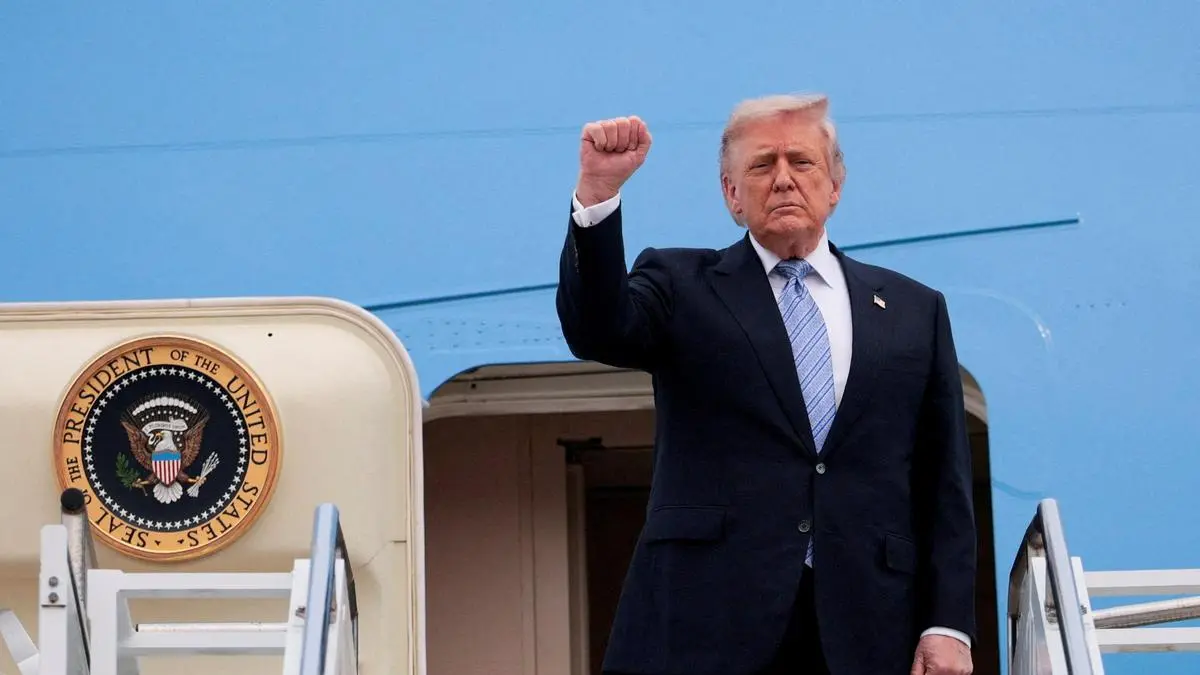
The shift in American foreign policy regarding the Iranian-Pakistani corridor signals a transition from reactive containment to a multipolar balance-of-power strategy. When President Donald Trump characterizes a cessation of hostilities with Iran as a "favour" to Pakistan, the statement functions as an admission of the structural interdependence between Islamabad’s internal stability and Tehran’s regional influence. This is not a matter of diplomatic altruism; it is a cold calculation of the Regional Security Dilemma, where a conflict in one node of the Middle East-South Asia (MESA) axis threatens to collapse the adjacent node, creating a power vacuum that neither the United States nor its allies can effectively manage.
The Triangulation of Interests: Washington, Tehran, and Islamabad
To understand the mechanics of this "favour," one must analyze the three distinct vectors of pressure currently acting upon Pakistan. The Pakistani state operates within a constrained fiscal environment, burdened by high debt-to-GDP ratios and a persistent need for International Monetary Fund (IMF) interventions. Any escalation between its western neighbor (Iran) and its primary security benefactor (the United States) forces Pakistan into a binary choice that its economy cannot sustain.
- Kinetic Spillover and Border Management: The 900-kilometer border between Iran and Pakistan is a volatile theater for insurgent groups, specifically those operating in Balochistan. A hot war or intensified low-intensity conflict involving Iran necessitates a massive reallocation of Pakistan's military resources away from its eastern front with India and its northern counter-terrorism operations.
- Energy Infrastructure Stasis: The Iran-Pakistan (IP) gas pipeline remains a dormant asset. U.S. sanctions on Iran prevent Islamabad from operationalizing a project that would solve its chronic energy deficit. A "ceasefire" or de-escalation acts as a pressure valve, allowing Pakistan to delay the inevitable friction between its energy needs and its compliance with U.S. treasury regulations.
- The Diaspora and Remittance Variable: Pakistan hosts a significant Shia minority and maintains complex social ties with Iran. Domestic stability is directly correlated with religious harmony, which is historically strained when geopolitical tensions between Sunni-led states and Iran peak.
The Cost Function of Regional De-escalation
A de-escalated Iran provides the United States with a "buffer of neglect." By reducing the immediate threat of Iranian kinetic action, Washington can maintain its pivot toward the Indo-Pacific without being pulled back into the tactical minutiae of Gulf security. For Pakistan, the "favour" is the preservation of its sovereign bandwidth.
If we quantify the impact of a conflict-free western border for Pakistan, we see a reduction in the Security Premium—the extra cost of insurance, shipping, and military readiness that suppresses foreign direct investment (FDI).
The Mechanism of Selective Engagement
The logic of "doing a favour" implies a transactional framework that most observers miss. The Trumpian approach prioritizes bilateral leverage over multilateral treaties. By framing peace as a gift to Pakistan, the U.S. creates a debt of alignment. This debt is expected to be paid in specific currencies:
- Intelligence Cooperation: Increased monitoring of the Taliban-led Afghanistan, where both Iran and Pakistan have competing and overlapping interests.
- Counter-Proliferation: Ensuring that Iranian nuclear ambitions do not spark a secondary arms race involving the Sunni bloc, which often looks to Pakistan as a theoretical nuclear guarantor.
- Logistical Access: Maintaining the Ground Lines of Communication (GLOCs) and Air Lines of Communication (ALOCs) that remain vital for any potential U.S. footprint in the region.
The second-order effect of this strategy is the neutralization of the "China Factor." Beijing’s Belt and Road Initiative (BRI) thrives in stable environments. However, China also benefits from U.S. distraction. A stabilized Iran-Pakistan relationship, brokered or permitted by Washington, asserts American relevance in a geography where China has recently acted as the primary mediator (e.g., the Saudi-Iran normalization).
Risk Asymmetry in De-escalation Models
While a ceasefire appears beneficial, it contains an inherent Asymmetry of Risk. For Iran, a ceasefire is a tactical pause to bypass sanctions and rebuild conventional capabilities. For Pakistan, it is a survival mechanism. The United States, however, risks "Strategic Atrophy"—the loss of active influence as regional players learn to navigate their own disputes without American mediation.
The failure of previous frameworks, such as the JCPOA, stemmed from a lack of integration between nuclear constraints and regional kinetic behavior. The current rhetoric suggests a shift toward a Regional Integration Model where economic interlinkages are the primary leash. If Pakistan is "favoured" by a quiet Iran, Pakistan becomes the informal enforcer of that quietude, as it has the most to lose from its disruption.
The Bottleneck of Sovereign Debt and Geopolitics
Pakistan’s inability to act as a truly independent sovereign actor is the primary bottleneck in this security architecture. With an economy characterized by low foreign exchange reserves and high inflation, Islamabad cannot afford to offend the U.S. (its largest export market) or Iran (a critical neighbor and potential energy source).
This creates a Fragility Trap. When a U.S. leader speaks of "favours," they are highlighting Pakistan's lack of strategic autonomy. The "favour" is not merely the absence of war; it is the temporary suspension of the requirement to choose a side.
The Operational Reality of Border Securitization
Following the exchange of missile strikes in early 2024, both Tehran and Islamabad recognized that neither side could afford a protracted engagement. The strikes were symbolic—a "test of resolve" that yielded a stalemate. The subsequent de-escalation was less about diplomacy and more about the recognition of mutual exhaustion.
The United States utilizes this exhaustion to recalibrate its demands. By signaling that a ceasefire is a concession to Pakistan, Washington effectively tells Islamabad: "We are allowing this neighbor to remain unpressured for your sake; therefore, your cooperation on other fronts is non-negotiable."
Resource Allocation and the Indo-Pacific Pivot
The overarching strategy requires a reduction in the "CentCom Tax"—the amount of military and diplomatic capital spent on Central and South Asian stability. A de-escalated Iran-Pakistan corridor is the prerequisite for this reduction.
- The Naval Component: Reducing the need for constant Carrier Strike Group (CSG) presence in the North Arabian Sea.
- The Diplomatic Component: Freeing up State Department resources to focus on the "Quad" (U.S., Japan, Australia, India) rather than constant firefighting in the Indus Valley.
The limitation of this approach is its reliance on the internal stability of the Iranian regime. If Tehran perceives the "ceasefire" as a sign of American withdrawal rather than American strategy, it may increase its proxy activities in the Levant or Yemen, assuming that the U.S. is too committed to the Pakistan "favour" to retaliate.
Strategic Realignment Requirements
For this balance to hold, the following structural adjustments are necessary:
- Redefinition of "Red Lines": Washington must clearly articulate what Iranian actions would trigger an end to the "favour" for Pakistan, preventing Islamabad from being caught off-guard by a sudden shift in U.S. kinetic posture.
- Multilateral Validation: The U.S. must involve regional partners like Saudi Arabia and the UAE in this "favour" logic, ensuring that the Sunni bloc does not view de-escalation with Iran as a betrayal of their security interests.
- Economic Decoupling of Security and Energy: Pakistan requires a path to energy security that does not involve Iranian hydrocarbons, or the U.S. must provide a sanctioned-exempt "Energy Corridor" that satisfies Islamabad’s industrial needs without enriching the Islamic Revolutionary Guard Corps (IRGC).
The current trajectory points toward a regional order where the United States acts as a distant balancer rather than an active hegemon. In this model, Pakistan serves as the frontline manager of Iranian ambitions, compensated not with direct aid, but with the "favour" of a manageable western border. This transition marks the end of the post-9/11 security era and the beginning of a cold, transactional multipolarity.
The immediate strategic play for regional stakeholders is to maximize their value within this "favour" framework before the next cyclical shift in American domestic politics alters the cost-benefit analysis. Pakistan must use this window of relative calm to restructure its internal debt and secure its borderlands, as the "favour" of a superpower is a depreciating asset that will eventually be called in.