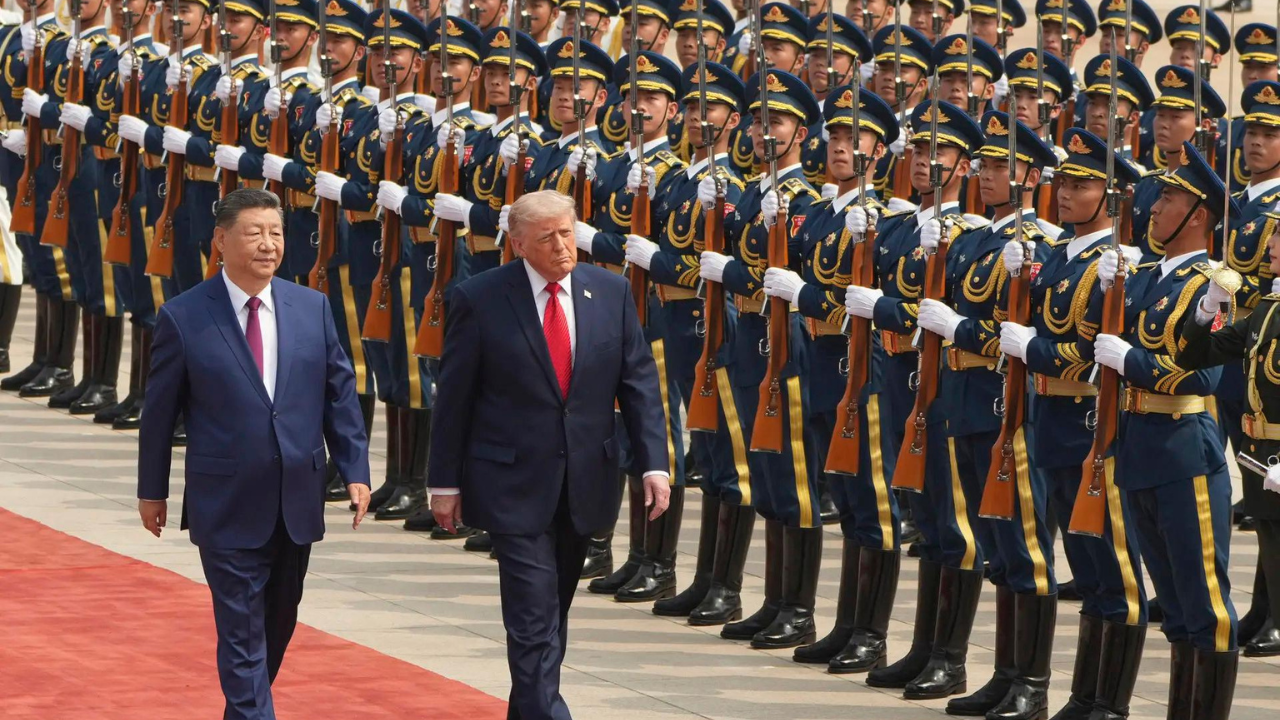
The stability of the global semiconductor supply chain and the maritime security of the Indo-Pacific now hinge on a binary friction point: the Chinese Communist Party’s (CCP) perception of "strategic clarity" versus the United States’ pursuit of "economic containment." While media narratives frame recent warnings from Xi Jinping to Donald Trump as mere rhetorical posturing, a structural analysis reveals a narrowing corridor for diplomatic maneuver. The friction is not rooted in personality clashes but in a fundamental misalignment of two competing national security architectures.
The Triad of Chinese Strategic Deterrence
To analyze Xi’s warnings, one must categorize them within the CCP’s established three-pillar framework for cross-strait relations. These pillars dictate the intensity of Beijing's response to any perceived shift in Washington’s policy.
- Sovereignty Inviolability: This is the ideological bedrock. For Beijing, Taiwan is a domestic jurisdictional issue, not a foreign policy chip. Any move by a U.S. administration to grant sovereign status—such as official diplomatic recognition or high-level state visits—triggers a pre-programmed escalation cycle.
- Anti-Secession Law Enforcement: This 2005 legal framework provides the domestic "trigger" for military action. If the CCP determines that "possibilities for a peaceful reunification should be completely exhausted," the state is legally mandated to use non-peaceful means.
- The Counter-Containment Mandate: Beijing views U.S. support for Taiwan as a component of a broader "island chain" strategy designed to bottle up the People’s Liberation Army Navy (PLAN) within the First Island Chain.
The Trump Transactionalism vs. Ideological Rigidity
A critical misalignment exists between Xi’s ideological consistency and Donald Trump’s transactional approach to foreign policy. The risk of "clashes and even conflicts" arises from a specific logic gap. Trump historically views tariffs and trade concessions as variables that can be traded for geopolitical positioning. Xi, conversely, treats Taiwan as a "zero-variable" constant.
The cost function of this misunderstanding is high. If the U.S. attempts to use Taiwan as a bargaining chip for trade deficits or currency manipulation agreements, Beijing perceives this not as a negotiation, but as a fundamental violation of the "One China" baseline. This creates a feedback loop:
- Action: U.S. increases arms sales or technical assistance to Taiwan as "leverage."
- Perception: Beijing interprets this as a permanent shift toward Taiwan independence.
- Reaction: PLAN increases gray-zone activities (ADIZ incursions, naval encirclement) to signal that the cost of U.S. interference is rising.
The Silicon Shield and Economic Interdependence
The "Silicon Shield"—Taiwan's dominance in the production of sub-7nm semiconductors—remains the primary deterrent against kinetic conflict, but its efficacy is degrading. The logic of the Silicon Shield suggests that because a war would destroy Taiwan Semiconductor Manufacturing Company (TSMC) facilities and collapse the global economy, no rational actor would initiate a strike.
However, the "Integrated Circuit Bottleneck" is shifting the calculus. The U.S. "CHIPS and Science Act" and subsequent export controls on high-end AI chips (NVIDIA H100s/A100s and beyond) have signaled to Beijing that the U.S. is already engaged in a form of "technological decapitation."
When the U.S. restricts China’s access to the tools needed for the fourth industrial revolution, Beijing’s incentive to maintain the status quo diminishes. If they cannot participate in the global tech ecosystem due to U.S. sanctions, the "cost" of a conflict over Taiwan becomes relatively lower compared to a future of permanent technological stagnation.
Quantifying the Gray Zone Escalation
Conflict in the Taiwan Strait is unlikely to begin with a full-scale amphibious assault. Instead, the "clashes" Xi warns of will likely manifest in three escalating tiers of gray-zone warfare:
Tier 1: The Customs and Quarantine Blockade
The China Coast Guard (CCG) begins stopping and searching commercial vessels heading to Taiwanese ports, citing "domestic security regulations." This effectively bypasses the legal definition of an "act of war" while creating a "risk premium" for global shipping, driving up insurance rates and strangling the island’s economy.
Tier 2: Kinetic Harassment of Asymmetric Assets
Targeted interference with Taiwan’s undersea cables and energy infrastructure. By disrupting the digital and electrical grid without a physical invasion, Beijing tests the limits of the U.S. Taiwan Relations Act, which commits the U.S. to provide "defense articles" but remains ambiguous on "cyber or infrastructure restoration."
Tier 3: The Exclusion Zone
Beijing declares a temporary exclusion zone for "military exercises" that covers major shipping lanes in the South China Sea and the Taiwan Strait. This forces a choice upon the U.S. Navy: ignore the zone and risk an accidental collision/skirmish, or respect it and cede de facto control of the waterway.
The Decoupling Paradox
The U.S. strategy under a second Trump term would likely involve accelerated economic decoupling. While intended to reduce vulnerability, decoupling actually removes the "mutually assured economic destruction" that has prevented war since 1979.
The mechanism is simple:
- High Interdependence: Both parties have a massive financial stake in the other’s survival. Conflict is irrational.
- Low Interdependence (Decoupling): The "opportunity cost" of war drops. If the U.S. no longer relies on Chinese manufacturing and China no longer relies on U.S. capital/tech, the primary barrier to military action becomes purely kinetic rather than economic.
Xi’s warning reflects an awareness that the "guardrails" are being dismantled. The transition from a symbiotic economic relationship to a zero-sum security competition creates a "Thucydides Trap" scenario where the established power (U.S.) and the rising power (China) view every move as a preparation for the inevitable.
Strategic Bottlenecks in U.S. Policy
Washington faces two primary constraints in responding to Xi’s warnings.
First, the Defense Industrial Base (DIB) bottleneck. Current U.S. munitions production—specifically Long Range Anti-Ship Missiles (LRASMs) and torpedoes—is insufficient for a sustained high-intensity conflict in the Pacific. War games consistently show the U.S. exhausting its precision-guided inventory within the first three weeks of a strait conflict. Until the DIB is scaled, "strategic clarity" lacks the necessary "kinetic backing."
Second, the Allied Cohesion variable. While the U.S. has strengthened the QUAD and AUKUS, the economic reliance of regional partners (Japan, South Korea, Australia) on Chinese trade remains a point of divergence. A U.S. policy that is "too hawkish" without providing an economic alternative risks fracturing the very coalition required to deter Beijing.
The Resultant Vector of the Xi-Trump Dynamic
The trajectory of the U.S.-China relationship is moving toward a "militarized stalemate." The warning issued by Xi is an attempt to establish a psychological "no-go zone" before the next administration takes office.
The strategic play for the next four years will not be found in grand bargains, but in the management of the "Escalation Ladder." To prevent "clashes and even conflicts," the U.S. must synchronize its trade policy with its naval deployment schedule. If tariffs are raised (economic aggression) while naval presence is reduced (military retreat), it signals weakness. If arms sales are increased (military aggression) without a diplomatic channel (diplomatic vacuum), it signals an intent for war.
Stability requires a calibrated "Internal Strengthening" strategy: prioritize the domestic production of high-end semiconductors and munitions to regain the leverage of the Silicon Shield, while maintaining a clear, non-negotiable definition of the "One China" policy to deny Beijing a legal pretext for escalation. The goal is to make the cost of conflict perpetually higher than the cost of a frustrated peace.