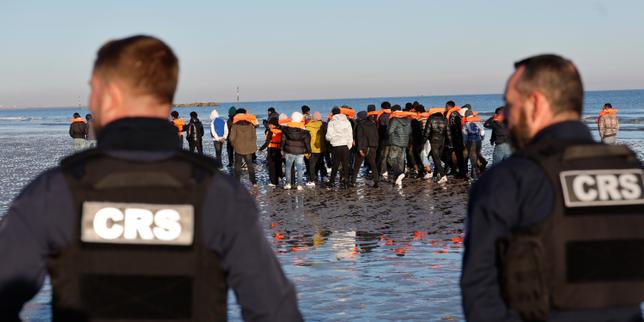
The maritime border between France and the United Kingdom functions not as a physical barrier but as a dynamic marketplace shaped by geopolitical friction and logistical arbitrage. The most recent bilateral agreement aiming to curb small boat crossings represents a localized tactical adjustment to a systemic continental problem. To understand why these treaties frequently fall short of their stated objectives, one must examine the operational mechanics of the Channel crossing as a logistical supply chain and the inherent limitations of state-level intervention in decentralized migrant networks.
The Three Pillars of Border Externalization
The Franco-British strategy rests on three specific operational pillars: technical surveillance, boots-on-the-ground presence, and financial burden-sharing. By analyzing these components, the logic of the agreement moves from political rhetoric to measurable security outputs. For an alternative perspective, read: this related article.
- Technical Saturation: The deployment of drones, thermal imaging, and fixed-site sensors aims to eliminate "blind spots" along the 150-mile coastline. This creates a high-resolution surveillance net intended to detect movement before a vessel reaches the water.
- Increased Personnel Density: A significant portion of the UK’s financial contribution—totaling hundreds of millions of euros over a multi-year period—funds the payroll for additional French gendarmes and police officers. The goal is to reach a saturation point where the risk of detection for smugglers exceeds the potential for successful launch.
- Command and Control Integration: For the first time, the treaty establishes a joint monitoring cell. This is an attempt to reduce the latency between detection on the French side and interception or notification on the British side.
This framework assumes that increasing the "cost of entry" for smugglers will eventually lead to a collapse in the volume of attempts. However, this logic ignores the elasticity of the smuggling market. When the cost of a launch increases due to higher security, smugglers simply adjust their pricing or shift to more dangerous, less-monitored launch sites, effectively moving the problem rather than solving it.
The Cost Function of Maritime Displacement
The primary failure of the current maritime strategy is its focus on the "point of departure" rather than the "point of origin." The Channel crossing is the final leg of a multi-thousand-mile journey. By the time a migrant reaches the beaches of northern France, they have already invested significant capital—social and financial—making the final barrier a sunk-cost problem rather than a deterrent. Similar analysis regarding this has been published by NBC News.
From a tactical perspective, the increased surveillance in traditional hotspots like Calais and Dunkirk has created a "displacement effect." Smugglers now utilize more remote sections of the coast, such as the beaches near Wimereux or further south. This increases the transit time for French security forces to respond to a launch.
The economic model of the crossing can be broken down as follows:
- Asset Acquisition: Procurement of inflatable boats and engines from Central and Eastern European suppliers.
- Logistics and Storage: The hidden movement of vessels from inland warehouses to the shoreline.
- Risk Premium: The fees paid to local "fixers" to navigate French police patrols.
When the UK pays France to increase patrols, they are essentially attempting to raise the "Risk Premium." However, as long as the demand (migrants seeking to reach the UK) remains constant and the "Asset Acquisition" remains cheap, the smugglers' profit margins can absorb the increased operational difficulty.
Structural Bottlenecks in Joint Enforcement
The effectiveness of the Franco-British agreement is hampered by a fundamental misalignment of legal and political incentives. The UK views the Channel crossing as a breach of national sovereignty and a threat to border integrity. France, conversely, views the situation as a humanitarian and public order crisis occurring on its soil, largely triggered by British labor market pull factors.
The French legal system imposes significant constraints on what gendarmes can do on the beaches. Unless a crime is actively being committed, French law often prevents the physical detention of individuals merely present in the dunes. Furthermore, the "push-back" of boats once they are in the water is widely considered a violation of maritime law and human rights obligations, meaning that once a boat is launched, the French security mission shifts from prevention to rescue.
This creates a paradox:
- The UK expects interception.
- France prioritizes safety of life at sea.
As long as these two objectives are not aligned, the joint monitoring cell acts as a data-gathering exercise rather than a unified enforcement mechanism. The data confirms the activity but does not provide the legal authority to stop it once the vessel is afloat.
The Divergence of Internal and External Policy
The agreement fails to address the "pull factors" that make the UK an attractive destination compared to France or other EU nations. These include:
- Labor Market Accessibility: The UK’s large informal economy and the lack of a mandatory national ID card system make it easier for undocumented individuals to find work.
- Linguistic Ties: Many migrants from former British colonies or English-speaking regions choose the UK for ease of integration.
- Family Reunification: Existing diaspora communities provide a support network that mitigates the risks of arrival.
By focusing almost exclusively on the maritime border, the treaty ignores the internal policy levers that could reduce the demand for the crossing. A strategy that does not address the ease of working illegally in the UK or the processing speed of asylum claims will continue to face an uphill battle at the shoreline.
Tactical Reorientation for Future Accords
If the objective is a quantifiable reduction in crossings, the strategy must shift from beach-level patrols to high-level financial and logistical disruption.
First, the focus must move to the supply chain of maritime assets. Small boats and outboard motors used in these crossings are not manufactured in northern France. They are imported through established European trade routes. A pan-European task force focused on the seizure of uncertified or suspicious shipments of inflatable vessels would do more to hinder launches than additional police on the sand.
Second, the legal framework for processing must be internationalized. The current system encourages a "pass-the-parcel" approach between European states. A joint processing center, perhaps located in France but funded and staffed by both nations, would allow for the immediate determination of asylum status. This would remove the incentive to cross the Channel for those whose claims are likely to be rejected.
Third, the financial intelligence aspect of smuggling must be prioritized. These operations generate millions in cash. Targeting the "hawala" systems and informal money transfers used by smuggling rings to move profits back to source countries would degrade the organizational capacity of these networks far more effectively than physical barriers.
The current Franco-British agreement is a political necessity that provides a temporary bandage for a deep-seated structural issue. It manages the symptoms of the crisis while leaving the underlying economic and logistical drivers untouched. Success will not be found in more drones or more money for French police, but in a coordinated, multi-national dismantling of the smuggling business model from its point of origin to its point of profit.


