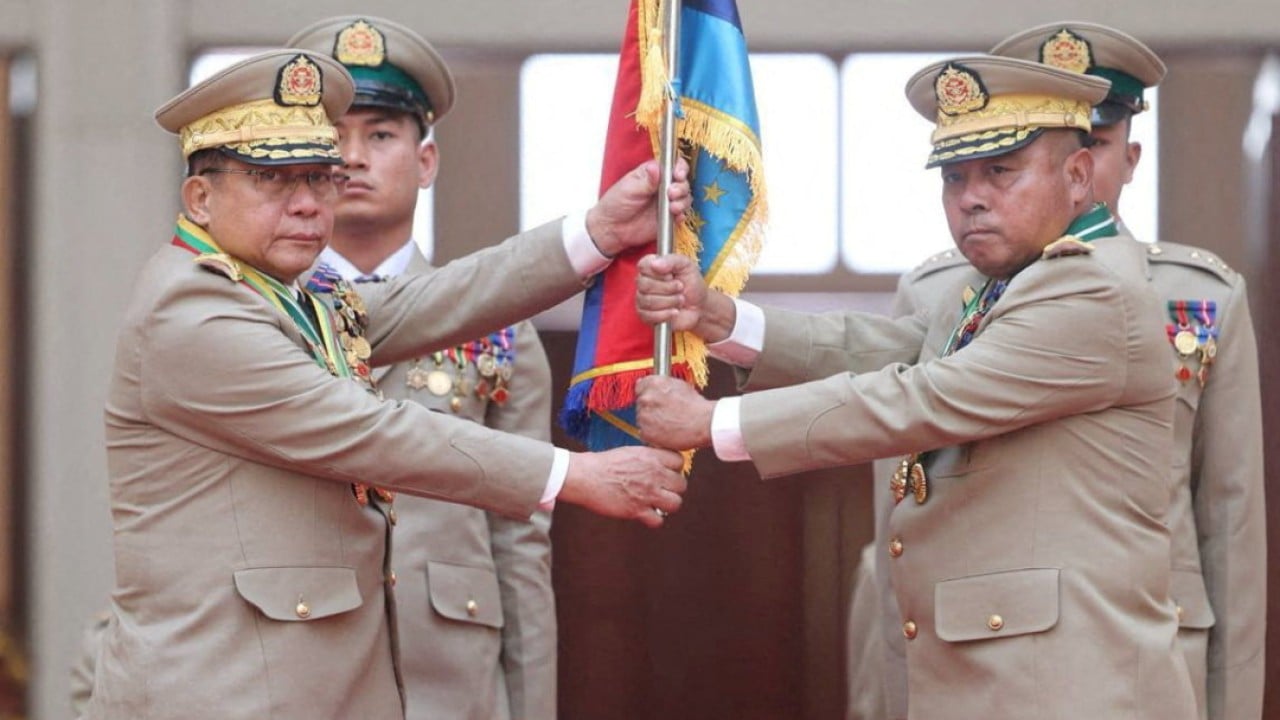
The departure of Senior General Min Aung Hlaing from the apex of Myanmar’s military hierarchy does not represent a shift toward democratization or a weakening of the junta’s resolve; rather, it is a calibrated tactical pivot designed to preserve the institution’s survival via a reshuffling of human capital. In authoritarian systems under existential threat, the leadership "exit" serves as a pressure valve to deflect international sanctions and internal dissent while maintaining the underlying architecture of power. To understand the current trajectory of the State Administration Council (SAC), one must look past the individuals and analyze the structural mechanisms of the Tatmadaw—an institution that prioritizes its own corporate longevity over the political survival of any single commander.
The Triple Lock of Institutional Continuity
The assumption that removing a top general signals a change in regime DNA ignores the three pillars that sustain the Myanmar military’s grip on the state. These pillars ensure that whether Min Aung Hlaing or a successor holds the title of Commander-in-Chief, the operational reality remains static.
- Constitutional Entrenchment: The 2008 Constitution was engineered specifically to survive leadership changes. By mandating military control over the ministries of Home Affairs, Border Affairs, and Defense, the document decouples the military's power from the civilian electoral cycle. Any "successor" inherits a legal framework that forbids civilian oversight of military internal affairs, effectively making the Commander-in-Chief a sovereign unto himself.
- Economic Autarchy: Through the Myanmar Economic Corporation (MEC) and Myanmar Economic Holdings Ltd (MEHL), the military operates a parallel economy. This revenue stream is insulated from the national budget. A change at the top is merely a change in the board of directors for a conglomerate that controls gems, timber, banking, and telecommunications. This economic autonomy prevents the "starve the beast" strategy often employed by international sanctions, as the incoming leadership inherits a self-funding war machine.
- The Praetorian Ideology: The military views itself as the only institution capable of preventing "disintegration of the union." This isn't mere propaganda; it is the core curriculum of the Defense Services Academy (DSA). The internal socialization of the officer corps ensures that any general rising to replace the incumbent will hold identical views on the necessity of military dominance.
The Cost Function of Leadership Churn
Internal shifts in the SAC are often misinterpreted as coups or fractures. In reality, these movements follow a discernible cost-benefit logic. The SAC is currently facing a "War of Attrition Cost" that necessitates a change in optics without a change in strategy.
- Diplomatic De-escalation: By replacing a sanctioned, "toxic" leader, the junta attempts to reset the clock with ASEAN and Western powers. The new face offers a "window of engagement," allowing mid-tier powers to argue for a softening of sanctions under the guise of supporting "reformists."
- Internal Scapegoating: When territorial losses to the Three Brotherhood Alliance or the People’s Defense Forces (PDF) become politically untenable, the military sacrifices the top tier to protect the institution's prestige. The outgoing leader is blamed for tactical failures, while the institution itself is presented as a corrective force.
- Consolidation of Loyalty: A leadership transition allows for the purging of "waverers"—officers who may have shown a lack of zeal in the scorched-earth campaigns against the resistance. It is a refinement of the hierarchy, not a softening of it.
The Myth of the Reformist General
Political analysts frequently fall into the trap of searching for a "Burmese Thein Sein"—a general willing to lead a transition. This search ignores the current high-stakes environment. In 2011, the military transitioned from a position of strength; today, it would be transitioning from a position of existential vulnerability.
The logic of "credible commitment" prevents any meaningful reform. Because the military has committed widespread atrocities since the 2021 coup, any transition to civilian rule involves a high probability of prosecution for the officer corps. Therefore, the dominant strategy for any incoming general is "Retrenchment over Reform." The cost of losing power now includes life imprisonment or execution, which creates an incentive structure where the military must win at all costs or perish entirely.
Tactical Decentralization and the Fragmented Front
While the top-level leadership reshuffles, the tactical reality on the ground is shifting toward fragmentation. The military is no longer a monolithic force capable of projecting power across all of Myanmar’s states simultaneously. This has led to a shift in the military's operational doctrine:
- Fortress City Strategy: The military is abandoning the periphery to consolidate power in the Bamar heartland and major urban centers like Naypyidaw, Yangon, and Mandalay.
- Air-Power Dependency: As ground troops suffer from low morale and desertion, the military has shifted its "Cost Function" toward high-intensity aerial bombardment. This minimizes military casualties while maximizing the cost of governance for the resistance in "liberated" zones.
- Proxy Proliferation: To compensate for manpower shortages, the military is increasingly relying on Pyu Saw Htee militias. This decentralizes violence and makes any future peace process exponentially more complex, as there is no longer a single chain of command to negotiate with.
The Failure of External Pressure Models
International strategy has largely relied on the "Sanction and Isolate" model. However, this fails to account for the military’s "Autarkic Pivot." By strengthening ties with regional actors like Russia and China, the SAC has diversified its hardware procurement and diplomatic cover.
China’s role is particularly nuanced. Beijing does not favor the SAC out of ideological alignment, but out of a desire for "Border Stability" and the protection of the China-Myanmar Economic Corridor (CMEC). If a leadership change in Naypyidaw promises better protection for Chinese assets, Beijing will facilitate the transition. This makes the leadership exit a commodity to be traded for regional support, rather than a step toward democratic restoration.
Assessing the Resistance Capability Gap
The National Unity Government (NUG) and Ethnic Armed Organizations (EAOs) have achieved unprecedented coordination, yet a leadership change in the military creates a specific risk for the resistance. The "Reform Mirage" can lead to a fracturing of the opposition. If a new general offers a partial ceasefire or local autonomy to specific EAOs, the unified front against the junta may dissolve. The military has historically been a master of "Divide and Rule," and a new leader provides the perfect opportunity to offer "new" deals to old enemies.
The resistance's success is not measured by the identity of the person in Naypyidaw, but by the degradation of the military's logistical and administrative capacity. Until the military loses its ability to collect tax revenue and deploy air power, a change in the Commander-in-Chief is a cosmetic adjustment.
The Strategic Play: Targeting the Institutional Core
To move beyond the cycle of military leadership reshuffles, the strategic focus must shift from "Who is in charge?" to "How does the machine run?" Meaningful change requires the systematic dismantling of the military's autonomous power centers.
The primary objective for external and internal actors should be the severance of the military’s dual-track economy. This involves:
- Direct Targeting of Aviation Fuel Supply Chains: Eliminating the military’s primary tactical advantage—air strikes—by cutting off the specialized fuel and insurance markets that allow these sorties to continue.
- Delegitimizing the 2008 Constitution in International Fora: Moving beyond the recognition of the NUG to a formal legal challenge of the military's "right" to exist as a state within a state.
- Incentivizing Mid-Tier Defections: Creating a "Safe Harbor" mechanism for battalion-level officers. The current focus on the top tier ignores the fact that the military collapses when the mid-level officers refuse to execute orders.
The "exit" of a top general is a scripted performance in the theater of authoritarian survival. It is a reshuffling of the deck in a game where the house—the Tatmadaw—always intends to win. True analysis requires ignoring the actors and focusing on the mechanics of the stage itself. The military’s survival strategy is now a race between its ability to reform its image and the resistance’s ability to bankrupt its operations.