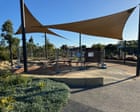
The repeated closure of Victoria Park in Camperdown functions as a case study in cascading systemic failure, where the initial remediation of a known toxin—bonded asbestos—has been undermined by secondary chemical leaching. Public infrastructure safety is not a binary state of "open" or "closed" but a continuous function of supply chain integrity and environmental monitoring. The emergence of a "black tar-like substance" weeping from timber structures suggests that the remediation process itself introduced new variables that were either unmonitored or incorrectly specified. This creates a feedback loop where public trust erodes at a faster rate than the physical site can be rehabilitated.
The Triad of Contamination Vectors
To understand why a playground remains non-operational despite multiple "cleans," the site must be viewed through three distinct contamination vectors. The failure to treat these as interconnected systems is why the current strategy remains reactive rather than preventive.
- Direct Fragmentary Contamination (Asbestos): The initial crisis involved the discovery of bonded asbestos in recycled mulch. This is a procurement failure. Recycled mulch is a byproduct of the construction and demolition (C&D) waste stream. When the sorting mechanisms at the waste processing facility fail to achieve 100% purity, friable and non-friable asbestos particles enter the public landscaping supply chain.
- Chemical Exudation (The "Tar" Phenomenon): The recent closure stems from a "bleeding" effect on timber equipment. This is typically a failure of material compatibility or environmental stress. Timber used in public parks is often pressure-treated with chemicals like Creosote or Copper Chrome Arsenate (CCA). Under extreme heat or when subjected to specific solvents—possibly used during the asbestos decontamination wash-down—the internal chemical stabilizers can lose their bond with the wood fibers.
- Cross-Contamination via Remediation: The process of removing asbestos mulch involves heavy machinery, high-pressure water, and physical agitation of the topsoil. This disturbance can expose legacy issues (older buried contaminants) or cause chemical runoff to pool in drainage-poor areas like playground pits, leading to the concentrated "tar" sightings reported by the City of Sydney.
The Cost Function of Regulatory Oversight
The Sydney asbestos mulch scandal is an externality of the Linear Waste Model. In a rush to meet sustainability targets through "circular economy" initiatives, the regulatory framework governing recycled wood products has lagged behind the volume of production.
The cost of a failure in this system is not merely the price of replacing the mulch. The true cost function ($C_{total}$) is defined by:
$$C_{total} = R + O + L + T$$
Where:
- $R$ (Remediation): The direct labor and material costs of removing and disposing of hazardous waste.
- $O$ (Opportunity Cost): The loss of utility for the community and the economic impact on local businesses surrounding the park.
- $L$ (Liability): The legal and insurance premiums associated with potential long-term health claims (mesothelioma or chemical dermatological issues).
- $T$ (Trust Deficit): The intangible but quantifiable decline in government authority, leading to increased public resistance to future infrastructure projects.
The recurring nature of the Victoria Park closure proves that the remediation phase ignored the $T$ and $L$ variables. By focusing only on the visible asbestos, the council failed to audit the integrity of the surrounding timber structures, which were likely stressed during the initial cleanup.
Material Science and the Failure of Timber Preservation
The "black tar" reported at the site points toward a breakdown in the Polymers and Preservatives (P&P) Matrix of the playground equipment. In high-traffic urban environments, timber is treated to resist rot, fungi, and termites.
Two primary mechanisms explain the recent "bleeding":
- Thermal Expansion and Viscosity Reduction: Sydney’s fluctuating temperatures cause the wood cells to expand. If the timber was treated with a high concentration of oil-based preservatives (like creosote, though its use is restricted in many modern contexts, older installations often retain it), the heat reduces the liquid's viscosity, forcing it out through the pores.
- Chemical Synergies with Decontaminants: If the asbestos cleanup involved surfactants or aggressive cleaning agents to suppress dust, these chemicals may have reacted with the timber's existing treatment. This creates a new, unidentified compound that exudes from the wood as an oily residue.
The danger here is twofold. First, the substance itself may be a skin irritant or carcinogen. Second, the loss of these preservatives compromises the structural integrity of the wood, leading to internal rot that is not visible from the surface. A playground that is "safe" from asbestos but structurally compromised by chemical leaching is still a high-risk asset.
The Logistics of Supply Chain Purity
The root cause of the asbestos infiltration is a lack of Batch-Level Traceability. Currently, mulch is often treated as a bulk commodity rather than a regulated material. To prevent a recurrence, the procurement process must transition to a "Pharma-Grade" supply chain model.
- Positive Release Systems: No mulch should be spread until independent laboratory testing (not provided by the vendor) confirms the absence of prohibited fibers and chemical markers.
- Vendor Accountability Protocols: Contracts must include "clawback" clauses where the vendor is financially responsible for the entire $C_{total}$ if their product is found to be the source of a secondary shutdown.
- Digital Twins for Public Assets: Each park should have a digital record of every material batch delivered, including the date, source facility, and specific chemical profile of the treatment used on the timber.
Remediation Hierarchy and Structural Logic
When a site is closed for the second time in a short period, the standard "remove and replace" logic has failed. The City of Sydney must move up the Hierarchy of Controls.
The first failure was at the "Substitution" level—using recycled mulch that was not sufficiently vetted. The current failure is at the "Engineering Controls" level—failing to ensure the playground equipment was compatible with the remediation environment.
The site logic must now shift toward Total Site Sealing. This involves:
- Strip-down to Sub-base: Removing not just the mulch, but the top 100mm of soil where contaminants may have leached.
- Encapsulation: Using geotextile fabrics that provide a physical barrier between the earth and the play medium.
- Material Transition: Moving away from porous organic mulch and treated timber toward high-density polyethylene (HDPE) and poured-in-place rubber surfaces, which offer zero absorption for external toxins. While less "natural," these materials provide a predictable safety profile in contaminated urban contexts.
The Credibility Gap in Environmental Reporting
Public statements regarding "low risk" are often technically accurate but strategically disastrous. While bonded asbestos is indeed low risk if undisturbed, its presence indicates a failure of the Zero-Tolerance Safety Protocol. When the community sees "black tar" immediately after an asbestos cleanup, they do not distinguish between different types of risk; they perceive a singular, incompetent management of the environment.
The Council's reliance on visual inspections is a procedural bottleneck. A visual inspection cannot detect:
- Sub-surface asbestos fibers.
- Chemical concentrations within the timber core.
- Soil-to-water leaching rates.
To restore the site to a functional state, the analytical framework must shift from "detection of knowns" to "screening for unknowns." This requires gas chromatography-mass spectrometry (GC-MS) testing of the tar-like substance to identify its exact molecular structure. Only then can a specific neutralizing agent or removal protocol be developed.
Strategic Recommendation for Asset Rehabilitation
The City of Sydney must cease the incremental reopening of Victoria Park. The current "patchwork" remediation creates a high probability of a third closure, which would represent a terminal loss of public utility for that asset.
The immediate play is a Full Asset Audit and Deep Remediation. This involves the total removal of all timber structures showing signs of chemical exudation. These structures are likely at the end of their functional life or have been rendered unstable by the leaching process. The playground should not be reopened until the porous timber-mulch interface is replaced with non-reactive, synthetic alternatives that do not interact with cleaning agents or thermal shifts.
The procurement of organic mulch for high-density urban playgrounds must be suspended indefinitely until a mandatory state-wide certification for "Asbestos-Free Recycled Timber" is implemented at the point of production, rather than the point of delivery. Failure to execute this shift ensures that every playground in the city remains a latent liability, waiting for the next environmental trigger to force a shutdown.


