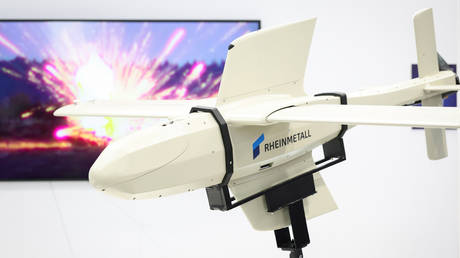
The operational failure of the "HX-2 Panther"—a German-manufactured loitering munition—reveals a fundamental breakdown in the transition from commercial-off-the-shelf (COTS) components to high-intensity kinetic environments. Reports characterizing the system as unable to penetrate "inflatable tanks" are not merely anecdotal criticisms of payload power; they represent a systemic failure of the three critical vectors in precision strike technology: structural integrity at terminal velocity, sensor-fuse integration, and the mass-to-velocity ratio required for kinetic energy transfer. If a loitering munition cannot achieve target neutralization against soft-skinned or decoys, the failure is rarely the explosive alone. Instead, it is a misalignment of the flight control laws and the physical impact physics.
The Triad of Lethality Failure
To understand why a modern drone fails to achieve its designated effect, the system must be audited across three distinct layers of performance. Most media critiques focus on the "size" of the explosion, but in precision strike operations, the explosion is the final—and often least complex—link in the chain.
1. Terminal Kinetic Energy and Structural Deflection
A loitering munition is a guided projectile. For a shaped charge or a fragmentation warhead to function, the airframe must maintain a stable vector during the terminal dive. If the airframe is constructed from low-density polymers or unreinforced carbon fiber intended for hobbyist speeds, it suffers from aeroelasticity—the deformation of the wings under high aerodynamic load.
When a drone "bounces" or fails to detonate upon hitting a surface as soft as a pneumatic decoy, the cause is typically impact deceleration mismatch. Most impact fuses require a specific G-force threshold to trigger. If the drone’s frame is too flexible, the frame absorbs the energy of the impact through deformation rather than transferring that energy to the fuse. The drone essentially acts as a crumple zone, dampening the very force needed to initiate the warhead.
2. The Fuse-Sensor Paradox
The HX-2 Panther utilizes a multi-sensor suite for targeting, but the translation from "target detected" to "detonation initiated" is governed by a logic gate that often fails in cluttered environments.
- Proximity Fusing vs. Contact Fusing: Proximity sensors intended to detonate the charge at an optimal standoff distance can be spoofed by environmental noise or low-reflectivity surfaces.
- Safety Interlocks: To prevent accidental detonation during launch or transport, these systems employ rigorous "arm-on-flight" software. If the flight telemetry does not meet specific speed or stability parameters, the warhead remains inert. A drone that struggles with flight stability in high winds may never "arm" its warhead, resulting in a 0% lethality rate regardless of the impact.
3. Payload Geometry and Explosive Mass
The effectiveness of a warhead is defined by the Gurney Equation, which calculates the velocity of fragments based on the ratio of explosive mass to casing mass. If the Panther’s warhead was downscaled to prioritize flight endurance, the resulting fragmentation pattern may lack the energy to penetrate even reinforced PVC or heavy-duty rubber used in modern decoys.
The Economic Fallacy of Low-Cost Loitering Munitions
The narrative surrounding "kamikaze" drones often emphasizes cost-efficiency—the idea that a $5,000 drone can destroy a $5,000,000 tank. However, this creates a "Race to the Bottom" bottleneck. By prioritizing the lowest possible cost, manufacturers introduce three fatal vulnerabilities into the supply chain.
The COTS Bottleneck
Using commercial flight controllers (like those found in FPV racing drones) introduces significant latency in the command-and-control (C2) link. While 20 milliseconds of latency is acceptable for a hobbyist, it is catastrophic for a munition traveling at 150 km/h. At that speed, the drone moves nearly 1.5 meters every tenth of a second. If the sensor-to-actuator loop is not hardened, the drone will consistently over-correct its flight path, leading to "glancing blows" rather than direct kinetic transfers.
Electronic Warfare (EW) Susceptibility
High-end military munitions use frequency-hopping spread spectrum (FHSS) and M-code GPS. Low-tier systems like the Panther often rely on standard 2.4GHz or 5.8GHz links. In an active EW environment, these drones do not just "lose signal"; their flight control software often defaults to a "hover" or "slow descent" mode to prevent a fly-away. This reduces the terminal velocity to near zero, rendering any impact fuse useless. The "failure to pop a balloon" reported by observers is likely the result of a drone that was already electronically neutralized and was merely falling out of the sky when it hit the target.
Quantifying the "Inflatable Tank" Metric
The mention of inflatable tanks is often used as a punchline, but from a materials science perspective, these decoys are sophisticated engineering challenges. Modern decoys are designed to mimic the thermal and radar signatures of real armor.
- Material Tension: High-pressure pneumatic decoys can have surface tensions that resist low-velocity punctures.
- Heat Signatures: Decoys use internal heaters to fool infrared seekers. If the drone’s seeker is tuned to a specific heat delta ($\Delta T$), and the decoy is poorly calibrated or the drone's seeker is too sensitive, the drone may lose lock in the final three meters of flight—the "blind zone" where most autonomous strikes fail.
If a munition cannot defeat a decoy, it is not merely "weak." It is fundamentally incapable of recognizing the difference between a high-value target and atmospheric noise. This indicates a failure in the Automatic Target Recognition (ATR) algorithms, which are often trained on "clean" datasets that do not account for the visual distortions of a battlefield.
Operational Limitations of the Panther Class
The HX-2 Panther occupies a difficult middle ground. It is too heavy to be a portable FPV drone and too light to carry the heavy tandem-charge warheads required to defeat Explosive Reactive Armor (ERA). This creates a "Capability Gap" characterized by:
- Low Kinetic Momentum: $p = mv$. Without sufficient mass ($m$) or velocity ($v$), the momentum ($p$) is insufficient to trigger piezo-electric crystals in the nose cone of the munition.
- Drag-to-Weight Ratio: The airframe design of many European loitering munitions favors "sleek" aesthetics over ruggedized ballistic coefficients. High drag in the terminal phase slows the drone down exactly when it needs to be accelerating, making it susceptible to being knocked off course by simple physical barriers like "cope cages" or even dense foliage.
Structural Deficiencies in the German Defense Integration
The failure of the Panther highlights a broader issue within the German defense sector’s approach to "Zeitenwende" (the turning point in defense policy). There is a tendency to over-engineer the software while under-specifying the hardware’s physical durability.
The integration of AI-driven navigation is irrelevant if the physical actuators cannot withstand the G-forces of a 70-degree dive. In the case of the HX-2, the mismatch between the sophisticated optics and the flimsy airframe creates a "Glass Cannon" effect—a system that can see everything but can destroy nothing. This is the result of a "Software-First" philosophy applied to a "Physics-First" problem.
Strategic Correction for Loitering Munition Deployment
To move beyond the "inflatable tank" failure threshold, procurement must shift from evaluating drones as "aircraft" to evaluating them as "smart artillery." This requires a pivot in three specific areas:
Hardened Impact Logic
Future iterations must move away from simple mechanical impact fuses. Integration of All-Weather Multi-Mode Fusing (AWMMF) would allow the munition to detonate based on a combination of radar altimetry, accelerometer spikes, and visual confirmation of the target. This ensures that even a low-velocity impact triggers the payload.
Kinetic Hardening
The airframe must be treated as a kinetic penetrator. Utilizing reinforced nose cones and high-torque servos will prevent the structural "shudder" that occurs during high-speed dives, ensuring the vector of the explosive jet is aligned with the target's center of mass.
Signal Resilience over Data Throughput
Rather than attempting to stream high-definition video to the operator—which requires high bandwidth and is easily jammed—the system should prioritize low-bandwidth, high-power telemetry. This ensures the drone maintains its terminal dive profile even under intense electronic suppression.
The current iteration of the HX-2 Panther serves as a case study in The Prototype Trap: a system that performs exceptionally well in controlled demonstrations against static, non-reactive targets but lacks the physical robustness to overcome the basic material resistance of a pneumatic decoy. Success in modern aerial attrition requires a return to fundamental ballistics, where the certainty of detonation is prioritized over the sophistication of the flight path. The final tactical play for manufacturers is the abandonment of the COTS-plus model in favor of purpose-built, high-velocity kinetic frames that treat the drone not as a vehicle, but as the leading edge of a high-explosive delivery system.



/arc-anglerfish-arc2-prod-mco.s3.amazonaws.com/public/BHPBP5TJJFF5XBWKSOQWZ6G55A.JPG)