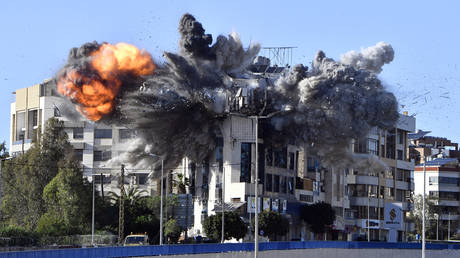
The current military escalation between Israel and the Lebanese-based organization Hezbollah is not a spontaneous eruption of regional animosity but the execution of a specific security doctrine designed to resolve a two-decade-long strategic bottleneck. At its core, the conflict functions as a violent recalibration of the "Mutual Assured Destruction" (MAD) parity that existed between 2006 and 2023. Israel’s objective is the permanent decoupling of the Lebanese front from the conflict in Gaza, a goal that requires the systematic degradation of Hezbollah’s command hierarchy and the physical reconfiguration of the border geography.
The Doctrine of Strategic Decoupling
For the past year, Hezbollah has maintained a "support front" logic, tethering the cessation of northern attacks to a ceasefire in Gaza. Israel’s military response operates on a counter-logic: the enforcement of a localized security zone regardless of Gaza’s status. This shift represents a transition from a containment strategy to an extraction strategy. Israel is attempting to extract the northern border problem from the broader regional "ring of fire" by raising the cost of Hezbollah’s participation beyond its organizational capacity to absorb.
The mechanics of this decoupling rely on three operational levers:
- Asymmetric Attrition: Targeting mid-level and senior leadership to induce a "command vacuum," forcing the organization into a reactive, decentralized posture.
- Infrastructure Denudation: The systematic identification and destruction of hardened launch sites and ammunition depots embedded within civilian topographies.
- Geographic Buffer Enforcement: Forcing a retreat of Radwan Forces—Hezbollah's elite offensive unit—beyond the Litani River to eliminate the threat of a cross-border ground incursion.
The Buffer Zone Variable and Tactical Displacement
A primary driver of the assault is the internal political pressure generated by the displacement of approximately 60,000 Israeli civilians. In military terms, this creates a "functional shrinkage" of the state. To reverse this, Israel must achieve a "perceived security equilibrium." This cannot be reached through aerial bombardment alone; it requires the physical inability of Hezbollah to utilize short-range anti-tank guided missiles (ATGMs), which have a flat trajectory and a range of approximately 5 to 10 kilometers.
The geography of Southern Lebanon dictates the conflict’s intensity. The terrain is characterized by "natural fortresses"—deep valleys and limestone ridges that favor a defensive, entrenched actor. Israel’s strategy involves "Active Defense through Offensive Projection." Instead of waiting to intercept projectiles, the IDF is proactively clearing the launch radius. This creates a de facto buffer zone, even if a permanent ground occupation is not the stated endgame. The risk inherent in this mechanism is "mission creep," where the technical requirement for a safe buffer expands deeper into Lebanese territory to account for the increasing range of Hezbollah’s mid-tier rocket systems.
Command Degradation and the Intelligence Paradox
The efficacy of the Israeli assault is largely a function of a multi-year intelligence "over-investment." Following the perceived failures of the 2006 war, Israeli intelligence shifted from broad surveillance to "granular targeting." This involves the mapping of the "human terrain"—identifying the specific supply chain managers, communications officers, and tactical commanders who comprise the backbone of the organization.
The recent sequence of kinetic operations demonstrates a "cascading failure" in Hezbollah’s internal security. When a command structure is decapitated at the speed currently observed, the organization suffers from:
- Information Asymmetry: Junior commanders must make strategic decisions without the benefit of a centralized operational picture.
- Trust Erosion: The suspicion of deep-level penetration leads to internal purges and a slowdown in decision-making cycles.
- Resource Misallocation: Energy is diverted from offensive operations toward survival and the re-establishment of secure communication lines.
However, the paradox of command degradation is that it often leaves behind a "headless" but heavily armed insurgency. While the organizational capacity to launch coordinated, multi-front maneuvers is reduced, the local units retain the hardware to conduct localized, high-intensity attrition warfare.
The Iranian Constraint and Proxy Management
The escalation in Lebanon cannot be analyzed in a vacuum from Tehran’s regional architecture. Hezbollah is not merely a proxy; it is the "crown jewel" of Iran’s Forward Defense strategy. Its primary function was historically to serve as a deterrent against an Israeli or American strike on Iranian nuclear facilities.
By committing Hezbollah to a prolonged war of attrition in Lebanon, Israel is effectively "burning the deterrent." Every long-range precision missile destroyed in the Bekaa Valley is a reduction in Iran's ability to retaliate against Israel from a secondary front. This forces a strategic dilemma upon Tehran:
- Option A: Intervention: Direct Iranian involvement to save Hezbollah, which risks a full-scale regional war and the potential destruction of the Islamic Republic’s domestic infrastructure.
- Option B: Calculated Abandonment: Allowing Hezbollah to be degraded to preserve Iran's own security, which undermines the credibility of the "Axis of Resistance" and signal to other proxies that they are ultimately expendable.
Economic and Civil Foundations of the Conflict
The assault also targets the "Social Contract" between Hezbollah and the Lebanese population. Lebanon is currently a "failed state" in economic terms, with a currency that has lost over 90% of its value since 2019. Israel’s military pressure is designed to exacerbate this fragility. By striking infrastructure used by Hezbollah—which is often integrated with civilian transit and logistics—the cost of the war is shared by a population that did not vote for it.
The intent is to trigger a "domestic rejection mechanism." If the cost of hosting Hezbollah's military infrastructure becomes higher than the benefits provided by its social services, the group’s domestic political legitimacy may fracture. However, history suggests that in the Lebanese context, external pressure often leads to "sectarian hardening," where groups retreat into their respective camps, potentially leading to internal civil strife rather than a unified move against the militia.
Technical Limitations of the Iron Dome and Arrow Systems
While Israel’s offensive capabilities are high, its defensive systems face a "saturation challenge." No missile defense system is 100% effective, and the cost-benefit analysis favors the attacker in a long-term exchange.
- Interceptor Scarcity: An Iron Dome Tamir interceptor costs approximately $50,000, while a Hezbollah "dumb" rocket costs a few hundred to a few thousand dollars.
- Multi-Vector Threats: The integration of drones, cruise missiles, and ballistic rockets can overwhelm the processing capacity of radar arrays.
Israel’s strategy is therefore "Preemptive Depletion." By destroying the launchers on the ground, the IDF reduces the "volumetric pressure" on its air defense systems. The objective is to keep the number of incoming projectiles below the "saturation threshold" where the system's failure rate begins to climb exponentially.
The Escalation Ladder and Terminal States
The conflict is currently in a phase of "Vertical Escalation." Each side is testing the other’s "pain threshold" while attempting to remain just below the level of total, unrestricted war. However, the margin for error is shrinking.
The primary risk is the "Sunk Cost Fallacy" of regional actors. Having invested decades and billions of dollars into building Hezbollah’s arsenal, Iran and the group’s leadership may feel compelled to use their most advanced weapons (such as the Fateh-110 precision missiles) before they are destroyed on the ground. This would represent a "Use it or Lose it" moment, likely triggering a full Israeli ground invasion of Southern Lebanon.
A secondary risk is the "Security Dilemma" of the Israeli government. If the IDF succeeds in pushing Hezbollah back but fails to establish a sustainable diplomatic mechanism (such as an empowered UNIFIL or a reformed Lebanese Armed Forces), the withdrawal of Israeli troops would simply lead to a vacuum that Hezbollah would re-occupy.
Strategic Realignment Requirements
The terminal state of this conflict will be determined by the ability to transition military gains into a diplomatic "De-linkage." This requires:
- Enforcement Mechanisms: Moving beyond the "observation" role of UN Resolution 1701 toward a kinetic enforcement mandate that prevents the re-entry of heavy weaponry into the border zone.
- Lebanese Sovereignty Support: Strengthening the central Lebanese government as a counter-weight to Hezbollah, a task that has failed repeatedly over the last four decades.
- Regional Normalization: Potential expansion of the Abraham Accords to include elements of the Lebanese state, though this remains a low-probability outcome in the current climate.
The most probable outcome is the establishment of a "Contested Buffer." Israel will likely maintain a high-intensity fire zone in Southern Lebanon for an indefinite period, effectively moving the border inward by several kilometers. This does not resolve the underlying ideological conflict, but it transforms a strategic threat into a manageable tactical nuisance. The success of this strategy depends entirely on maintaining an intelligence advantage that is currently unprecedented but inherently perishable. Every day the conflict continues, Hezbollah’s tactical units adapt to the new operational reality, narrowing the window for a decisive Israeli military victory.