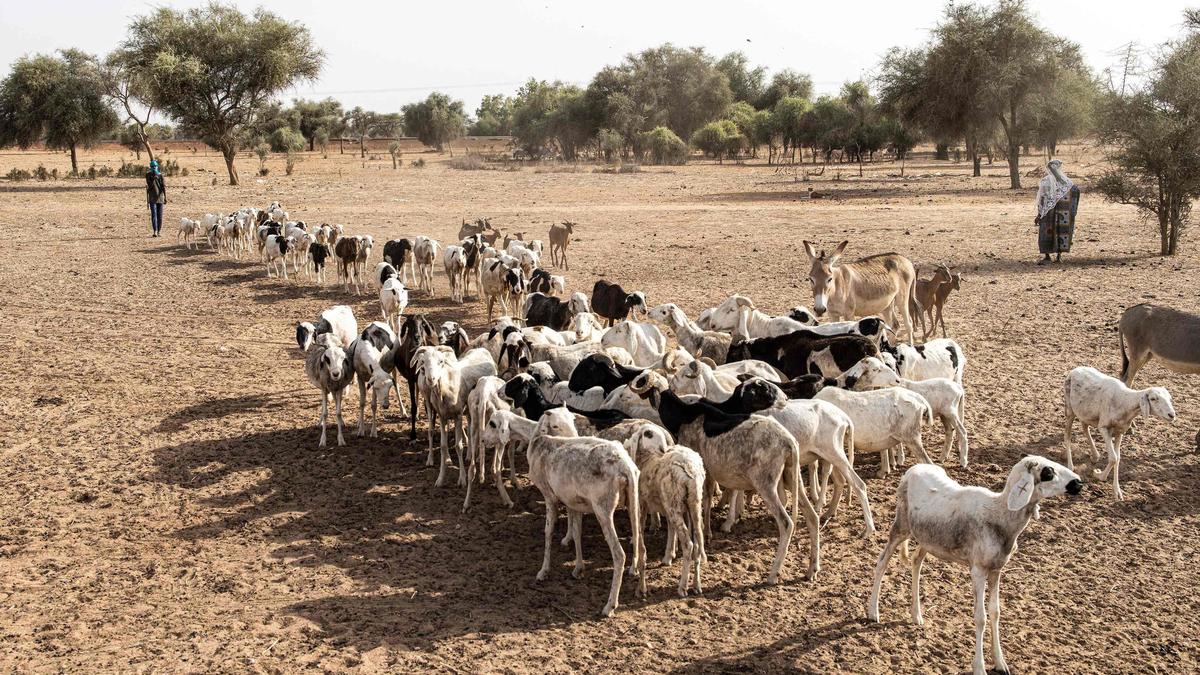
The escalation of violence involving Nigerian and Beninese militias against pastoralist communities is not a series of isolated ethnic skirmishes but a predictable outcome of a decaying security architecture along the 773-kilometer border. This conflict is driven by the intersection of three systemic failures: the erosion of traditional land-tenure mediation, the proliferation of non-state armed groups filling a sovereign authority gap, and the breakdown of the ECOWAS Protocol on Free Movement of Transhumance. To understand the recent casualties, one must analyze the operational incentives of the militias and the geographic bottlenecks that turn seasonal migration into a kinetic flashpoint.
The Triad of Conflict Drivers
The violence operates within a closed-loop system where environmental pressure acts as the catalyst, and the absence of state presence acts as the accelerant.
1. The Institutional Mediation Gap
Historically, the movement of herders from Nigeria’s northern belts into the middle belt and across the Beninese border was governed by "tithe-for-passage" arrangements and local dispute resolution committees. These informal institutions have collapsed. As local governments in both Nigeria and Benin prioritize sedentary agricultural output to shore up domestic food security, the legal framework has shifted to criminalize transhumance. When the state removes the legal pathway for migration, it inadvertently delegates enforcement to local "self-defense" militias.
2. The Sovereign Vacuum and Militia Proliferation
The border regions between Nigeria’s Kebbi, Kwara, and Niger states and Benin’s Alibori and Borgou departments suffer from a "low-density governance" model. State security forces are concentrated in urban hubs, leaving the periphery to be policed by irregular actors. These militias operate on a localized "protection racket" logic. They justify their existence by framing pastoralist movements as existential threats to sedentary farming yields, using this pretext to seize livestock—a liquid asset in a cash-poor economy.
3. The Collapse of the Transhumance Protocol
The 1998 ECOWAS Protocol on Transhumance was designed to provide a structured framework for cross-border grazing. Its failure is rooted in the "Reciprocity Deficit." While the protocol mandates open borders for herders with valid International Transhumance Certificates, individual member states have implemented contradictory national laws, such as Nigeria’s various state-level anti-grazing bills and Benin’s tightened border controls. This legislative dissonance creates a "gray zone" where herders are legally compliant at the regional level but criminalized at the local level.
Anatomy of the Kinetic Flashpoint
The recent "scores of deaths" reported in the borderlands follow a specific tactical pattern. Conflict is rarely spontaneous; it occurs at predictable geographic and temporal junctions.
Geographic Chokepoints
The majority of lethal encounters occur at "riparian intersections"—areas where cattle must access water sources also used for crop irrigation. In the Nikki and Kalalé districts of Benin, the concentration of livestock at limited water points creates a high-target density for militias. These groups utilize "encirclement tactics," cutting off escape routes to the Nigerian side of the border before engaging.
The Seasonal Conflict Curve
Violence peaks during the "Early Harvest Transition." As farmers begin to harvest crops, the presence of cattle near fields represents a total loss of annual investment. The economic stakes are binary: either the crop is harvested or the cattle graze. This zero-sum competition ensures that any minor trespass escalates into a lethal confrontation.
Arms Proliferation and Lethality Scaling
The transition from machete-based skirmishes to high-casualty events is directly linked to the "Sahlian Arms Leakage." Following the destabilization of the central Sahel (Mali, Burkina Faso, and Niger), small arms and light weapons (SALW) have flowed southward into the Nigerian and Beninese hinterlands. The militias are no longer "vigilantes" with hunting rifles; they are organized paramilitary units equipped with semi-automatic weapons, allowing for the rapid "clearing" of herder camps.
The Economic Distortion of Cattle Rustling
It is a mistake to view these killings purely through the lens of ethnic animosity. There is a strong "Extractive Incentive" at play. Cattle are a high-value, mobile commodity. In many instances, the "ethnic clash" serves as a narrative cover for large-scale cattle rustling.
- Asset Liquidation: A single head of cattle can be worth between $400 and $800. Killing the herders allows militias to seize entire herds, often numbering in the hundreds, representing a windfall of tens of thousands of dollars.
- Supply Chain Contamination: Rustled cattle are quickly integrated into local markets or moved across borders to be sold in urban centers like Cotonou or Lagos, where the origin of the meat is impossible to trace.
- Funding Insurgency: There is increasing evidence that these "militias" are not just local farmers but are occasionally infiltrated by, or selling to, broader insurgent networks looking for mobile capital to fund operations.
The Intelligence Breakdown and Response Deficit
The inability of the Nigerian and Beninese governments to prevent these massacres stems from a failure in "Tactical Signal Intelligence."
The terrain in these border zones consists of dense bush and fragmented road networks. Militia movements are coordinated via basic mobile telephony, yet state security apparatuses lack the localized signal interception capabilities to anticipate raids. Furthermore, the "Cross-Border Response Lag" is a critical bottleneck. If a militia attacks a herder camp on the Benin side and retreats across the Nigerian border, the Beninese forces are legally prohibited from pursuit, and the Nigerian forces are often too far removed or under-resourced to intercept.
Structural Vulnerabilities in the Current Strategy
The current reactive posture—deploying troops after the bodies are counted—is a failed model. It ignores the "Displacement Effect," where military pressure in one sector simply pushes the militias into the next unpoliced department.
- The Sovereignty Paradox: By failing to provide security, the state forces communities to outsource their safety to militias. This strengthens the very groups the state eventually has to fight.
- The Information Asymmetry: Herders are often mobile and disconnected from local government communication channels, leaving them unaware of shifting "red zones" or militia mobilizations until it is too late.
- The Judicial Vacuum: When massacres occur, there is almost zero forensic follow-up or prosecution. The lack of a "Cost of Aggression"—meaning legal consequences for militia leaders—ensures that violence remains a viable and low-risk political or economic strategy for local actors.
Strategic Reorientation Requirements
To de-escalate the borderlands, the focus must shift from "Point Defense" to "Systemic Management."
Kinetic De-escalation
Joint Border Patrol Teams (JBPT) must be transformed from customs enforcement units into rapid-response security details. These units require satellite-based monitoring of large-scale herd movements to identify when they are entering high-risk "Conflict Polygons"—areas where agricultural density and cattle paths overlap.
Legislative Harmonization
The "Benin-Nigeria Border Commission" must move beyond demarcating physical lines and begin the work of "Legal Alignment." This involves creating a unified legal status for transhumant herders that is recognized by local police on both sides of the border, removing the "criminal by default" label that militias use as justification for violence.
Economic Formalization
The livestock trade must be moved from the informal "gray market" into a tracked value chain. Implementing digital ear-tagging and blockchain-based ownership registries would destroy the economic incentive for cattle rustling, as stolen livestock would be unsellable in formal markets.
The persistence of these killings signals the end of the "Laissez-Faire Border" era. Without a transition to a "Managed Border" model—characterized by real-time tracking, joint military jurisdiction, and the aggressive dismantling of the militia economic model—the border between Nigeria and Benin will continue to function as a laboratory for low-intensity warfare. The security vacuum is currently being filled by the most violent actors available; the only solution is the reassertion of a professionalized, neutral sovereign presence.