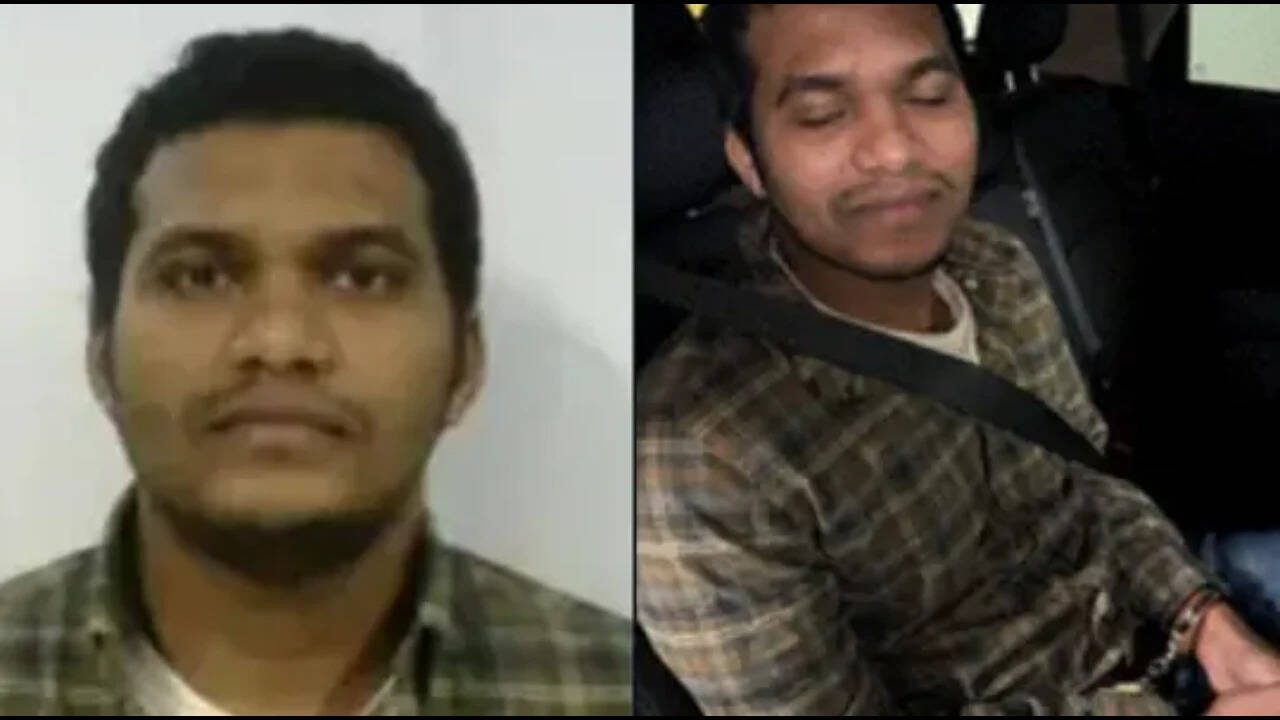
Federal agents recently apprehended Pratik Soni, a 26-year-old Indian national, in a targeted enforcement action in Michigan that exposes a massive breakdown in the intersection of educational oversight and immigration enforcement. Soni remained in the United States long after a 2023 conviction for the sexual assault of a minor and months after his student visa was officially revoked. His case is not an isolated incident of administrative lag. It is a stark illustration of how predators can exploit the lag time between a criminal conviction and the actual execution of a deportation order.
The arrest, carried out by U.S. Immigration and Customs Enforcement (ICE), followed a lengthy period where Soni was effectively hiding in plain sight. Despite a legal system that had already flagged him as a high-risk offender, he moved through the community as a non-immigrant student whose "status" existed only on paper while his actual threat level had been established in a court of law.
When the System Fails to Talk to Itself
The core of the problem lies in the disconnect between local criminal courts and federal immigration databases. When an international student is arrested for a violent crime, the school is supposed to be notified, and the Student and Exchange Visitor Information System (SEVIS) is updated. However, the reality is far messier.
In Soni’s case, the conviction for third-degree criminal sexual conduct occurred in Washtenaw County. While the judicial process moved toward a conviction, the administrative process to terminate his legal right to stay in the country lagged behind. This creates a "gray zone" where a convicted felon holds a valid-looking visa while waiting for the Department of Homeland Security (DHS) to catch up with the Department of Justice (DOJ).
Federal data indicates that thousands of students fall out of status every year, but only a fraction are actively pursued for removal unless they commit a "high-priority" crime. Even then, the "priority" designation does not always trigger an immediate arrest. The paperwork must move from a county clerk to a federal field office, then through a chain of command that is often buried under a backlog of millions of pending immigration cases.
The Myth of Automatic Revocation
There is a common misconception that a criminal conviction automatically and instantaneously triggers an ICE team to appear at a defendant's door. It doesn't.
Revocation of a student visa is an administrative act. Deportation is a judicial one.
Soni’s visa was reportedly revoked in early 2024, yet he was not taken into custody until much later. During those intervening months, he was a "fugitive" in the eyes of immigration law but remained at large in the community. This gap exists because the SEVIS system relies heavily on the "Designated School Official" (DSO) at the university to report status changes. If a student stops attending classes because they are in jail or awaiting trial, the school may terminate the record, but that doesn't mean ICE has the resources or the real-time location data to move in immediately.
The Role of University Oversight
Universities often find themselves in a difficult position. They are educational institutions, not law enforcement agencies. Yet, they are the primary gatekeepers for the F-1 and J-1 visa programs. When a student like Soni is accused of a crime, the university’s internal disciplinary process often moves faster than the federal government’s removal process.
However, schools are often hesitant to report students until a final conviction is reached to avoid litigation. This hesitation, while legally defensive for the university, provides a window of opportunity for dangerous individuals to remain in the country. The "red tape" involved in coordinating between campus police, local police, and federal agents is thick and often impenetrable.
Tracking the Geography of Oversight
Michigan has become a focal point for these types of enforcement actions due to its high density of international students and its proximity to the border. The Detroit Field Office of ICE, which oversaw this arrest, manages one of the busiest corridors in the country.
The logistical challenge is immense.
One agent for every thousand out-of-status individuals.
That is the approximate ratio federal offices deal with when attempting to track non-citizens who have violated the terms of their stay. When you add a violent criminal conviction to the mix, the stakes rise, but the manpower remains stagnant. The arrest of Soni required specific intelligence and a coordinated effort that the system simply cannot sustain for every visa overstay.
The Problem of the Non-Commensurate Penalty
For many international students, the fear of losing their visa is a major deterrent against even minor infractions. But for someone facing a felony conviction for sexual abuse, the loss of a visa is the least of their concerns. They are already facing prison time and a lifetime on a sex offender registry.
At that point, the threat of deportation becomes a secondary factor that may actually encourage them to go "underground." Soni’s ability to remain in the Michigan area after his visa was revoked suggests he had a support network or the means to stay off the grid, at least temporarily. It highlights a fundamental flaw: our immigration system is designed to manage people who want to follow the rules, not those who have already shattered them.
National Security and Public Safety Interests
The debate over immigration often focuses on the borders, but the Soni case proves that the real vulnerability is often located in our suburbs and university towns. International student programs are a vital part of the American economy and academic prestige, bringing in billions of dollars and some of the world's brightest minds. But the "trust-based" nature of the student visa program is being tested.
When a student commits a crime of this magnitude, it isn't just a failure of the individual; it’s a failure of the vetting and monitoring infrastructure.
Examining the Vetting Process
Was there anything in Soni’s background that could have predicted this? Usually, the answer is no. Initial visa vetting focuses on financial solvency and the intent to return home. It does not—and arguably cannot—predict future criminal behavior. However, the system must be judged on how it reacts once that behavior manifests.
If a person is convicted of sexual abuse, the "removal" should be the very next step in the sequence, not a footnote that takes months to resolve. The delay in Soni’s arrest indicates that the "high priority" label given to sex offenders in the immigration system is often hamstrung by procedural delays.
The Mechanical Failures of Enforcement
To understand why Soni wasn't picked up the day his visa was revoked, one must look at the "Order to Show Cause" and the "Notice to Appear" (NTA). These are the legal documents that start the deportation process.
- The NTA backlog: There are currently over 3 million cases pending in immigration courts.
- Detention Space: Michigan facilities have limited beds for administrative detainees.
- Jurisdictional Friction: Local "sanctuary" policies in some areas prevent local jails from honoring ICE detainers, though this varies significantly by county in Michigan.
In Soni’s instance, the conviction finally gave ICE the legal leverage it needed to bypass some of the standard administrative hurdles. But the fact remains that he was free to move within the state for an extended period after the government decided he had no right to be here. This is the "implementation gap" that critics of current immigration policy point to as a glaring hole in public safety.
Beyond the Headline
The arrest of Pratik Soni will be touted as a success for ICE, and in the narrowest sense, it is. A convicted predator is off the streets and facing removal. But a broader analysis suggests this was a reactive measure to a systemic failure. The objective should not be to celebrate the eventual arrest of a known offender, but to question why the mechanism for his removal was so slow to engage.
The federal government needs to bridge the communication gap between local courts and federal immigration authorities. If a non-citizen is booked on a felony charge involving a minor, that information should trigger an immediate and automatic hold that prevents them from being released back into the community before their immigration status is resolved.
We are currently operating on a system of "check-ins" and "notifications" that belong in a different era. The digital infrastructure exists to link these databases, but the political will to integrate them remains absent. Until the DOJ and DHS operate from a shared, real-time dashboard of criminal activity among visa holders, we will continue to see cases where the most dangerous individuals are the ones the system takes the longest to catch.
The safety of the community depends on the speed of the software as much as the bravery of the agents on the ground. When the paperwork moves slower than the predator, the system is fundamentally broken.