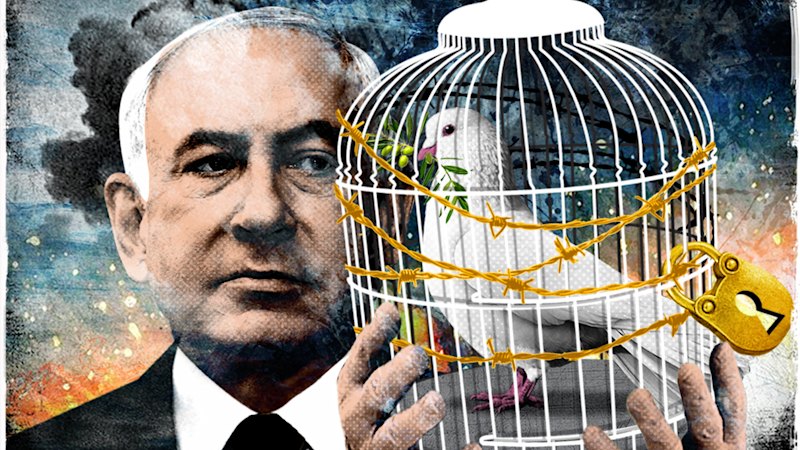
The air in Jerusalem carries a specific weight during a wartime winter. It is the smell of cold stone, diesel exhaust from idling armored vehicles, and the invisible, suffocating pressure of a clock that refuses to stop ticking. For Benjamin Netanyahu, that clock is a predator. It isn't just measuring the duration of a military campaign in the sand-choked tunnels of Gaza; it is counting down the seconds until a courtroom or a ballot box demands an accounting he is not ready to give.
Contrast this with the gold-leafed quiet of Mar-a-Lago. Donald Trump sits at a different table now. He is no longer the man who stood beside Netanyahu in the White House, moving embassies like chess pieces and carving up the map of the Middle East with the flourish of a Sharpie. For Trump, the war in Gaza is a distraction from his own branding—a messy, lingering conflict that lacks the "win" he craves.
They started this journey as twins of a specific political species. Both men built careers on the idea that they alone could hold back the tide of chaos. They shared a base, a bravado, and a deep-seated belief that the rules of the old world didn't apply to them. But as the smoke over the Mediterranean refuses to clear, the partnership has fractured along the lines of their own personal necessities. One needs the war to end to claim victory. The other needs the war to continue to stay in power.
Consider a family in a bomb shelter in Sderot. To them, the high-level shifts in Washington and the Prime Minister’s Office aren't abstract geopolitical theories. They are the difference between a son coming home from reserve duty and a funeral. They are the difference between a future and a stalemate. This is where the human cost of political survival becomes visceral. When a leader’s personal freedom is tethered to a state of emergency, the emergency becomes a lifeline.
The Architecture of a Shared Mirage
For four years, the two men constructed a reality that felt, to their supporters, like an era of unprecedented strength. They called it the "Deal of the Century." They brokered the Abraham Accords, bypassing the Palestinian issue as if it were a redundant piece of software that could simply be deleted. It was a period of high-fives and theatrical signings.
Netanyahu used Trump’s presidency to validate his claim that he could manage the conflict indefinitely without ever solving it. Trump used Netanyahu to cement his status as the ultimate dealmaker. They were symbiotic. If you looked at the photos from 2019, you saw two men who believed they had mastered history.
Then came the October 7 massacre. It was the moment the floor dropped out of the mirage. The "Mr. Security" persona that Netanyahu had spent decades refining was shattered in a single morning of unthinkable violence. For a man whose entire political existence was predicated on the promise of safety, such a failure is usually terminal.
But Netanyahu is not a usual politician. He is a survivor of the highest order.
The war that followed was not just a response to terror; it became the new framework for his political life. In Israel, there is an unwritten rule: you don't change horses in the middle of a firestorm. As long as the Israel Defense Forces (IDF) are engaged in "total victory," the protests that once choked the streets of Tel Aviv stay relatively subdued. The corruption trials that haunt him are pushed to the periphery of the public consciousness. The moment the guns go silent, the questions get louder.
The Trump Pivot
Trump’s loyalty has always been a one-way street, paved with the requirement of total fealty. The rift began not with a policy disagreement, but with a congratulatory phone call. When Netanyahu called Joe Biden to congratulate him on his 2020 victory, Trump felt betrayed. In his mind, he had given Netanyahu everything—the Golan Heights, the embassy move, the end of the Iran deal—and he received "disloyalty" in return.
Now, as he eyes a return to the White House, Trump’s perspective on the war in Gaza is purely transactional. He sees the images of leveled city blocks and the mounting civilian death toll not through a lens of humanitarian concern, but as a public relations disaster. He told reporters that Israel is "losing the PR war."
To Trump, "winning" must be fast, loud, and final. A grinding, multi-year insurgency in the ruins of Gaza doesn't fit the brand. It looks weak. It looks like "forever wars," the very thing he promised his voters he would end. He has signaled a desire for Israel to "finish it up" and get back to the business of being a prosperous, normal country. He wants the problem gone before he takes the oath of office, so he doesn't inherit a quagmire that he can't fix with a tweet or a summit.
The irony is sharp. The man who gave Netanyahu the most political cover in history is now the one most impatient for him to stop.
The Invisible Stakes of "Total Victory"
Walk through the halls of the Knesset, and you will hear the phrase "total victory" repeated like a mantra. It is a powerful phrase. It suggests a clear ending, a cinematic resolution where the bad guys are gone and the heroes stand tall.
But military experts and the families of hostages know that reality is far more jagged. "Total victory" in an urban environment against an entrenched insurgency is a ghost. You can't kill an idea with a 2,000-pound bomb, and you can't rescue hostages by leveling the buildings they are hidden under.
For Netanyahu’s far-right coalition partners, the war is an opportunity to reshape the region permanently. They speak of resettlement and "voluntary migration." They provide the parliamentary votes Netanyahu needs to stay out of jail, and in exchange, they demand a war without an exit ramp.
If Netanyahu pivots toward a ceasefire that includes a pathway to a Palestinian state—the very thing the Biden administration and even some of Trump’s circle have hinted at—his government collapses. If he stays the course, he risks total international isolation and a permanent rupture with the United States.
It is a claustrophobic choice.
Imagine being a mid-level IDF officer. You are tired. You have been away from your job and your kids for months. You believe in the mission—protecting your home—but you begin to notice that the goals of the mission keep shifting. First, it was destroying Hamas. Then it was "de-radicalization." Now, it’s an indefinite security control over millions of people. You start to wonder if the strategy is being dictated by the needs of the nation or the needs of a single man’s legal defense.
The Ghost at the Table
The people most often forgotten in this clash of egos are the ones living in the dirt. The Palestinian mother in a tent in Rafah isn't thinking about Trump’s polling numbers or Netanyahu’s trial dates. She is wondering if the flour will last through Tuesday.
The invisible stakes are the lives of a generation being radicalized by the rubble. Every day the war continues without a "day after" plan, the vacuum of power is filled by something darker. Both Trump and Netanyahu are masters of the short term—the news cycle, the primary, the weekly poll. But history is made of the long term, and the long term in Gaza is a landscape of bitterness that will take decades to heal.
Trump’s impatience is a mirror of a growing segment of the American electorate. They are tired of the images. They are tired of the billions of dollars in aid. They want a "win" or an exit. Netanyahu, meanwhile, is betting that he can outlast the impatience. He is betting that if he can just keep the flames high enough, no one will notice the house is falling down around him.
The alliance that once seemed unbreakable is now a cautionary tale about the nature of power. When two leaders build a world based on their own personal survival, the moment their interests diverge, the world they built begins to crumble.
The Final Calculation
Netanyahu knows that if Trump wins in November, the pressure might actually increase, not decrease. A second Trump term wouldn't be a blank check for a never-ending war; it would be a demand for a resolution that makes Trump look like a peacemaker.
The Prime Minister is running out of allies and running out of time. He is a man standing on a narrowing strip of sand, with the tide coming in from all directions. To his left, a vengeful Trump. To his right, a radical coalition. Behind him, a legal system that doesn't forget. And in front of him, a war that he cannot win in the way he promised.
The tragedy of the "Survivalist" is that eventually, there is nowhere left to hide. You can't use a nation's grief as a shield forever.
In a small apartment in Tel Aviv, a father looks at a photo of his daughter, still held somewhere in the dark beneath the Gaza strip. He doesn't care about the Abraham Accords. He doesn't care about the 2024 election. He just wants the politics to stop so the rescue can begin. But in the world created by the Showman and the Survivalist, the politics never stop. They just change shape, while the people in the shadows wait for a dawn that feels further away with every passing night.
Netanyahu looks into the camera and speaks of strength. Trump looks into the camera and speaks of deals. And somewhere in the silence between their words, the reality of a broken region continues to bleed.