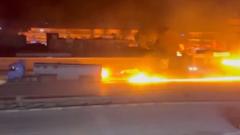
A massive fuel truck turned a Syrian highway into a literal river of fire, and the footage is as terrifying as you’d imagine. This isn't just a freak accident. It’s a stark reminder of the crumbling infrastructure and the desperate, high-stakes logistics currently defining life in Syria. If you’ve seen the video circulating on social media, you know it looks like a scene from an action movie, but the reality for the people on that road was far more grim.
The incident happened in the northern countryside of Aleppo, a region that’s been a logistical bottleneck for years. A tanker carrying thousands of liters of highly flammable fuel began leaking while in motion. As the truck sped down the asphalt, the trailing fuel ignited, creating a horizontal blowtorch that stretched for dozens of meters behind the vehicle.
Why Syrian fuel transport is a rolling disaster
Most people see a fire and think "accident." I see a systemic failure. Transporting fuel in Syria today is a gamble. You’re dealing with aging tankers, poorly maintained roads, and a lack of basic safety equipment. The driver in this footage wasn't just dealing with a mechanical failure; he was likely driving a vehicle that should have been scrapped a decade ago.
When a leak starts on a moving truck, the friction or the heat from the exhaust is usually enough to kickstart the nightmare. In this specific case, the "trail of fire" effect happens because the liquid fuel spreads across the road surface while the source—the truck—keeps moving. It creates a continuous fuse. If that fire reaches the main tank, the result isn't just a trail; it's a massive BLEVE (Boiling Liquid Expanding Vapor Explosion).
The psychology of the driver in the hot seat
You have to wonder what goes through a person's head when they look in the rearview mirror and see a wall of flame chasing them. In many of these Syrian incidents, drivers face a split-second choice. Do they stop and jump out, risking a static explosion that levels everything nearby? Or do they keep driving to get the "bomb" away from populated areas?
It’s a hero-or-suicide mission. There have been recorded instances in the region where drivers purposefully steered burning rigs away from markets or gas stations, knowing they might not make it out. We don’t talk enough about the sheer guts required to operate in these zones. The risk isn't just the fire; it's the lack of any emergency response. In most developed countries, you’d have a HAZMAT team and foam trucks on-site in minutes. In northern Syria, you’re lucky if someone has a handheld extinguisher that actually works.
What the footage tells us about regional instability
This isn't just about one truck. It’s about the economy of the "shadow" energy market. Much of the fuel moving through Aleppo and Idlib comes from informal refineries or is smuggled across shifting frontlines.
- Quality control is nonexistent. Impure fuel is more volatile and harder on engines.
- Maintenance is a luxury. Parts are expensive or unavailable due to sanctions and trade barriers.
- Overloading is standard practice. To make a trip profitable, drivers often pack more weight than the chassis or the tank seals can handle.
When you see a trail of fire on a Syrian road, you're seeing the physical manifestation of a broken supply chain. This fuel is the lifeblood for bakeries, hospitals, and homes. Every lost tanker is a local catastrophe that drives up prices and leaves thousands of people in the dark or without heat.
Safety lessons from a war zone fire
If you ever find yourself near a vehicle fire of this scale—though I hope you don’t—the rules are different than a standard car fire. A fuel fire is a fluid event. It follows the topography of the road. If the road slopes, the fire follows the gravity.
- Distance is your only friend. A fuel tanker explosion can throw debris and a fireball hundreds of feet.
- Upwind and uphill. Never stand "downstream" of a leaking fuel truck. The vapors are often heavier than air and will "crawl" along the ground toward an ignition source.
- Forget the cell phone. We live in an age where people want to film everything. That’s why we have this footage. But if you can see the flames clearly enough to film them, you’re likely within the kill zone if the tank breaches.
The Syrian fuel truck fire is a viral moment for the rest of the world. For the people on the ground, it’s just another Tuesday in a place where the basic necessities of life are actively trying to kill you. We need to stop looking at these videos as mere "spectacles" and start recognizing them as the inevitable result of a region pushed to its absolute limit.
If you’re tracking regional news, keep an eye on fuel prices in the Aleppo governorate over the next week. These incidents usually trigger a temporary spike in local markets, hitting the most vulnerable families the hardest. Watch the logistics, not just the flames.