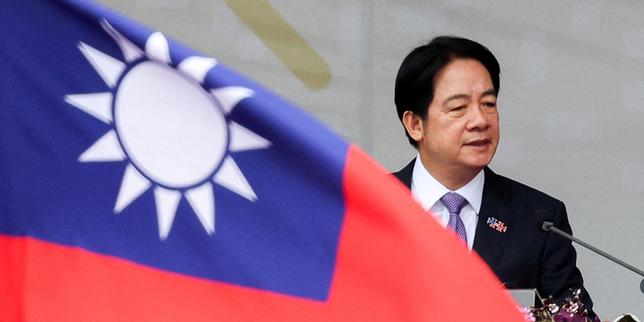
The headlines are screaming about a "diplomatic blow" to Taipei. They paint a picture of a stranded president, a bullying Beijing, and a handful of African nations suddenly growing a backbone to say "no" to a flight path.
This narrative is amateur hour.
If you think this is about "revoked flight authorizations," you’re watching the shadow play while the puppeteers are out for lunch. The postponement of the Taiwanese president's trip to Eswatini isn't a failure of logistics or a sudden shift in African aviation policy. It is a masterclass in the commodification of airspace.
Stop looking at this as a travel delay. Start looking at it as a liquidity event.
The Airspace Arbitrage
Most analysts treat sovereign territory as a static map. In reality, for many developing economies, the sky is a high-yield asset class. China isn't just "pressuring" these nations; they are outbidding the competition.
When a country like South Africa or Mozambique denies a flyover to a Taiwanese official, they aren't doing it out of a deep-seated philosophical commitment to the "One China" policy. They are doing it because the "no" is worth more than the "yes."
I’ve seen this play out in backrooms from Johannesburg to Nairobi. The currency isn't just cash. It's infrastructure debt forgiveness, 5G rollouts, and favorable mineral rights. If Taiwan wants the flight path, they need to pay the market rate. Currently, Beijing is setting a price floor that Taipei—constrained by its own democratic oversight—simply cannot match.
The Sovereignty Paradox
We love to talk about "foreign interference." It’s a comfortable term. It suggests that African nations are passive victims of great power politics.
That is a lie.
These nations are playing the game with extreme proficiency. By revoking flyover rights at the eleventh hour, they maximize the visibility of their loyalty to Beijing. It is a public signal intended to trigger the next round of investment. It’s not "pressure"; it’s a sale.
The mainstream media misses the nuance of the Sovereignty Paradox: The more a nation appears to be "controlled" by Chinese interests, the higher the price they can extract for their next act of compliance.
Why Eswatini is the Wrong Metric
Eswatini remains Taiwan's last official ally on the continent. Critics point to this dwindling list as proof of Taiwan's failing strategy. They are asking the wrong question.
The goal for Taiwan shouldn't be a collection of flags on a map. That is 20th-century thinking. In a world of digital trade and decentralized finance, official recognition is a vanity metric.
Look at the trade volume. Look at the unofficial "representative offices" that function as de facto embassies in countries that technically don't "recognize" Taiwan. The real power is in the hardware.
If you are a nation that needs high-end semiconductors or advanced medical tech, you talk to Taiwan. You just don't do it while the cameras are on. The flyover drama is the theater we watch while the real business happens via secure servers and offshore accounts.
The Cost of the "Moral" High Ground
Taiwan’s biggest handicap isn't China. It’s its own desire to be the "good guy."
Taipei plays by the rules of international decorum. They ask for permits. They follow protocols. They respect the "rules-based order."
Meanwhile, Beijing operates on a purely transactional basis.
If Taiwan wants to stop being a pawn in this specific geopolitical chess match, they need to stop trying to win hearts and minds and start winning balance sheets. They need to turn their technical superiority into a weapon that makes it too expensive for any country—African or otherwise—to say no.
Imagine a scenario where Taiwan ties its chip exports or technical support to the guaranteed openness of international corridors. That’s not "interference." That’s market-driven diplomacy.
Dismantling the Victim Narrative
The "poor Taiwan" trope is exhausting. It ignores the fact that Taiwan is one of the wealthiest, most technologically advanced societies on the planet. They aren't victims of a flight path cancellation; they are victims of their own refusal to use their economic weight with the same ruthlessness as their neighbors.
When a country revokes a permit, it’s a breach of contract. Treat it as such. Don't send a diplomatic note; send a bill. Or better yet, send a notification that the next shipment of critical tech components is "under review due to logistical uncertainties."
The Real Power of the Sky
Airspace is a physical manifestation of political will. If you can’t fly over it, you don’t influence it.
But here’s the cold truth: the president of Taiwan doesn't need to land in Eswatini to maintain the relationship. The relationship is maintained through the constant, invisible flow of capital and expertise that happens 24/7.
The media focuses on the plane because it’s a big, shiny object that isn't moving. They miss the millions of bits of data and dollars that are moving perfectly fine.
The "pressure" from China is real, but it’s only effective if the other side believes the lie that formal recognition is the only thing that matters.
The map is not the territory. The flight path is not the relationship.
Stop mourning the "postponed" trip. It’s a distraction. The real battle is being fought in the supply chains, and in that arena, the "revoked permissions" of a few transit states are little more than a rounding error.
Stop asking why the plane didn't take off. Start asking why we still care about the plane in the first place.
Build the tech. Control the flow. Let them keep their empty skies.