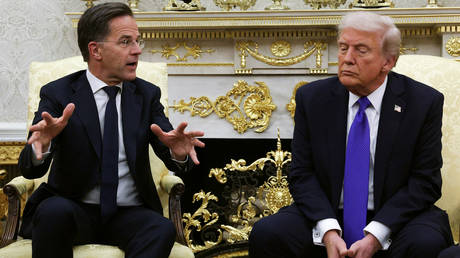
The air conditioning in the Brussels headquarters of the North Atlantic Treaty Organization is usually set to a precise, bureaucratic chill. It is a temperature designed for men in charcoal suits to discuss ballistic missile defense systems and the minutiae of Article 5 without breaking a sweat. But in 2018, the thermostat didn't matter. The heat was radiating from the center of the table.
Donald Trump sat across from Jens Stoltenberg. The reports trickling out of the room later would use blunt, unvarnished language to describe the exchange. One specific account from Politico characterized the meeting with a phrase rarely found in diplomatic cables: it "went sh*t." Read more on a similar topic: this related article.
This wasn’t just a bad day at the office for the world’s most powerful military alliance. It was a fundamental collision between two irreconcilable ways of viewing the world. On one side was the institutionalist—Stoltenberg—who viewed NATO as a sacred, unbreakable bond. On the other was the transactional populist—Trump—who viewed it as a delinquent country club where the United States was paying everyone else's membership dues.
The Ledger and the Lifeblood
To understand why that room turned toxic, you have to look past the podiums and the flags. Think of a neighborhood watch group. Imagine you spend your weekends patrolling the streets, buying the flashlights, and maintaining the radios. Meanwhile, your neighbor across the street spends his weekends at the lake, occasionally waving at you while you sweat in the sun. Eventually, you’re going to stop waving back. More journalism by Al Jazeera delves into similar perspectives on the subject.
That was the mental model Trump brought to Brussels. He didn't see the "tapestry" of post-war peace—he saw a ledger. He saw Germany’s defense spending at barely 1.2 percent of its GDP while the U.S. was carrying the heavy lifting of nearly 3.5 percent. For him, the math didn't add up. It wasn't about the grand strategy of containing a resurgent Russia; it was about the raw, visceral feeling of being "suckered."
Stoltenberg, a man whose career was built on the steady, patient work of consensus, found himself in a position no Secretary General had ever faced. He wasn't just managing a budget or a troop deployment. He was managing a personality that threatened to pull the plug on the entire experiment.
The tension wasn't just about money. It was about the loss of predictability. Diplomacy is built on the idea that today’s promise is tomorrow’s reality. When that predictability vanishes, the floor drops out from under every embassy in the world.
The Invisible Stakes of a Shouting Match
When a meeting of this magnitude fails, the consequences aren't felt by the men in the room. They are felt by a nineteen-year-old private in a cold trench in Estonia. They are felt by a family in Riga who looks at the border and wonders if the American umbrella still has holes in it.
The "sh*t" meeting wasn't a failure of policy. It was a failure of the shared fiction that holds the West together. We all agree to believe in these alliances because the alternative is a return to the 19th-century world of every nation for itself. That world is loud. That world is violent. And that world is exactly what seemed to be peeking through the doors of the NATO summit as the leaders emerged, looking shaken.
Critics of the former president’s approach argued that he was destroying decades of trust for a talking point. Supporters argued he was finally demanding the respect—and the checks—the U.S. deserved. But the human reality in the middle was a breakdown of communication so severe that the professional diplomats, the people paid to make everything sound smooth, couldn't even find a polite word to describe it.
The Ghost at the Table
There is a third person in every NATO meeting, even if they aren't physically present: the shadow of the Kremlin. Every time a crack appears in the Western facade, it is measured and analyzed in Moscow.
During that specific, disastrous meeting, the crack wasn't just a hairline fracture. It was a canyon. When the leader of the free world questions the very utility of the alliance, he isn't just negotiating. He is signaling to every adversary that the "all for one" guarantee might have an asterisk next to it.
Imagine a marriage where one partner constantly reminds the other that they are only staying because the lease hasn't expired yet. You can still live in the same house. You can still share the grocery bill. But the soul of the union is gone. You are just two people waiting for the clock to run out.
Stoltenberg’s job was to convince the world that the marriage was still strong, even as the yelling could be heard through the drywall. He had to perform a delicate dance—praising Trump for his "leadership" on spending while simultaneously working behind the scenes to ensure the American military didn't actually start packing its bags.
The Cost of the Cold Shoulder
We often think of international relations as a game of chess, but it’s more like a game of trust. If I believe you have my back, I will take risks. I will invest in my economy instead of just my military. I will keep my borders open. If I don't believe you, I start building walls.
The 2018 summit changed the way European leaders slept at night. It birthed the realization that the American security guarantee was no longer a constant of the universe, like gravity or the speed of light. It was a variable. It was subject to the whims of an election cycle and the mood of a single man in a high-backed chair.
The real tragedy of a meeting that "goes sh*t" isn't the insult or the hurt feelings. It’s the lingering doubt. Even after the suits are dry-cleaned and the leaders move on to the next summit, that doubt remains in the room. It sits in the corner, quiet and patient.
Europe began to talk about "strategic autonomy"—a fancy way of saying "we might have to learn to live without them." The U.S. began to talk more loudly about the "Pacific pivot." The glue was thinning.
In the end, the alliance survived the 2018 blowup, but it emerged with scars that haven't quite faded. You can see it in the way current budgets are drafted. You can see it in the frantic energy of every subsequent meeting. The world learned that the most powerful military alliance in history is held together by something as fragile as a conversation. And when that conversation breaks down, the chill in the room is enough to freeze the future.
The doors to the summit hall eventually swung open. The motorcades sped away. The air conditioning continued to hum, indifferent to the fact that the world outside the glass walls had become a much more dangerous place in the span of a few hours.