The floorboards don't groan under the weight of thirty-one trillion dollars. There is no physical pile of gold or a mountain of paper sitting in a vault in D.C. that you can point to and say, "There it is. That is the debt." Instead, it is an invisible atmospheric pressure. It is the silent passenger in your car when you fill the tank. It is the reason the numbers on your grocery receipt seem to be growing limbs and climbing toward the ceiling while your paycheck stays tethered to the floor.
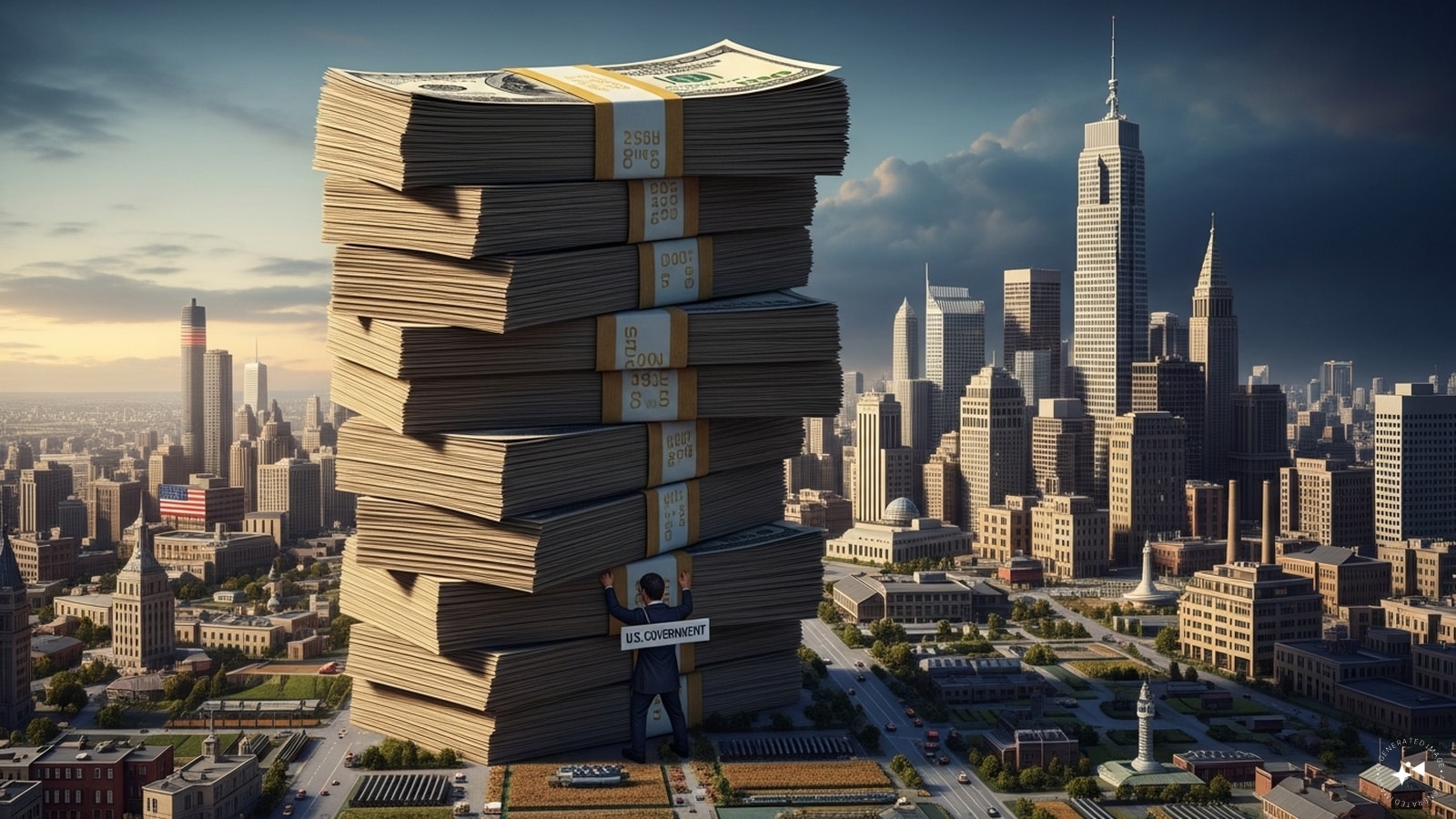
Most people hear the number $31.27 trillion and their eyes glaze over. The human brain isn't wired to process twelve zeros. We understand the cost of a cup of coffee. We understand a mortgage. We can even visualize a billion if we think about a stack of hundred-dollar bills reaching the height of the Empire State Building. But thirty-one trillion? That is a cosmic measurement. It is the distance to a star we will never reach. For another view, check out: this related article.
Yet, for the first time in history, that shadow is now larger than the entire room it occupies. The United States national debt has officially surpassed the size of the American economy. We are living in a house where the mortgage is bigger than the value of every stick of furniture, every brick, and the very land it sits on.
The Baker and the Bill
Consider a man named Elias. He owns a small bakery in a town that has seen better days. Elias doesn't think about the Treasury Department when he wakes up at 4:00 AM to proof his dough. He thinks about the price of flour, which has jumped 20% in a year. He thinks about the electricity running his ovens. Similar insight on the subject has been provided by MarketWatch.
When the government spends money it doesn't have, it issues IOUs called Treasury bonds. The world buys these because they are seen as the safest bet on Earth. But to pay back the interest on those trillions, the government has a few choices: it can grow the economy faster than the debt, it can raise taxes, or it can effectively print more money.
When more money enters the system without a matching increase in actual goods—the bread Elias bakes—the value of each individual dollar shrinks. This is the "hidden tax." Elias feels it when his supplier calls to say the price of yeast is up again. He can’t raise the price of a sourdough loaf every week without losing his neighbors’ business. So, he eats the cost. His margins thin. His ability to hire a second baker vanishes.
This is how a $31 trillion figure hits a kitchen table. It isn’t a sudden explosion. It’s a slow, rhythmic draining of purchasing power. It is the quiet disappearance of the "extra" in the American life.
The Tipping Point of the Scales
For decades, economists argued that debt didn't really matter as long as the economy—the Gross Domestic Product (GDP)—was growing faster than what we owed. It was like a bodybuilder gaining weight; as long as it was muscle (productivity), the scale didn't matter.
But the scales have tipped.
Our debt is no longer just muscle. It is a weight that is beginning to strain the joints. When the debt-to-GDP ratio crosses 100%, we enter a strange, thin-air environment. We are now at roughly 120%. History is littered with empires that reached this crossroads. From the Romans debasing their currency with base metals to the British Empire's post-war exhaustion, the story is always the same. When the cost of servicing the past becomes higher than the cost of investing in the future, the future starts to look very bleak.
The interest alone on $31 trillion is becoming a line item that rivals the defense budget. Think about that. We aren't paying for new roads. We aren't paying for cancer research or better schools. We are simply paying the "rent" on money we already spent years ago. It is a treadmill that is speeding up, and we are losing our breath.
The Myth of the Magic Money Tree
There is a tempting logic that suggests since we owe much of this money to ourselves, it isn't "real." It’s just an accounting trick, right?
Wrong.
The debt is held by pension funds, by your 401(k), by foreign governments, and by the Federal Reserve. If the world loses faith in the dollar’s ability to hold value, they stop buying our debt. To entice them back, the government has to raise interest rates.
Now, imagine a young couple, Sarah and Marcus. They are trying to buy their first home. Because the national debt is so high and inflation is biting, the Federal Reserve hooks the "interest rate" lever and pulls it upward. Suddenly, Sarah and Marcus find that their monthly mortgage payment for a modest three-bedroom house has jumped by $800. They are priced out. They stay in their cramped apartment. The "American Dream" isn't killed by a law or a decree; it is suffocated by the interest rates required to keep the $31 trillion engine from seizing up.
We often treat the national debt as a political football, something to be yelled about during budget ceilings and then forgotten once the cameras turn off. But it is more like a geological shift. It is a tectonic plate moving inches at a time. You don't feel it day to day, but over a decade, the landscape is unrecognizable.
The Ghost in the Machine
The tragedy of the $31 trillion milestone is that it feels inevitable. We have become addicted to the "now." We want the services, the infrastructure, and the safety nets today, but we have a profound allergy to paying for them in the present. We are effectively sending the bill to a generation that hasn't been born yet.
We are signing the names of our grandchildren to a loan agreement they never saw and never agreed to.
Suppose you went to a restaurant, ordered the finest steak, drank the best wine, and then walked out, telling the waiter to find your grandson in thirty years and make him wash the dishes. That is the moral reality of the current fiscal trajectory. It is an intergenerational heist.
But there is a psychological toll on the present, too. A society buried in debt becomes a society of short-term thinkers. We stop building cathedrals that take a century to finish. We stop dreaming of Mars. We become obsessed with the next quarter, the next interest rate hike, the next emergency bailout. We become a nation of firefighters, too busy putting out the flames of the "now" to plant the forests of "tomorrow."
The Cost of Being the World’s Anchor
The only reason the floor hasn't fallen out yet is because the US Dollar is the world’s reserve currency. We are the "least dirty shirt in the laundry." When the global economy gets shaky, everyone still runs to the dollar. This gives us a "superpower" known as exorbitant privilege. We can borrow more cheaply than anyone else.
But privilege is not a permanent law of nature. It is a trust.
If the debt continues to dwarf the economy, that trust begins to fray. Other nations start looking for alternatives. They start trading in other currencies. They stop holding so many Treasuries. If that anchor slips, the $31 trillion shadow doesn't just stay a shadow anymore. It becomes a storm.
We see the edges of that storm in the "shrinkflation" at the grocery store—where the cereal box is the same price but two ounces lighter. We see it in the crumbling bridges that we "can't afford" to fix because the interest payments on the debt are eating the budget alive. We see it in the eyes of people like Elias the baker, who works harder every year only to find himself standing in the exact same place.
The numbers on the screen in D.C. are just light and pixels. The reality is the thinning of the American middle-class margin. It is the gradual loss of agency.
We are currently a nation that produces roughly $25 trillion in value every year, but we owe over $31 trillion. We are working overtime to pay for a lifestyle we already lived. The lights are still on, and the music is still playing, but the host has realized the credit card has been declined, and he’s just waiting for the tapping on his shoulder.
Until then, we keep baking the bread, filling the tanks, and trying not to look at the shadow growing across the floor. It is a long way down, and we are already over the edge; we just haven't looked down to see there's no ground left beneath our feet.