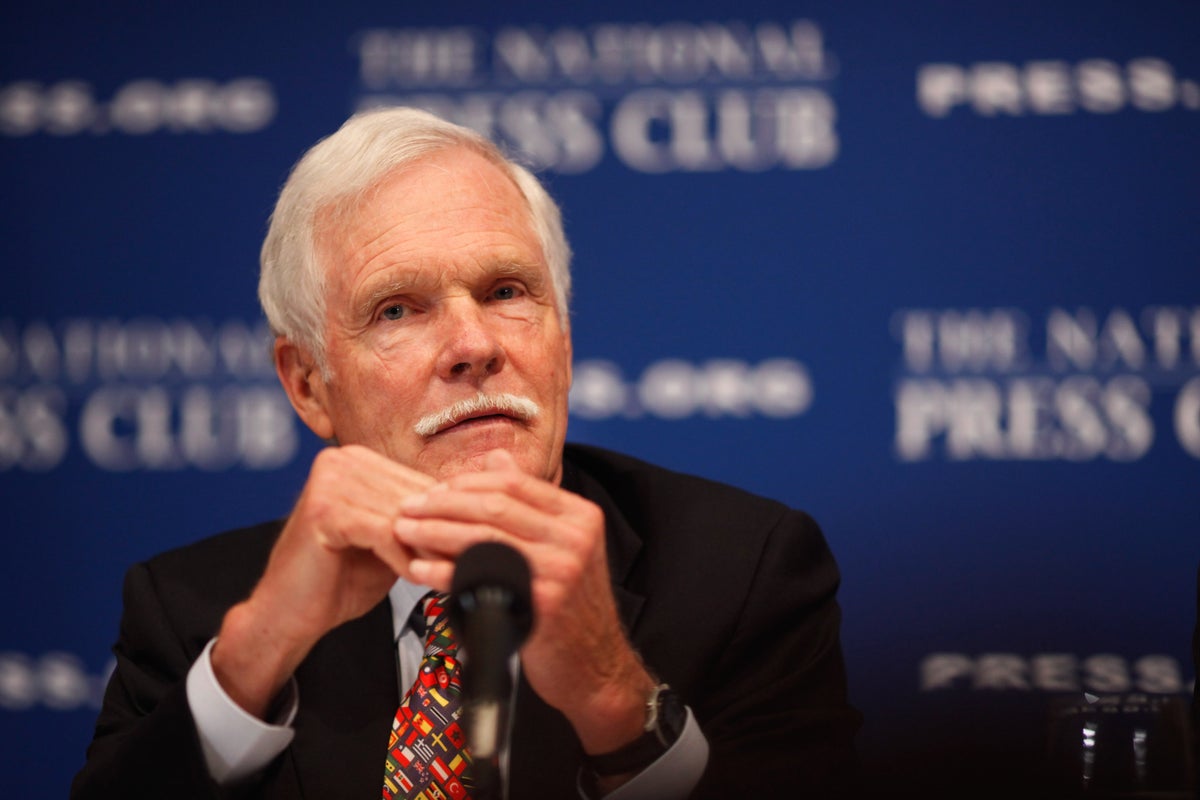
The death of Ted Turner represents more than the passing of a media titan; it marks the formal expiration of the "CNN era," a period defined by the 24-hour news cycle that Turner pioneered and Donald Trump eventually mastered. In a characteristic move that blurred the lines between a traditional eulogy and a political broadside, Trump reacted to Turner’s passing by doubling down on his long-standing grievance with the network. He framed Turner’s death as the final chapter of a "baby" that had been destroyed by modern corporate management. This wasn't just a stray social media post. It was a calculated autopsy of a media model that is currently bleeding out in real-time.
Trump’s assertion that the current stewards of CNN have ruined Turner’s legacy touches on a raw nerve within the industry. To understand the friction, one has to look at what Turner actually built in 1980. He created a platform that thrived on the "Chicken Noodle News" shoestring budget, relying on the raw urgency of live events to captivate a global audience. Trump, a creature of the 1980s New York media circuit, views Turner as a fellow flamboyant billionaire-maverick who understood the power of the spectacle. By attacking the modern iteration of the network during a moment of mourning, Trump is signaling that the era of "objective" institutional news is dead, replaced by a battlefield of pure personality and partisan warfare.
The Maverick and the Mogul
Ted Turner and Donald Trump were often compared in the late 20th century. Both were loud, colorful, and prone to making massive bets with other people’s money. Turner bet on the idea that people would watch news even when nothing was happening; Trump bet that he could become the news itself. The tragedy of their intersection lies in how the medium Turner created eventually became the primary weapon used against the world Trump wanted to build.
When Trump speaks of the "destruction" of Turner’s baby, he is referencing the shift from Turner’s wide-tent, globalist vision to the high-intensity, opinion-driven programming that defined the Trump presidency. Under Turner, CNN was a utility. Under its subsequent corporate masters—from Time Warner to AT&T and eventually Warner Bros. Discovery—it became a lightning rod. Trump’s critique suggests that Turner’s original sin was selling the network to corporate suits who lacked the founder’s "gut" for what the American public actually craves.
The Financial Rot Beneath the Rhetoric
While Trump focuses on the "fake news" narrative, the business reality is even more grim. The cable news model is facing a structural collapse that Turner likely saw coming. Cord-cutting is not a trend; it is a mass exodus.
- Subscriber Revenue: In the 1990s, CNN made a fortune from "carriage fees"—the money cable companies paid just to have the channel in their bundle. That pool of money is evaporating.
- Ad Dollars: Advertisers are moving toward targeted digital platforms, leaving cable news to fight over a shrinking demographic of viewers aged 65 and older.
- Trust Metrics: Trust in mass media has hit historic lows, specifically among the very voters Trump counts as his base.
Trump’s commentary taps into this volatility. He isn't just complaining about coverage; he is mocking a failing business model. By framing the current leadership as the vandals of Turner’s legacy, he positions himself as the only one willing to tell the truth about the industry’s decline.
The Weaponization of the Eulogy
In traditional politics, the death of a rival or a significant public figure usually warrants a dignified, boilerplate statement. Trump has never adhered to these norms. His decision to use Turner’s death as a platform to attack CNN is a move straight out of the populist playbook: never waste a moment of high public attention.
This tactic serves a dual purpose. First, it re-centers the conversation on Trump himself. Second, it forces the network to defend its own existence and history during a time of internal mourning. It creates a "no-win" situation for the media. If they ignore him, his base sees it as a confirmation of his claims. If they report on his "disrespectful" comments, they are once again centering their broadcast around the man who has driven their ratings—and their internal anxieties—for a decade.
The Turner Legacy vs. The Corporate Reality
Ted Turner was famous for his "Mouth of the South" persona, but he was also a man who believed in the United Nations and global cooperation. His CNN was designed to be the "world's news leader." Trump’s critique intentionally ignores Turner’s liberal leanings to focus on the "strength" of the original brand.
"Ted Turner would never have allowed this to happen," is the subtext of every Trumpian jab.
It is a nostalgic appeal to a time when media moguls were individual men with distinct personalities, rather than faceless boards of directors. Trump misses the era of the Great Man theory of history, mostly because he views himself as the last one standing in that category.
Why the "Baby" is Actually Dying
The "baby" Trump refers to isn't just a television channel. It is the concept of a centralized national conversation. Turner’s CNN provided a shared set of facts that the country reacted to simultaneously. Whether it was the Challenger disaster or the Gulf War, the world watched it together on one channel.
That centralization is gone. We now live in a fragmented ecosystem where "news" is whatever appears in your specific algorithmic feed. Trump didn't destroy this; he simply recognized that it was happening and stepped into the vacuum. The "destruction" he attributes to CNN’s leadership is actually the result of a massive technological shift that Turner’s original model was never equipped to survive.
The Conflict of Interest in Modern Journalism
The modern newsroom is caught in a trap. To get the ratings required to satisfy corporate shareholders, they must lean into conflict. But that conflict is exactly what Trump uses to brand them as "enemies of the people." It is a circular firing squad. Trump points at the smoke and claims he didn't start the fire, while the network is forced to keep the flames alive to pay the bills.
- Ratings Spikes: Whenever Trump is on screen, viewership goes up.
- Brand Erosion: While ratings go up, the perceived "objectivity" of the network goes down among half the population.
- The Founder's Ghost: Turner, in his later years, often lamented the loss of hard news in favor of punditry. In a rare moment of alignment, both the founder and his greatest critic seem to agree that the soul of the project has been traded for a pittance.
The Future of the Conflict
With Turner’s passing, the last bridge to the "Golden Age" of cable news has been burned. We are now entering a phase where the media is no longer an observer of the political process, but an active participant in a struggle for survival.
Trump’s comments aren't just an insult; they are a prediction. He is betting that the institutional media will collapse under the weight of its own overhead and its inability to connect with a fractured public. He sees a world where the "babies" of the old guard are replaced by lean, aggressive, personality-driven platforms that mirror his own communication style.
The battle over Ted Turner’s legacy is ultimately a battle over the definition of truth in the 21st century. Was Turner’s vision of a global, objective news source a noble goal that was botched by his successors, or was it a temporary anomaly in a history that is usually defined by yellow journalism and partisan broadsheets? Trump has already made his choice. He is dancing on the grave of the 20th-century media consensus, and he’s inviting his followers to join him.
The cable news networks are now faced with a choice: try to reclaim the Turner-esque mantle of the "dispassionate observer" or lean fully into the role of the "opposition," as Trump has defined them. One path leads to irrelevance in a hyper-partisan world; the other leads to the very destruction Trump is mocking. There is no middle ground left. The era of the mogul is over, and the era of the digital warlord has begun.