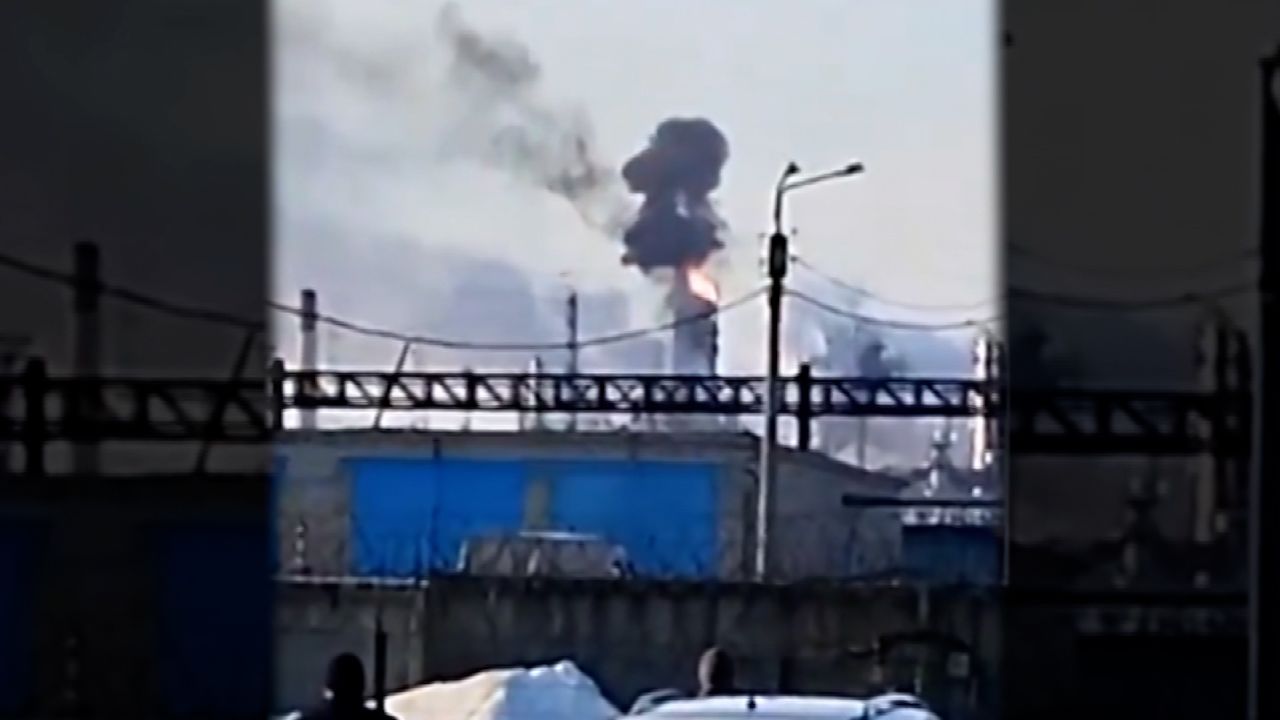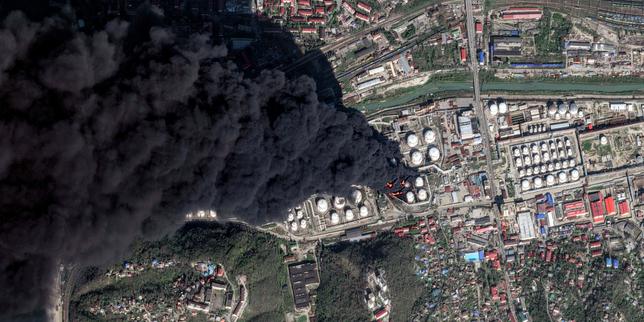
The black smoke billowing over the Black Sea coast signals a shift in the gravity of the conflict. For the second time in recent months, the Tuapse refinery, a massive processing hub owned by Rosneft, has been knocked offline by Ukrainian long-range strike drones. This isn't just another tactical exchange on a map. It is a calculated, surgical strike against the financial engine that fuels the Russian military machine. By hitting Tuapse, Kyiv is moving past mere border skirmishes and aiming directly at the Kremlin’s ability to refine, export, and profit from its "liquid gold."
This latest fire at the Tuapse facility underscores a fundamental vulnerability in Russia's industrial defense. Despite the presence of sophisticated S-400 batteries and Pantsir systems across the region, low-cost, domestically produced Ukrainian drones are successfully navigating the gauntlet to find their mark. The math of this war is changing. A drone costing a few thousand dollars is now capable of inflicting hundreds of millions of dollars in structural damage and lost revenue.
The Strategic Importance of the Tuapse Hub
The Tuapse refinery is not your average industrial plant. It is one of the oldest and most strategically positioned assets in the Rosneft portfolio. Its proximity to a major deep-water port allows Russia to ship refined products—primarily diesel and fuel oil—directly to international markets in Southern Europe, Turkey, and beyond.
When Tuapse stops, the flow of currency into the Russian central bank slows. The refinery has an annual capacity of approximately 12 million tons of crude. In a world where Russia is already grappling with heavy Western sanctions and a $60-per-barrel price cap on crude, the loss of refined product exports is a heavy blow. Refined products fetch a higher premium than raw crude. By forcing Russia to export more raw oil rather than the high-value fuel processed at Tuapse, Ukraine is effectively shrinking the Kremlin’s profit margins.
Gravity and Drones
We are witnessing a revolution in the "how" of this war. Ukraine has developed a sophisticated domestic drone industry that bypasses the restrictions placed on Western-supplied long-range missiles. While the U.S. and Europe debate the optics of using ATACMS or Storm Shadows against targets deep inside Russian territory, Kyiv has simply built its own solutions.
The drones used in the Tuapse strike are likely iterations of the Lyutyi or similar long-range models. These aircraft are designed with carbon-fiber frames and modest engines, making them difficult for traditional radar to track. They fly low, following the terrain, and use GPS and visual navigation to hit specific distillation towers.
Distillation towers are the Achilles' heel of any refinery. They are massive, pressurized structures that separate crude oil into its various components. They cannot be easily replaced. In fact, many of the components required to repair these towers are specialized and were historically sourced from Western engineering firms like Honeywell UOP or Lummus Technology. With sanctions in place, Russia now faces a grueling logistical nightmare to source these parts through "shadow" markets or less efficient Chinese alternatives.
The Economic Ripple Effect
The fire at Tuapse is not just a Russian problem; it creates tremors in the global energy market. Every time a major refinery goes dark, the supply of diesel tightens. While Russia has redirected much of its trade toward India and China, the global "jigsaw puzzle" of oil supply means that a disruption in the Black Sea can drive up prices at pumps in Istanbul or Mumbai.
Within Russia, the consequences are more immediate. The Kremlin has already been forced to implement temporary bans on gasoline exports to stabilize domestic prices and ensure the military has enough fuel for its ongoing summer offensives. Repeated hits on Tuapse and similar facilities in Ust-Luga or Yaroslavl create a cumulative "stress test" on the Russian internal market. If the Russian people see fuel prices spike at home while their government claims the "special military operation" is going according to plan, the domestic narrative begins to fray.
Defense Gaps and Electronic Warfare
Why can't Russia stop these drones? The Russian Federation is a massive landmass. Protecting every square kilometer of industrial infrastructure is a mathematical impossibility. While the Kremlin has moved air defense assets from the front lines to protect Moscow and Saint Petersburg, the southern energy corridor remains porous.
Ukraine is also using electronic warfare (EW) to confuse Russian defenses. Before the actual strike drones arrive, "decoy" drones are often sent to light up Russian radar, forcing the defenders to reveal their positions or waste expensive interceptor missiles. By the time the real threat appears, the defense grid is often saturated or out of position.
The Shadow of Sanctions on Repair Cycles
The most critical factor in the Tuapse strike isn't the fire itself—it is the recovery time. In the pre-2022 era, a fire at a Rosneft plant would see specialized crews from Western Europe arriving within weeks with precision-machined parts. Today, the process is shrouded in secrecy and inefficiency.
Russia is attempting to "reverse-engineer" critical refinery components. This is a slow, error-prone process. A repair that should take three months can now take a year or more. During that time, the refinery sits idle, and the crude oil must be diverted elsewhere, often sold at a steep discount to buyers who know Russia is desperate to move its inventory.
Beyond the Front Lines
The Tuapse incident proves that the geography of the war is no longer confined to the Donbas or Kharkiv. The front line is now anywhere a Ukrainian drone can reach—which, as we’ve seen, now includes targets over 1,000 kilometers from the Ukrainian border. This creates a psychological burden on the Russian leadership. They must choose between protecting their troops in the trenches or protecting the refineries that pay for those troops.
This is a war of attrition where the targets are no longer just soldiers, but the very infrastructure of the state. Ukraine is betting that by systematically dismantling the Russian oil and gas sector, they can win a victory of economic exhaustion. It is a high-stakes gamble that relies on the continued innovation of their drone engineers and the inability of the Russian military to adapt to a decentralized, low-tech aerial threat.
Logistics of the Attack
Analysis of satellite imagery following recent strikes suggests that Ukraine is targeting the Primary Distillation Units (CDU-6). These are the hearts of the refinery. If you hit a storage tank, you cause a big fire that looks dramatic on social media but can be repaired relatively quickly. If you hit the CDU-6, you kill the refinery's ability to function.
Reports from the ground in Tuapse indicated multiple explosions followed by a blaze that took hours to contain. Local authorities often downplay the damage, citing "minor debris" or "successful interceptions," but the satellite data tells a different story. When the smoke clears, the scorched remains of the distillation columns stand as a testament to the accuracy of the Ukrainian targeting.
The Dilemma for the West
This campaign puts Washington and Brussels in a difficult spot. The Biden administration has previously expressed concern that strikes on Russian energy infrastructure could lead to a spike in global oil prices, potentially hurting Western economies. However, Kyiv has remained firm. From their perspective, every barrel of oil Russia refines is a barrel that fuels a tank crossing into Ukrainian territory.
The "Red Lines" are being redrawn. The international community is realizing that they cannot dictate how a nation under existential threat chooses to defend itself. If the West will not provide the long-range weapons to strike Russian military bases, Ukraine will build the drones to strike Russian economic pillars.
A Systemic Failure of Protection
The recurring nature of these fires suggests a systemic failure in the Russian Ministry of Defense's ability to pivot. They are fighting a 20th-century war of massed artillery while failing to defend against a 21st-century war of autonomous systems. The Tuapse refinery, sitting exposed on the coast, is the perfect symbol of this mismatch.
Russia’s reliance on centralized, massive industrial hubs makes it an easy target for a nimble adversary. Unlike the Ukrainian energy grid, which has been hardened and decentralized over two years of constant bombardment, the Russian oil sector remains a collection of high-value, "soft" targets.
The strategy is clear: make the cost of the war unbearable for the Russian elites. When the oligarchs who control Rosneft and Lukoil see their assets turning into charred ruins, the pressure on the Kremlin to find an exit ramp increases. Whether that pressure will be enough to change the course of the war remains to be seen, but the smoke rising over Tuapse is a clear signal that the status quo is over.
Russia's energy sector, once considered untouchable, is now a front line. The Tuapse refinery will likely be repaired, eventually, but the question is whether it can survive the next swarm. For the engineers in Kyiv, the coordinates are already locked in. The war of the refineries has only just begun.
Stop waiting for a "decisive battle" in the mud of the Donbas. The decisive battle is happening in the control rooms of the Black Sea energy hubs, where the clicking of a drone's flight path is louder than any artillery barrage. Keep an eye on the price of Brent Crude, but keep a closer eye on the thermal signatures over the Russian coast. That is where the war is being won or lost.