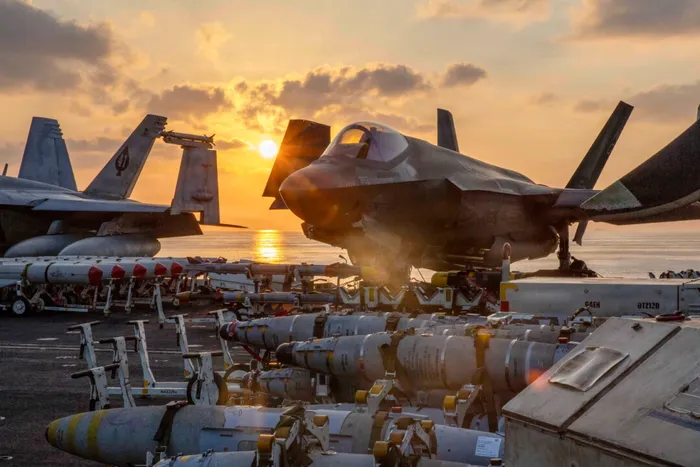
The idea of "virtually unlimited" weapons is a comforting bedtime story for a nation that hasn't fought a peer-to-peer industrial war in eighty years. It’s a sedative. When politicians stand on a stage and promise that the United States possesses an inexhaustible well of kinetic power, they aren't describing reality; they are describing a 1991 snapshot of a world that no longer exists.
The "lazy consensus" in modern defense reporting assumes that because we spend nearly a trillion dollars a year, we must have a warehouse the size of Texas filled with missiles. We don’t. We have a boutique assembly line of exquisite, overpriced jewelry that we happen to call "ordnance."
The Just-In-Time Death Trap
For decades, the Department of Defense (DoD) adopted the same "Just-In-Time" manufacturing philosophy that allows Amazon to ship you a toaster in twenty-four hours. In the world of consumer electronics, this is efficiency. In the world of high-intensity conflict, it is a suicide pact.
We have optimized for a peace-time economy. We build complex systems like the MIM-104 Patriot or the AGM-158 JASSM at a glacial pace. I have spent time inside these procurement cycles. I’ve seen the "white-glove" treatment these weapons receive. We aren't mass-producing tools; we are hand-crafting Ferraris.
When you look at the burn rates in Ukraine or the Levant, the math stops working immediately. If a major theater opening requires us to fire 500 long-range precision missiles in the first week, and our annual production capacity is only 450, we aren't "unlimited." We are a week away from throwing rocks.
The Sub-Tier Supplier Ghost Town
The "unlimited" claim falls apart the moment you look past the household names like Lockheed Martin or Raytheon. The real bottleneck isn't the guy putting the final shell together; it’s the third-tier supplier in a strip mall in Ohio that is the only place on earth making a specific vibration-resistant screw or a specialized thermal battery.
- The Single Point of Failure: We have consolidated our defense industrial base from over fifty major firms in the 1990s to five "Primes" today.
- The Talent Void: The people who know how to cast large-scale solid rocket motors are retiring. The kids graduating from MIT want to write code for ad-tech companies, not figure out the chemistry of stable energetics.
- The Material Chokehold: We are dependent on global supply chains—often involving our direct adversaries—for the raw rare-earth elements required for the magnets in our guidance systems.
If the "unlimited" narrative were true, we wouldn't be frantically scouring 1980s-era stockpiles in South Korea or scraping the bottom of the barrel for 155mm artillery shells. The reality is that our "unlimited" supply is actually a series of very thin, very fragile glass pipes.
Precision is a Double-Edged Sword
We traded mass for precision. We decided that one $2 million missile that hits its target is better than 1,000 "dumb" bombs that might miss. That was a brilliant strategy for hunting insurgents in caves. It is a catastrophic strategy for a war of attrition against a near-peer.
In a high-intensity conflict, precision munitions are consumed at a rate that outstrips any possible replacement cycle. Once the "smart" stuff is gone, you need "mass." But we gutted our ability to produce "mass" years ago. We closed the foundries. We sold the tooling. We prioritized the high-margin, high-tech contracts because they look better on a quarterly earnings report.
The Shell Game of Readiness
When a leader says we have "unlimited" weapons, they are often counting what’s on the books, not what’s "mission capable." There is a massive delta between an inventory count and a combat-ready stockpile.
A missile sitting in a canister for fifteen years isn't a weapon; it's a liability until the O-rings are checked, the sensors are recalibrated, and the propellant is tested. I’ve seen "full" magazines that were essentially high-tech museums because the maintenance backlog was three years deep.
The Counter-Intuitive Fix: Embrace "Good Enough"
The solution isn't more money. Throwing another $100 billion at the current system is like pouring water into a sieve. To actually achieve something resembling an "unlimited" posture, we have to do the unthinkable:
- De-complexify: We need weapons that can be built by a workforce that doesn't all have PhDs.
- Modular Attrition: We need to move toward 3D-printed, short-range loitering munitions that can be produced by the tens of thousands in converted automotive plants.
- End the Monopolies: Break the Primes. Open up the bidding to mid-sized firms that are hungry and haven't been corrupted by decades of cost-plus contracts.
The truth is uncomfortable: the U.S. is currently a glass cannon. We have an incredible first punch, but we have almost no chin and even less stamina. If we don't fix the industrial base, "unlimited" will remain a slogan used to lose the next big war.
Stop believing the brochures. Start looking at the lead times.
Go find the lead time for a standard Block V Tomahawk. It’s measured in years, not days. Now tell me again how our stockpiles are "unlimited."